Marketing automation ROI is the incremental profit generated by automated marketing minus its total cost, divided by that total cost. A useful calculation follows the full path from traffic source to landing page, signup, activated user, and revenue, while separating results caused by automation from results that would have happened anyway.
A simple benchmark can help you set expectations, but it cannot prove your own return. Your decision should rest on a small measurement system that connects:
- Marketing cost, including software, setup, review time, and maintenance.
- Business outcomes, such as qualified pipeline, paid conversions, retained revenue, or gross profit.
- Incrementality, meaning the additional outcome created by automation compared with a reasonable counterfactual.
Key takeaways
- Marketing automation ROI is derived by dividing the incremental gross profit created by automation, minus its total cost, by the total cost.
- Total automation cost includes not only software and fees but also team time for setup, review, maintenance, creative production, and opportunity costs.
- Gross profit is a better measure of return than raw revenue, and for long sales cycles, leading indicators like qualified opportunities can be valued based on historical conversion rates.
- There is no reliable average marketing automation ROI, as published benchmarks often lack control groups and ROI varies significantly based on variables like customer lifetime value, gross margin, and data quality.
- Instead of a universal average, build three planning scenarios (conservative, expected, upside) to assess downside risk, set operating plans, and understand potential, using your own baseline as the most useful internal benchmark.
What Is Marketing Automation ROI?
Marketing automation ROI measures the financial return from automated marketing activity after accounting for the complete cost of running it.
The basic formula is:
Marketing automation ROI =
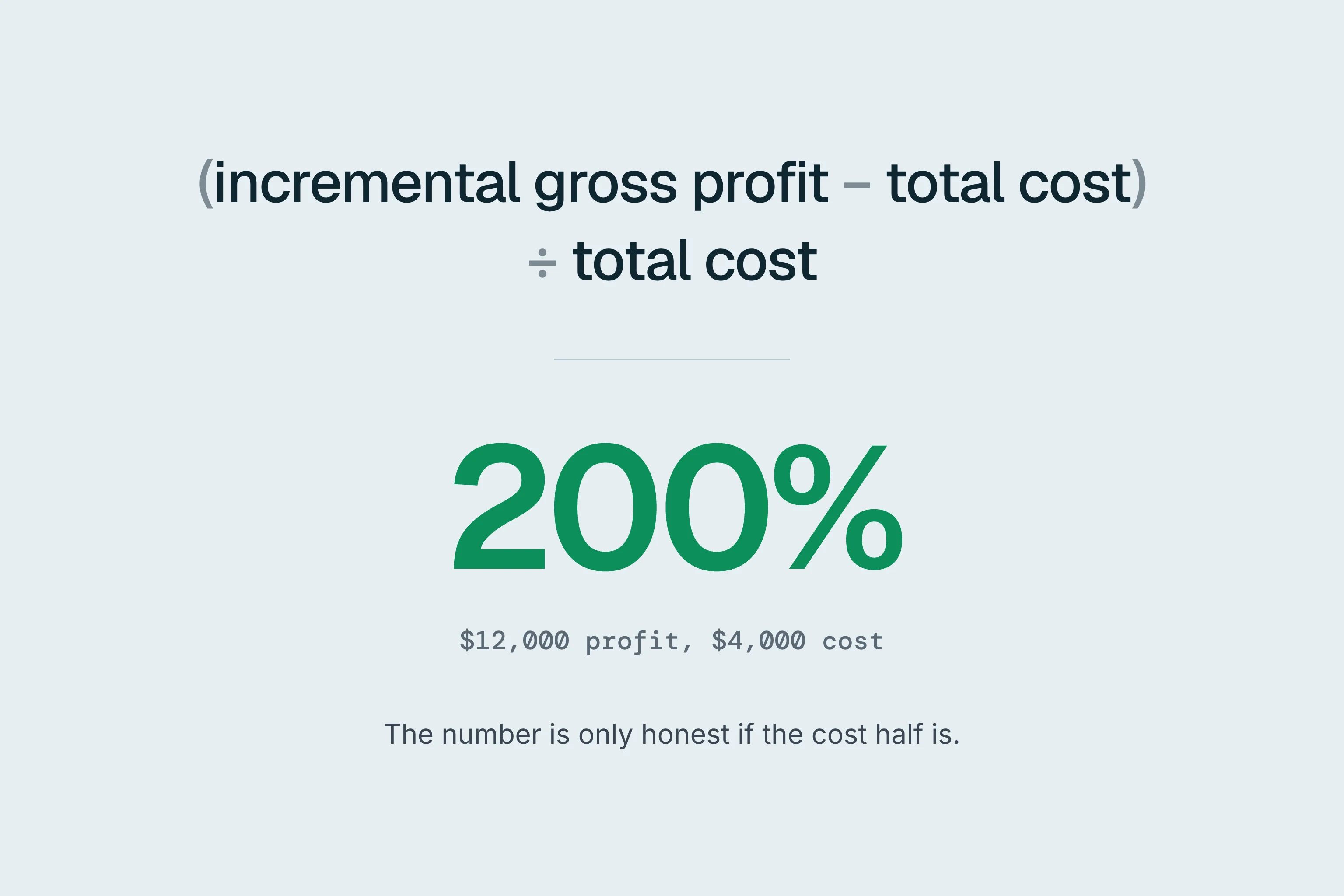
(Incremental gross profit - total automation cost) / total automation cost
If automation creates $12,000 in incremental gross profit and costs $4,000, the ROI is:
($12,000 - $4,000) / $4,000 = 2.0, or 200%
That means the program returned $2 in profit for every $1 spent, after recovering the original cost. Some teams report ROI as a ratio, such as 3:1. Others report it as a percentage. Pick one format and use it consistently.
What counts as total automation cost?
Software is only one part of the investment. Include the costs that would disappear if the workflow stopped tomorrow:
- Subscription and usage fees
- Initial setup, tracking, and data cleanup
- Marketing and product team time
- Human review and approval
- Creative production and content editing
- CRM or analytics work
- Maintenance, testing, and troubleshooting
- Opportunity cost from work the team postponed
For a small B2B SaaS company, review time can change the calculation substantially. A $500 monthly tool that requires 30 hours of supervision may cost more than a $1,000 tool that produces a usable draft in five hours.
What counts as a return?
Revenue is easy to understand, but gross profit is usually better for ROI decisions. If a customer pays $2,400 during the measured period and your gross margin is 80%, the return used in the model is $1,920, before subtracting automation costs.
You can also measure earlier outcomes when the sales cycle is long. Qualified opportunities, product-qualified accounts, activated workspaces, and trial-to-paid conversions can serve as leading indicators. Assign them a value based on historical conversion rates, then replace those estimates with actual revenue as the cohort matures.
The output should still connect to money. “The workflow produced 400 leads” is an activity result. “The workflow produced 14 activated accounts worth an expected $8,400 in gross profit” is an ROI input.
Is There An Average Marketing Automation ROI?
There is no reliable average marketing automation ROI that applies to every company. A frequently cited benchmark says organizations received $5.44 in benefits for each dollar spent over the first three years, with payback in under six months, but the figure came from 16 vendor-published case studies from 2016 to 2020. None of those case studies used a control group, so the number should be treated as a directional benchmark rather than a forecast.
The limitations behind that benchmark are documented in this analysis of marketing automation ROI and the $5.44 figure. It is useful for understanding why published averages often look attractive. It is not enough to approve a new program.
Why averages mislead
ROI changes with several variables:
- Customer lifetime value
- Gross margin
- Sales cycle length
- Existing traffic and demand
- Workflow adoption
- Data quality
- Human review time
- Conversion rate at each stage
- Whether the audience already had strong purchase intent
A workflow that recovers abandoned demo requests can produce a high return with a small audience. A broad content workflow may take months to generate qualified traffic and still be economically sound. Comparing their first-month ROI would produce a poor decision.
Channel attribution also changes the result. A prospect may discover a company through search, read a Reddit discussion, return through direct traffic, and convert after an email. Giving the entire result to the last touch can make one channel look better than it was while hiding the contribution of the others.
What is an average ROI for marketing?
Average marketing ROI depends on the channel, time period, margin, and attribution method. There is no universal number that can be used as a safe planning assumption.
For planning, build three scenarios instead:
| Scenario | Assumption | Decision use |
|---|---|---|
| Conservative | Low conversion and slower payback | Tests downside risk |
| Expected | Current conversion rates and realistic workload | Sets the operating plan |
| Upside | Better conversion or lower production cost | Shows potential, not a promise |
For example, suppose a workflow costs $2,000 per month. Your conservative case might assume two incremental customers, the expected case four, and the upside case six. If gross profit per customer is $900 during the measured period, the workflow produces $1,800, $3,600, or $5,400 in gross profit. Only the expected case should guide the normal budget, and the conservative case should still be survivable.
The most useful internal benchmark is your own baseline. Compare automated workflows with the same channel before automation, a similar audience that did not receive the workflow, or a later cohort after the workflow changed.
How To Calculate Marketing Automation ROI Step By Step
Calculate marketing automation ROI by defining one business outcome, assigning its gross-profit value, recording the full cost, and measuring incremental results against a baseline.
1. Choose one primary outcome
Start with a result close to revenue. For an early-stage B2B SaaS company, a sensible order is:
- New paid accounts or expansion revenue
- Activated trial accounts
- Qualified opportunities
- Signup conversion
- Engaged visits or content consumption
Choose one primary outcome for the decision. Supporting metrics can explain the result, but they should not replace it.
A traffic workflow might use “activated signup within 14 days” as its primary outcome. An account-based nurture workflow might use “sales-qualified opportunity created within 60 days.”
2. Define activation before measuring it
“Activated” must describe a meaningful product action. For a developer tool, it could mean a workspace connected, a project deployed, an API request completed, or a teammate invited. A signup alone is rarely enough.
Write the definition in plain language:
Activated account =
Signup completed AND first project created within 14 days
This prevents the team from improving a shallow conversion metric while product usage stays flat.
3. Assign a value to the outcome
Use observed data whenever possible. If 20% of activated accounts become paid customers and the average measured gross profit from a paid customer is $1,000, one activated account has an expected value of $200.
Expected value per activation =
Activation-to-paid rate × gross profit per paid customer
If the workflow generated 30 incremental activated accounts, the estimated return is:
30 × $200 = $6,000 in expected gross profit
State the time window. A 30-day value and a 12-month value answer different questions.
4. Record every cost
Create a monthly cost line for the workflow. Include the automation platform, connected tools, setup work, copy review, design, analytics, and maintenance.
For labor, use:
Labor cost = hours spent × fully loaded hourly cost
A founder's time still has an economic cost, even if no invoice is paid. If the workflow saves time, record the time saved separately and decide whether it becomes actual capacity for revenue work. Do not count every saved hour as profit automatically.
5. Calculate observed ROI
Observed ROI uses the outcome recorded in your analytics and billing systems:
Observed ROI =
(Observed gross profit - total cost) / total cost
This is useful for operating decisions, but it may include conversions that would have happened without automation.
6. Estimate incremental ROI
Incremental ROI removes the expected baseline result:
Incremental ROI =
(Incremental gross profit - total cost) / total cost
Incremental return is the revenue or profit that would not have been generated without the automation. This counterfactual-adjusted approach is also described in the marketing automation ROI methodology.
Suppose an automated nurture sequence produces 50 paid conversions. A comparable holdout group suggests that 35 would have converted without the sequence. The incremental conversions are 15, not 50.
If each conversion contributes $600 in gross profit and the workflow costs $4,000:
Incremental gross profit = 15 × $600 = $9,000
Incremental ROI = ($9,000 - $4,000) / $4,000 = 125%
That is a much more useful result than reporting the apparent return from all 50 conversions.
7. Add payback period
ROI describes return. Payback period describes how quickly the investment is recovered.
Payback period =
Total implementation and operating cost / monthly incremental gross profit
If setup and operating costs total $6,000 and the workflow produces $2,000 in incremental gross profit each month, payback is three months.
For SEO and content, use a longer measurement window. A workflow can have negative short-term ROI while producing positive returns later. Set the review date before launch so the team does not stop or continue the program based on a convenient snapshot.
Which Marketing Automation Workflows Have The Highest ROI?
The highest-ROI marketing automation workflow is usually the one that reaches users with existing intent and moves them toward a high-value action with little added production cost.
For B2B SaaS, that often means a product-led nurture or onboarding workflow. It can respond to a signup, explain the next useful action, remove a known setup obstacle, and measure activation. The audience already expressed interest, so the workflow does not need to create demand from zero.
High-intent signup and trial nurture
A practical sequence might include:
- A message immediately after signup that sets one clear next action
- A follow-up based on whether the user completed that action
- Help for the most common setup problem
- A use-case example matched to the user's stated role or job
- A prompt to invite a teammate or request help
- A stop condition after activation or conversion
The workflow should branch on behavior. Sending the same five messages to every account creates noise and makes measurement harder.
Onboarding and activation prompts
Onboarding often has strong economics because a small improvement in activation can affect every new signup. Measure the funnel in stages:
Visitor → signup → onboarding complete → first value action → paid conversion
Track the time between stages. A workflow that raises activation but delays the first value action may not be improving the business.
Abandoned high-intent actions
Recovery workflows can target incomplete demo requests, pricing-page visits followed by signup, unfinished workspace setup, or abandoned upgrade flows. These actions signal intent, but they also require careful frequency limits. A reminder can help. Repeated messages can damage trust and distort the baseline.
Search-led content and distribution
Automating SEO research, drafting, internal linking, and content refreshes can reduce production cost. The ROI arrives through qualified organic visits, signups, and activated accounts over time.
The measurement challenge is delay. Search traffic may rise before conversions become statistically useful, and a new article may receive assisted conversions that analytics assigns elsewhere. Track landing pages and cohorts rather than judging every article on last-click revenue.
A guide to SEO automation without spam covers the operational constraint that matters here: automation still needs review, relevance, and a publishing standard.
Community and referral workflows
Referral and community workflows can produce strong returns when they answer a specific question for an audience that already has the problem. They are difficult to automate safely because context and community norms matter. Keep human approval in the loop, record the source and campaign, and measure qualified visits rather than raw replies or impressions.
How To Compare Automation Costs And Returns
Compare marketing automation programs using the same time period, profit definition, attribution rules, and labor assumptions. A cheap workflow with weak activation can be worse than an expensive workflow that produces valuable customers.
Use contribution margin, not vanity metrics
Revenue overstates return when service, infrastructure, payment, or support costs are material. Contribution margin gives a cleaner view:
Contribution profit =
Revenue - variable delivery and servicing costs
Then subtract the automation program's cost. Keep fixed brand or team costs separate unless the decision is whether to fund the entire marketing function.
Compare the alternatives you could fund
The relevant comparison may be:
- Manual execution by a founder
- A specialist hire
- An agency
- A single-purpose AI writing or SEO tool
- An integrated agent system
- Doing nothing for one quarter
For each option, estimate time to launch, monthly cost, expected output, review burden, measurement quality, and risk. A platform comparison should include the work your team must still perform. A low software price can hide planning, editing, publishing, and reporting time.
The article how AI agents for marketing work provides useful context for distinguishing content generation from systems that plan and delegate marketing work. The distinction matters for cost modeling because execution responsibility may remain with the team.
Separate setup costs from run-rate costs
A migration or tracking project can make the first month look unprofitable. Keep these lines separate:
First-period cost = one-time setup cost + recurring operating cost
Steady-state cost = recurring operating cost
Report both. The first tells you how much cash the project needs. The second tells you whether it works after launch.
Include quality and risk
A workflow that produces more output can still reduce ROI if it creates rework, inaccurate claims, poor-fit leads, or community penalties. Add a quality review field to the model:
Net return =
Incremental gross profit - operating cost - expected remediation cost
Do not assign a made-up dollar amount to every risk. For material risks, record the incident, time spent fixing it, and lost opportunity. The model will improve with real observations.
How To Connect Search, Signups, And Product Activation
Connect Search Console landing pages to signups and product activation by preserving the original landing-page and campaign context when a visitor enters the product funnel.
Search Console can show queries, pages, impressions, clicks, and click-through rate. It does not provide a complete user-level path from a search click to a paid account. Use it as the source for organic search performance, then join it to first-party product analytics through landing-page and cohort fields.
Create a consistent source convention
Use lowercase values and a controlled naming scheme for referral and campaign traffic:
utm_source=reddit
utm_medium=community
utm_campaign=problem_name
utm_content=reply_or_post_identifier
For email:
utm_source=product_email
utm_medium=email
utm_campaign=activation_nurture
utm_content=day_03_use_case
Do not add UTMs to ordinary internal links. Doing so overwrites the original acquisition source. Store the first known source and the latest known source separately.
Capture the landing page
When a visitor arrives, save:
- Initial landing page URL
- Initial referrer
- First known source, medium, and campaign
- Latest source, medium, and campaign
- Landing page query or page group
- Timestamp
- Anonymous visitor or account identifier, where permitted
On signup, copy these values into the user or account record. For account-based B2B SaaS, account-level attribution is usually more useful than assigning every later action to one person.
Define the PostHog event specification
A basic PostHog measurement specification should use stable event names and properties.
| Event | Trigger | Required properties |
|---|---|---|
marketing_landing_viewed | A tracked marketing landing page loads | landing_page, page_group, first_source, first_medium, campaign, referrer |
signup_completed | Account creation succeeds | account_id, signup_method, first_landing_page, first_source, latest_source |
onboarding_completed | The defined onboarding checklist is complete | account_id, completion_time_days, plan_or_trial_status |
activation_completed | The first meaningful product action occurs | account_id, activation_action, days_since_signup |
marketing_draft_approved | A human approves the first AI-generated marketing draft | account_id, channel, draft_type, days_since_signup |
paid_conversion | Account becomes paid | account_id, plan, gross_revenue, conversion_days |
Only create an event when the trigger is unambiguous. A page view should not count as onboarding completion. An opened editor should not count as activation unless that action has a proven connection to value.
The marketing_draft_approved event is useful for measuring a different activation path. It answers whether a founder moved from signup to approving a first piece of marketing work, rather than merely creating an account.
Build the funnel
In PostHog, create a funnel that groups users by the saved acquisition fields:
Landing page view
→ signup completed
→ onboarding completed
→ activation completed
→ paid conversion
Break it down by:
- Organic landing page or page group
- Referral source
- Campaign
- Signup month
- Product use case
- Company or account segment
Then compare conversion rates and time to activation. A landing page with fewer signups may produce more activated accounts than a high-volume page.
For organic traffic, use a page group such as /blog, /templates, /integrations, or a specific problem category. Search Console supplies the page-level search data. PostHog supplies the downstream behavior. Join them by URL and date or cohort, rather than pretending Search Console can identify individual users.
How To Measure Incremental ROI Without Misleading Attribution
Measure incremental ROI with a holdout, a controlled rollout, or a credible baseline, then report assisted and last-touch results separately.
Attribution answers “which touchpoints received credit?” Incrementality answers “what changed because the workflow ran?” They are related, but they are not interchangeable.
Use a control when possible
For an email or onboarding workflow, randomly hold out a small portion of eligible accounts. Keep the holdout from receiving the automation while maintaining the same product experience and other marketing exposure.
Then compare:
Incremental conversion rate =
Treatment conversion rate - control conversion rate
If 8% of the treatment group activates and 6% of the holdout activates, the measured lift is 2 percentage points.
For paid or audience-based campaigns, incrementality isolates lift by comparing people who saw the campaign with a control group who did not. The same principle applies to lifecycle and content workflows, although random assignment is often easier for owned channels.
When a holdout is impractical
Use a phased rollout. Launch the workflow to one eligible segment while a comparable segment remains on the old process. Match the groups on factors such as signup date, source, company size, use case, and prior product behavior.
A pre-and-post comparison is weaker because seasonality, product changes, pricing changes, and market demand can all affect the result. If it is your only option, record those changes and avoid claiming that the entire difference came from automation.
Report four views of performance
A credible monthly report can show:
- Operational performance, such as drafts created, messages sent, or hours saved
- Funnel performance, such as signup, activation, and paid conversion rates
- Attributed performance, such as revenue associated with first touch, last touch, or assisted touch
- Incremental performance, such as lift against a holdout or baseline
Keep the views side by side. If last-touch revenue is $20,000 but the holdout suggests only $7,000 was incremental, the report should show both numbers and explain the difference.
A review of published marketing automation case studies found that 52% of US brand and agency marketers used some form of incrementality testing, according to the source's discussion of incrementality measurement. The exact method matters more than the label. A poorly matched control can create false confidence.
Set a decision rule
Before launching, define what happens at the review point. For example:
Continue if incremental ROI is above 100% after 90 days
Revise if activation lift is positive but ROI is below target
Stop if there is no measurable lift after two valid test cycles
The threshold should reflect cash constraints and payback expectations. A bootstrapped company may prefer faster payback even when a longer-term program has a higher eventual return.
Also define what counts as a valid test. Require a minimum eligible audience, a complete event trail, and no major product or pricing change during the measurement period. Otherwise, the team may make a decision from incomplete data.
Watch for common measurement errors
The most frequent mistakes are simple:
- Counting all conversions touched by automation as incremental
- Using revenue instead of gross profit
- Ignoring founder and reviewer time
- Changing UTMs mid-test
- Overwriting first-touch attribution with internal links
- Treating a signup as activation
- Measuring SEO before the chosen evaluation window ends
- Comparing a high-intent workflow with a low-intent channel
- Reporting a benchmark without its source and limitations
A practical ROI model doesn't need to be elaborate. It needs stable definitions, complete costs, a visible path from landing page to product action, and a comparison that gives you some idea of what would have happened without the workflow.
FAQ
What is ROI in marketing automation?
ROI in marketing automation is the incremental gross profit produced by automated marketing, minus the total cost of the automation, divided by that total cost. The calculation should include software, setup, labor, review, maintenance, and the difference between the automated result and a reasonable baseline.
What is the average ROI of marketing automation?
There is no dependable universal average. A commonly cited $5.44 return per dollar came from 16 vendor-published case studies and did not use control groups, so it should guide questions about measurement rather than serve as a guaranteed forecast.
What is an average ROI for marketing?
An average marketing ROI varies by channel, margin, customer value, time window, and attribution method. Use conservative, expected, and upside scenarios based on your own conversion and profit data instead of applying one industry-wide percentage.
Which marketing automation workflow has the highest ROI?
For many B2B SaaS companies, high-intent onboarding and activation workflows have strong ROI because they reach people who already signed up and can influence a measurable product action. The best workflow for a specific company is the one with clear intent, a short path to value, low production cost, and a measurable holdout.

Founder of Sparqo, building an AI CMO that runs SEO, AI visibility and Reddit for indie founders and small teams who do their own marketing.