Best AI marketing tools arent about having more features. Theyre about matching the job you actually need done, whether thats drafting copy, running a full channel, or coordinating work across multiple platforms without your team drowning in tabs.
Founders in 2026 face a specific problem: AI content generators got good, but marketing still requires orchestration across Reddit, SEO, LinkedIn, X, and the emerging generative search answers. Single-purpose tools create silos. All-in-one suites promise everything and deliver mediocrity. The right choice depends on your team size, approval workflow needs, and whether youre building content or building a system.
Key takeaways
- Best AI marketing tools match the job needed, from drafting copy to coordinating across platforms, rather than simply offering more features.
- AI marketing tools categorize into content generation, channel management, and full orchestration with human oversight.
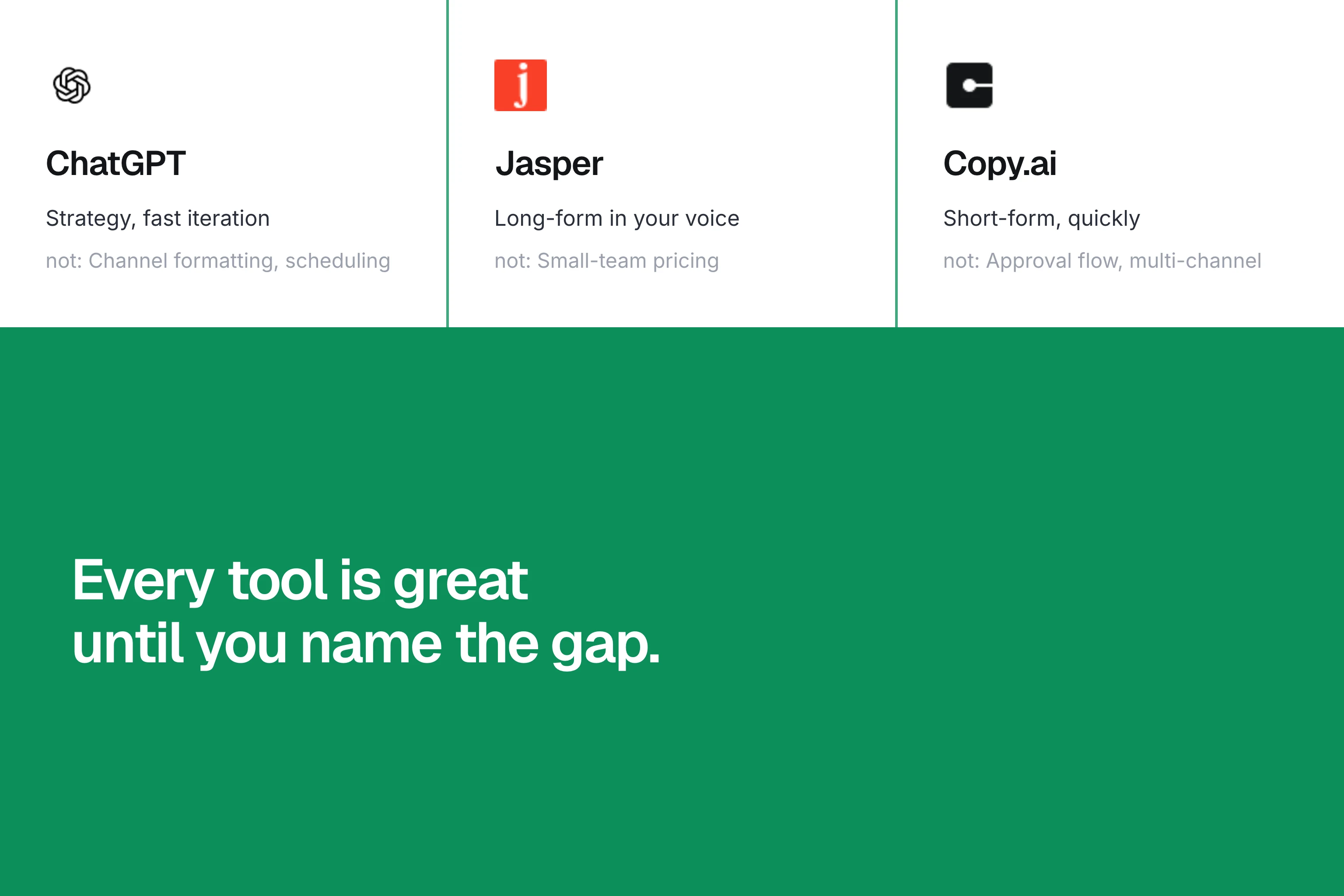
- ChatGPT excels at strategic deep reasoning, Jasper AI at long-form content with brand voice, and Copy.ai at fast short-form generation, but all lack multi-channel coordination or publishing.
- For solo founders, ChatGPT plus manual coordination is effective; small teams benefit from specialist tools for key channels or AI orchestration systems.
- Teams ready to scale beyond 3-5 marketing channels either hire a fractional CMO or adopt an AI orchestration system that learns preferences.
What Are The Best AI Marketing Tools
The best AI marketing tools divide into three categories by what they actually handle: content generation, channel management, and full orchestration with human oversight.
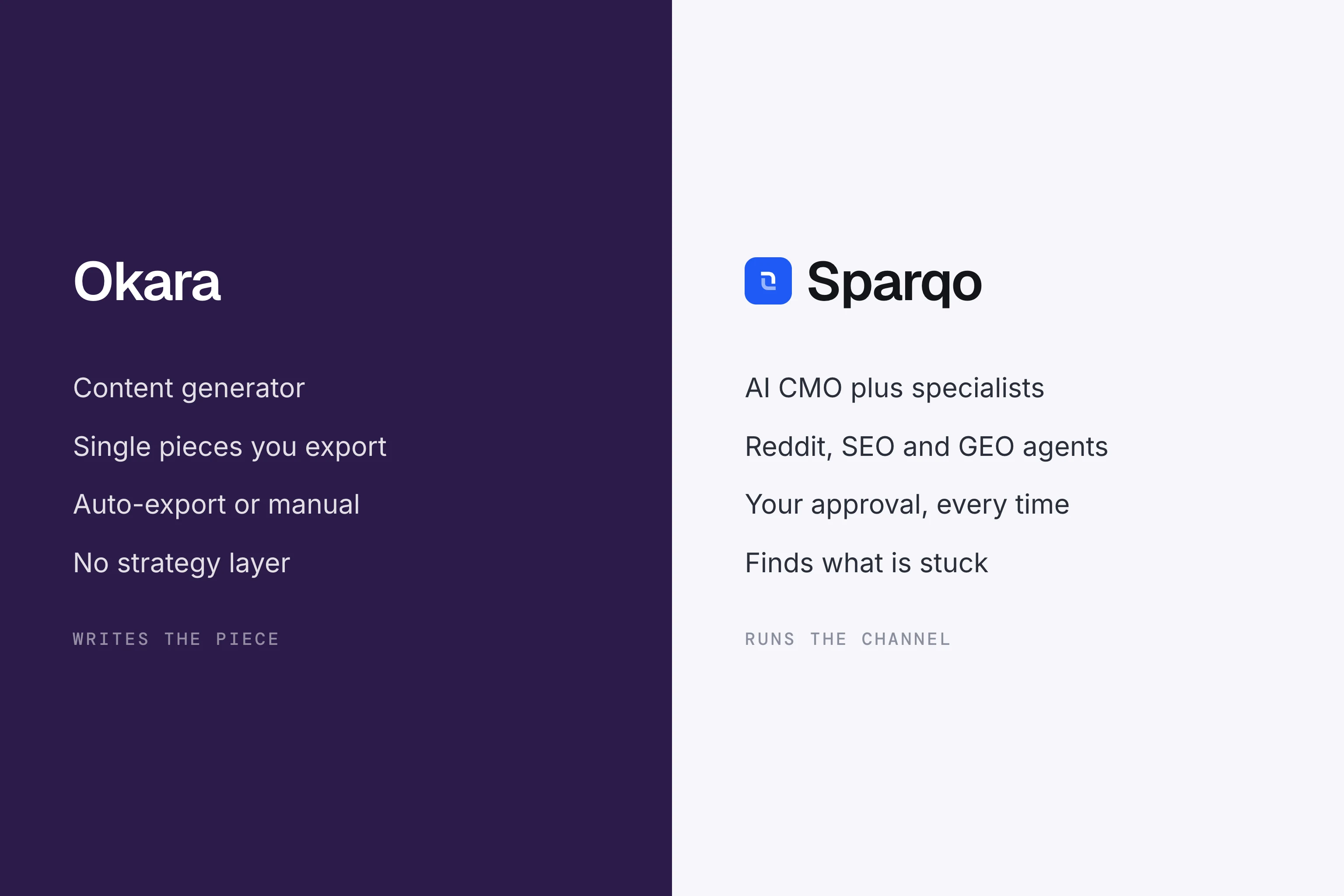
Content generators like Jasper AI and Copy.ai handle one thing well: producing draft copy from prompts. They excel at ad headlines, blog outlines, and email bodies. What they dont do is decide where that content goes, when it should publish, or whether it fits your brand voice across channels. You get a document, not a workflow.
Channel specialists focus on one platform. Surfer SEO optimizes for search rankings. Buffer and Hootsuite now embed AI for social scheduling. These tools work if your strategy is siloed, but they force you to context-switch between interfaces and strategy documents that never sync.
Orchestration systems coordinate multiple channels through a central agent. This is where newer approaches like Sparqo sit: an AI CMO that routes daily work to specialist channel agents (Reddit, SEO, GEO, X, LinkedIn), drafts on schedule, but requires human approval before anything publishes. The key differentiator is the learning loop. Every approval or edit trains the system so tomorrow's drafts need less revision.
Most teams in 2026 need either a channel specialist plus manual coordination, or a full orchestration system if they lack marketing headcount. Pure content generators are becoming features inside larger platforms, not standalone solutions worth subscribing to.
What The Big 3 AI Tools Are Good At
"The big 3" in AI marketing usually refers to ChatGPT, Jasper AI, and Copy.ai. Each has a specific competency and specific failure modes.
ChatGPT (OpenAI's conversational model) is the Swiss Army knife everyone already has. Its strengths: zero setup, deep reasoning on strategy questions, rapid iteration on tone and angle. Its weaknesses: no memory of your brand across sessions, no scheduling, no channel-specific formatting, and a tendency to produce generic output unless your prompts are precise. Many founders use it for first drafts, then manually adapt for each platform. That manual work is where time disappears.
Jasper AI built its reputation on marketing-specific templates and brand voice training. It works well for teams producing high volumes of long-form content who can afford editor review. The 2026 reality: Jasper's brand voice features are solid, but its pricing tiers push smaller teams toward alternatives. It also lacks native multi-channel orchestration (you still export and manually publish).
Copy.ai targets speed over depth. Its first-draft generator is fast, sometimes faster than ChatGPT for short-form copy like ad headlines and social hooks. The tradeoff is control. Output requires heavier editing for technical or B2B audiences, and like Jasper, there's no built-in approval workflow or publishing layer.
| Tool | Best At | Fails At | 2026 Pricing Reality |
|---|---|---|---|
| Strategy, rapid iteration, zero cost entry | Channel formatting, scheduling, brand memory over time | $20/month Pro still cheapest entry | |
| Long-form with brand voice, team collaboration | Small team affordability, native publishing | $49-125/seat, scales poorly for indies | |
| Fast short-form generation | Technical depth, approval workflows, multi-channel | $36/seat, overkill for solo founders |
The pattern: these tools generate. They dont coordinate. If your marketing is "make content, hope something works," any of the three suffices. If your marketing requires consistent presence across channels with feedback loops, you need a different architecture.
Best AI Marketing Tools Compared
Commercial intent here means you want a decision framework, not a feature list. Heres how to match tool category to workflow.
Solo founder, zero marketing budget: ChatGPT plus a free scheduling tool (like the free tier of Buffer) gets you 80% of what paid tools offer. Your constraint is time, not capability. Use ChatGPT for drafting, manually adapt per channel, schedule in bulk once weekly. The cost is cognitive load, not dollars.
Small team with one marketing hire: You need workflow, not more draft generation. Specialist tools for your highest-impact channel (likely SEO or LinkedIn for B2B) plus a coordination layer. This is where Sparqo's approach of a CMO agent routing daily tasks becomes relevant: you get channel specialists without managing five subscriptions.
Team ready to scale: You hit a decision point at 3-5 marketing channels. Either hire a fractional CMO to coordinate freelancers and tools, or adopt an AI orchestration system that learns your preferences. The cost comparison usually favors the AI system until youre at 10+ employees.
| Team Situation | Tool Approach | Monthly Cost Range | Hidden Cost |
|---|---|---|---|
| Solo, pre-revenue | ChatGPT + manual coordination | $0-20 | Your time (10-15 hrs/week) |
| Small team, no marketing hire | AI orchestration with approval workflow | $100-300 | Setup and training period |
| One marketing hire | Specialist stack + project management tool | $200-500 | Integration maintenance |
| Scaling team | Human coordination + AI assistance | $3,000-8,000+ | Management overhead |
The 2026 shift: tools are moving from "generate more" to "generate the right thing at the right time with less oversight." That progression matters more than marginal improvements in output quality.
Can ChatGPT Help With Marketing
ChatGPT can help with marketing extensively, but only if you treat it as a thinking partner, not a replacement for strategy. The specific use cases where it adds value versus where it wastes time:
What ChatGPT does well:
- Interviewing you to surface positioning angles you havent articulated
- Generating 10 variations of a headline fast so you can pick, not so you can use blindly
- Explaining why a competitors messaging might resonate (removing your blind spots)
- Drafting email sequences that you then heavily edit for specificity
- Coding simple automation scripts between your existing tools
Where ChatGPT fails in marketing:
- It cannot know your customers better than you do, and will confidently generate personas that sound right but arent validated
- It produces output that sounds like marketing, which is exactly what audiences now filter out
- Without strict prompting, it defaults to generic professional tone that disappears in feeds
- It has no access to your performance data, so it cant learn whats actually working
The practical workflow in 2026: use ChatGPT for divergence (generating options, exploring angles) not convergence (final decisions, published copy). Every founder starts with "Ill just use ChatGPT for everything," learns where it produces mediocre results, then adds specialized tools for those specific gaps.
For teams wanting ChatGPT's reasoning power with actual marketing execution, hybrid systems now exist. Sparqo, for example, uses GPT-class models behind channel-specific agents, but adds the critical layers ChatGPT lacks: scheduled drafting, approval gates, and learning from your edits. See how AI agents for marketing actually work for the architectural distinction.
Best AI Marketing Tools For Small Business
Small business marketing in 2026 has specific constraints: thin margins, no dedicated marketing hire, and the founder doing customer support on Tuesday afternoon when a viral post hits. The tools that survive this reality share three traits: flat pricing (no per-seat surprises), fast setup (no 40-hour onboarding), and forgiveness (when you ignore them for two weeks, they dont break).
The viable shortlist:
Buffer or Hootsuite (free tiers) for social scheduling. Not AI-native, but reliable. AI features are bolted on and mediocre, but the core scheduling works.
ChatGPT Plus for everything else. Accept that youll manually copy-paste between channels. The $20/month is cheaper than any specialized tool that sits unused.
Sparqo or similar AI CMO systems if you have $100-300/month and zero time for the manual coordination above. The value is the routing: one interface where you approve tomorrows Reddit comment, SEO post, and LinkedIn update without touching five tabs. The learning loop matters more here than at larger companies because you have no institutional memory (no marketing hire to train a replacement).
What small businesses should avoid:
- Per-seat pricing models that explode when you add one contractor
- Tools requiring API keys and webhook configuration (you wont maintain it)
- "AI social media managers" that autopost without approval (platforms ban these aggressively in 2026)
The hard truth: most small businesses overtool. Start with ChatGPT and a calendar reminder. Add complexity only when you can name the specific friction that justifies the cost. Marketing tools in 2026 are better than ever, which means the failure mode is buying capability you wont use, not missing capability you need.
Best Free AI Marketing Tools
Free AI marketing tools fall into two buckets: genuinely free with real limits, and freemium traps where the free tier is intentionally broken.
Genuinely useful free tier:
ChatGPT (free) limits you to GPT-4o mini and lower usage caps, but the core reasoning is intact. For founders writing one post per channel per week, the free tier handles it.
Buffer (free) gives you 3 social accounts and basic scheduling. Enough to get rhythm without cost.
Canva (free) for image generation and basic design. Their Magic Write feature is shallow but saves Canva Pro for later.
Notion AI (free quota) for internal documentation and rough content outlines. The AI quota refreshes monthly, so use it for planning, not production.
The freemium traps to skip:
- Copy.ai's free tier limits output length so severely you cant evaluate quality
- Jasper AI no longer offers meaningful free trial
- Any tool requiring credit card to start "free trial" (youll forget, theyll charge)
Free workflow that actually works:
Monday: Use ChatGPT free to draft weeks content based on your product updates. Tuesday: Edit heavily for specificity, split into channel formats manually. Wednesday: Schedule in Buffer free. Thursday-Sunday: Engage manually in communities (Reddit, LinkedIn comments). This costs $0 and takes 4-6 hours weekly. The moment that manual splitting and scheduling feels expensive, you have signal to pay for coordination.
Best AI Marketing Tools For Social Media
Social media AI tools in 2026 sorted by what they actually automate versus what they merely draft.
Content generation only:
ChatGPT, Jasper, Copy.ai produce draft posts. You still manually format for each platform (character limits, image specs, hashtag strategies), copy into native schedulers or third-party tools, and handle engagement responses. This is the starting point everyone outgrows.
Scheduling with AI assistance:
Buffer, Hootsuite, and Later now include AI caption suggestions, optimal timing predictions, and basic analytics. These features work for accounts with established audiences where timing matters. For new accounts, "optimal posting time" is meaningless (you have no data), and AI captions trend generic. The core value remains scheduling infrastructure, not the AI layer.
Community management and engagement:
This remains the hardest AI problem. Tools claiming to automate replies and DMs get accounts banned on X and flagged on LinkedIn. Reddit's 2026 API terms explicitly prohibit automated engagement. The viable path is AI-assisted drafting of replies that humans send, not automation of the send itself.
Full channel management with approval:
Systems like Sparqo treat social as one channel among several, with a dedicated agent that drafts daily posts per your schedule, suggests engagement opportunities, but never publishes or replies without human sign-off. This avoids platform penalties while reducing the cognitive load of "what should I post today?"
| Social Media Need | Tool Category | Representative Options | 2026 Reality Check |
|---|---|---|---|
| Draft generation | AI content tools | ChatGPT, Jasper, Copy.ai | You still handle everything else |
| Scheduling + basic AI | Social platforms | Buffer, Hootsuite, Later | AI features are secondary to core scheduling |
| Engagement automation | Risky automation | Various black-hat tools | Platform bans make this unsustainable |
| Managed channel with oversight | AI agent systems |  Sparqo Sparqo | Requires workflow discipline, pays off in consistency |
The pattern across social: AI can draft, but human judgment on tone and context remains essential. Tools that respect this boundary build sustainable workflows. Tools that promise full automation create account risk.
How To Choose The Right Tool For Your Workflow
Choosing an AI marketing tool is matching your constraint to what the tool actually solves. Misalignment is expensive.
Step 1: Identify your actual bottleneck
- "I dont know what to say" → content generation tools
- "I know what to say but no time to write" → AI drafting with your input
- "I write fine but forget to post" → scheduling tools
- "Im spread across six channels with no strategy" → orchestration systems or human coordination
Step 2: Audit your current stack for redundancy
Most founders in 2026 have overlap: ChatGPT for drafting, a social scheduler, an SEO tool, and spreadsheets for coordination. Before adding, subtract. One tool that coordinates replaces three that dont communicate.
Step 3: Test workflow, not features
Run a two-week trial on your actual content, not sample tasks. Does the tool reduce decisions or add decisions? Generative AI often adds the hidden work of "review and improve" that vendors dont advertise. Measure time-to-publish, not words-generated.
Step 4: Evaluate the learning loop
Does the system get better with your feedback? Or do you restart from zero each session? This separates tools worth keeping from perpetual new-user experiences.
Step 5: Price for your growth curve, not your dreams
Per-seat pricing punishes small teams planning to grow. Usage-based pricing punishes consistent production. Flat subscription aligns incentives. Know which model matches your trajectory.
The specific choice for indie devs and small B2B SaaS teams in 2026: if youre sub-$10k MRR with no marketing hire, resist complex stacks. ChatGPT plus discipline beats orphaned subscriptions. At $10-50k MRR, the coordination cost of manual systems becomes visible. This is where AI marketing automation with human approval gates pays for itself in founder focus. Above $50k, you likely need either a dedicated marketing hire or a fractional CMO, with AI as augmentation rather than replacement.
The tool that fits is the one that disappears into your workflow. If youre constantly thinking about the tool itself, its wrong.

Founder of Sparqo, building an AI CMO that runs SEO, AI visibility and Reddit for indie founders and small teams who do their own marketing.