Marketing tools are software applications, automated systems, and increasingly agent-based systems that handle audience research, content creation, multi-channel distribution, performance analytics, and conversion optimization. The category has grown from simple email schedulers to coordinated agent teams that draft across Reddit, SEO, LinkedIn, X, and Hacker News. For technical founders, the critical distinction is between tools that generate assets and tools that execute complete workflows.
What Core Marketing Functions Do Tools Address?
Every marketing tool maps to one of five core functions: discovery, creation, distribution, measurement, or optimization. Most founders confuse the categories, buying creation tools when their actual constraint is distribution, or analytics platforms when they lack any content to measure.
Discovery tools identify who to reach and how. These include keyword research platforms, audience intelligence tools like SparkToro, and social listening systems that surface where your users actually congregate. Discovery is the most underserved function; most teams guess at channels rather than validate them.
Creation tools generate or assist with content production. This spans language models for writing, design automation (Canva, Figma templates), video editors, and code generators for interactive tools. The 2026 landscape here is crowded; creation is commoditized by large language models.
Distribution tools handle publication and amplification. Social schedulers, email platforms, PR outreach systems, and community engagement tools. The hard problem in distribution is not posting; it is maintaining consistent presence across channels without spamming.
Measurement tools track what worked. Analytics platforms, attribution systems, cohort analysis, and custom dashboards. Most early-stage teams over-invest here, measuring activity before they have repeatable motion.
Optimization tools improve existing assets. A/B testing frameworks, personalization engines, and agents that rewrite based on performance data. This is where the compounding happens; most teams skip it.
The trap is buying point solutions for each function and expecting them to coordinate. They will not. A stack of five separate tools for each function still requires you to be the integration layer, exporting CSVs, copying and pasting between tabs, maintaining context across disconnected systems.
A stack of five separate tools still requires you to be the integration layer.
Essential Categories of Marketing Tools for Founders
The tools that matter depend entirely on your stage and constraint. Below is a framework for categorizing what you actually need versus what vendors want to sell you.
| Category | What It Actually Does | Typical Founder Mistake |
|---|---|---|
| Audience Intelligence | Identifies where prospects spend attention | Buying before validating anyone wants the product |
| Content Generation | Drafts copy, images, video, code | Treating output as finished rather than starting point |
| Channel Management | Publishes and schedules across platforms | Automating posts without engagement strategy |
| SEO/GEO Tools | Optimizes for search and generative engines | Keyword chasing without intent alignment |
| Email & CRM | Manages direct relationships and sequences | Building lists before having value to send |
| Analytics & Attribution | Tracks conversion paths and ROI | Perfect measurement of unrepeatable experiments |
Audience Intelligence
Tools like SparkToro, GWI, and Reddit analytics reveal where your specific users already gather. This is not demographic guessing; it is behavioral data showing that your DevOps audience spends disproportionate time on Hacker News and specific Slack communities, not Twitter. Most founders skip this research and default to the channels they personally use.
Content Generation
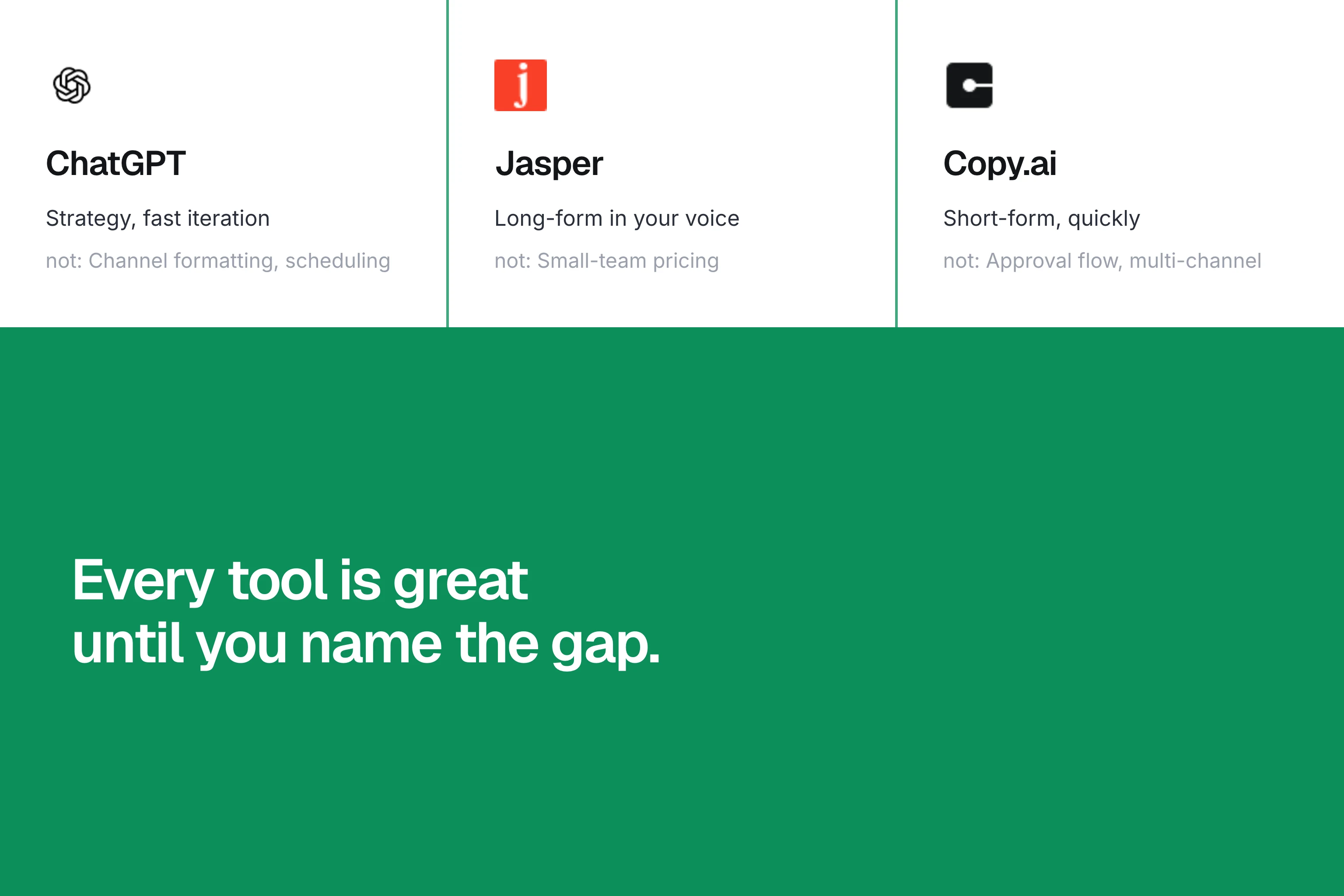
Language model-based writing tools have proliferated beyond utility. The differentiator in 2026 is not generation quality; it is context retention and brand voice learning. Jasper, Copy.ai, and generic model wrappers produce competent first drafts. What matters is whether the tool learns from your edits and improves over time, or treats each prompt as isolated.
Channel Management
Buffer, Hypefury, and native schedulers handle posting logistics. The limitation is they do not handle discovery or engagement; they assume you already know what to say and where. For technical founders, this creates a false sense of progress: scheduled posts that nobody sees.
SEO/GEO Tools
Traditional SEO platforms (Ahrefs, Semrush, SurferSEO) now compete with Generative Engine Optimization tools designed for answer engines. The distinction matters: GEO targets being cited by ChatGPT, Perplexity, and Google AI Overviews, not just ranking in blue links. See our 2026 SEO playbook for what actually worked.
Email & CRM
ConvertKit, Beehiiv, and HubSpot handle the owned audience. The common error is building infrastructure before content-market fit. A 10,000 person list with 2% open rates is worse than a 500 person list with 40% engagement.
Analytics & Attribution
Mixpanel, Amplitude, and newer attribution tools track what converts. The 2026 shift is from last-click attribution to probabilistic modeling that accounts for the multi-touch reality of B2B buying. Most early teams do not need this sophistication; they need to identify one channel that works repeatably.
How Marketing Tools Change the Game
Marketing tools in 2026 fall into three tiers: generation assistants, workflow automators, and autonomous agent teams. The distinction determines whether you are still the bottleneck or finally unblocked.
Generation assistants are the baseline now. Every major platform has integrated large language models for first-draft content, image generation, and code snippets. They accelerate individual tasks but do not change the workflow structure. You still decide what to make, review every output, and manage distribution manually.
Workflow automators connect steps with conditional logic. Zapier, Make, and marketing-specific platforms chain actions: when a blog post publishes, generate social variants, schedule across channels, notify the team. This helps until the workflow encounters an edge case, then it breaks or produces garbage silently.
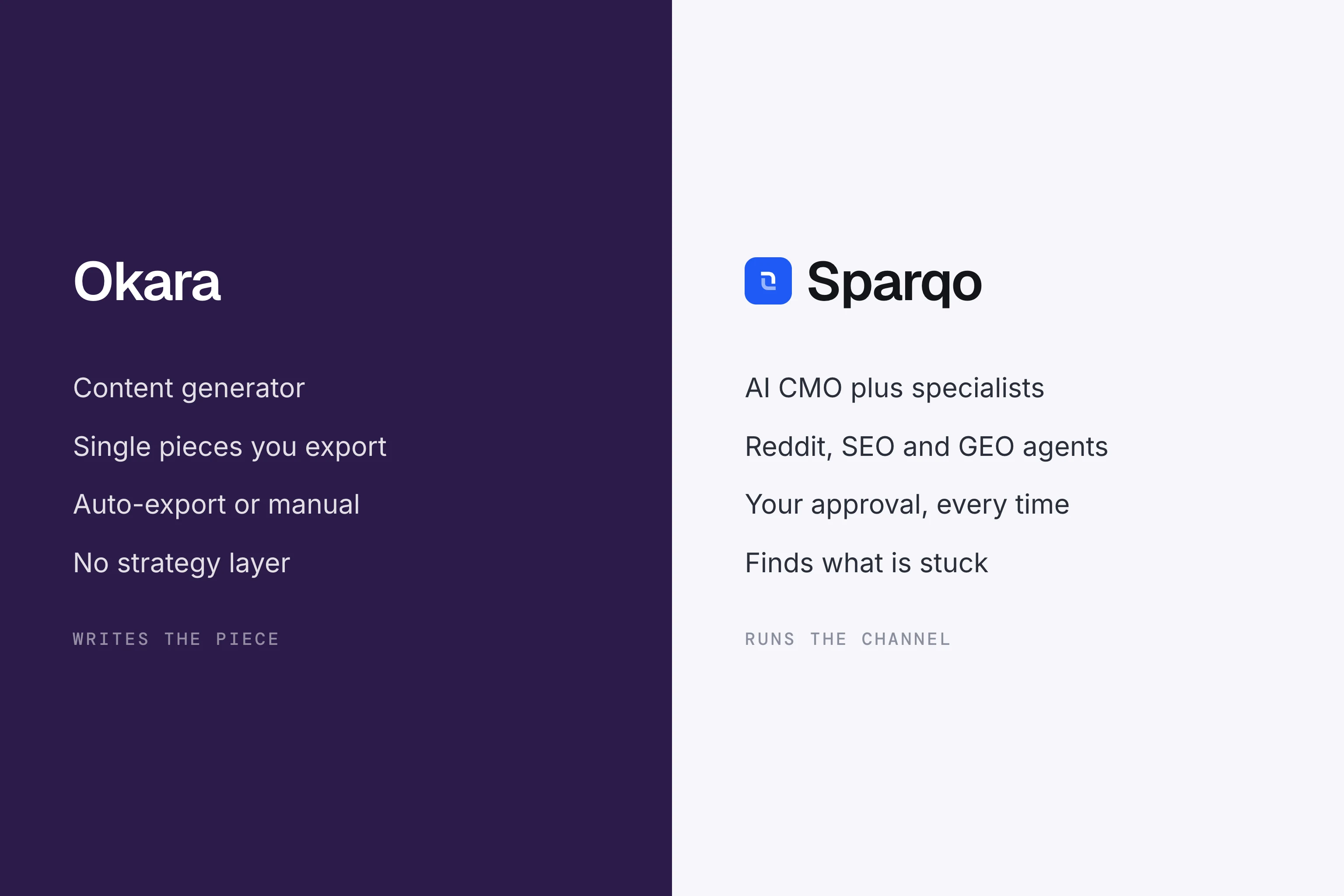
Autonomous agent teams are the emerging tier. These systems maintain persistent state, learn from feedback, and coordinate across functions without constant human intervention. An AI CMO agent identifies the current growth constraint, delegates to specialist agents (SEO researcher, Reddit engagement agent, LinkedIn content agent), aggregates their output, and presents unified drafts for approval. The human shifts from operator to editor and strategist.
The critical architectural difference is human-in-the-loop approval. Fully autonomous posting tools exist; they also get accounts banned regularly. Reddit shadowbans, LinkedIn algorithmic suppression, and platform terms of service violations are common when agents post without human judgment. The systems that last combine automation with mandatory approval gates, preventing the spam behavior that platforms increasingly penalize.
For early-stage B2B SaaS, this changes resource allocation. Instead of hiring a marketing generalist or agency, founders can run an agent team for a fraction of the cost, maintaining direct control without the coordination overhead. Compare agency versus AI CMO approaches.
Selecting the Right Marketing Tools for Your Stage
Stage-appropriate tool selection prevents the common failure mode: over-instrumenting before proving any channel works. Below is a minimal viable stack by company stage.
| Stage | Primary Constraint | Right Tools | Wrong Investment |
|---|---|---|---|
| Pre-launch | Unknown audience, no distribution | Audience intelligence, landing page builder, email capture | Full marketing automation, paid ads, content calendar |
| 0-100 users | First repeatable acquisition | One channel depth tool, simple email, basic analytics | Multi-channel suites, attribution modeling, video production |
| 100-1,000 users | Scaling what works | Channel expansion, SEO foundation, CRM with segmentation | Enterprise personalization, predictive modeling |
| 1,000+ users | Efficiency and optimization | Coordinated agent teams, advanced attribution, programmatic SEO | Still buying point solutions instead of integrated systems |
Pre-launch: Validate before building infrastructure
Your only job is proving someone wants this. Tools: SparkToro for audience research, Carrd or Webflow for landing pages, a simple email capture form. Do not build a content calendar; you have no content that works yet.
0-100 users: Find one channel that converts
Pick one channel where your users actually are. If that is Reddit, use native tools plus manual engagement tracking. If SEO, start with free keyword research and manual content production. The mistake here is spreading across five channels at 20% effort each. See our guide on Reddit marketing without getting banned if that is your channel.
100-1,000 users: Systematize and expand
Now you have signal. Invest in SEO tooling, expand to a second channel, build email segmentation. Still resist the full platform suites; buy specific tools for specific proven needs.
1,000+ users: Coordinate or drown
At scale, point solutions become technical debt. You need systems that share context, learn from outcomes, and reduce your operational surface area. This is where agent-based systems become economic: not because the technology is magical, but because coordination overhead compounds faster than headcount.
Integrating Tools for an Omni-Channel Strategy
Omni-channel in 2026 does not mean posting the same content everywhere. It means presence where your users are, with format-appropriate messaging, coordinated by a system that prevents the common failures: duplicated effort, contradictory positioning, and platform-specific policy violations.
The integration challenge
Most stacks fail at the seams. Your SEO tool finds a keyword, your content tool drafts a post, your social scheduler publishes a summary, your analytics tool tracks none of it consistently. The founder becomes the integration layer, copying between tabs, losing context, dropping threads.
Three integration patterns exist:
- Native integrations: Built-in connections between tools, often limited and brittle
- Workflow automation platforms: Zapier, Make, etc. connecting APIs with conditional logic
- Agent coordination layers: A central system that maintains state and delegates to specialists
For technical founders, the third pattern is increasingly viable. An AI CMO agent maintains project context, routes tasks to appropriate specialist agents, and presents unified output for approval. Instead of five tools with five interfaces, you have one system that understands your brand, your constraints, and your channel performance.
Channel-specific requirements
Each platform has evolved distinct content norms and enforcement regimes in 2026:
- Reddit: Authenticity detection is aggressive; promotional accounts are banned fast. Requires native-feeling engagement, not repurposed corporate content.
- LinkedIn: Algorithm favors original long-form and substantial commenting. Automation without value addition is suppressed.
- X/Twitter: High velocity, real-time relevance. Scheduling helps but cannot replace responsiveness to events.
- Hacker News: Meritocratic, anti-promotional. Only substantial technical content survives; no growth hacking works.
- SEO/GEO: Content must satisfy both traditional search and answer engines. Structure for extraction, cite authoritative sources, maintain freshness.
A true omni-channel approach respects these differences rather than syndicating identical assets. The systems that manage this well learn channel norms from your approvals and improve their drafting over time.
Avoiding Common Pitfalls with Marketing Tool Overload
Tool accumulation is a form of procrastination. Buying new software feels like progress when it replaces actual customer conversation and content creation. Below are the specific failure patterns and how to avoid them.
The integration tax
Every new tool adds hidden costs: authentication management, data export/import, learning curve, context switching. A stack of eight separate tools often underperforms three adequate ones because the founder spends cognitive load on coordination rather than creation.
Measurement theater
Founders love building dashboards for metrics that do not matter. Time-to-insight is the metric that matters: how quickly can you identify what is working and double down? If your analytics setup requires a data analyst to interpret, it is too complex for your stage.
False automation
Automating broken processes makes garbage faster. If your content does not resonate when manually posted, scheduling 10x volume solves nothing. Fix the message before scaling the medium.
Platform risk concentration
Depending entirely on one channel, or on one tool's integration with that channel, creates fragility. The 2025-2026 period saw multiple social tools lose API access overnight, and content policies shift repeatedly. Maintain direct relationships (email lists) and diversify discovery channels.
Approval bypass disasters
Tools that auto-post generated content without human review are getting accounts banned in increasing numbers. Reddit shadowbans are invisible until you notice zero engagement. LinkedIn algorithmic suppression reduces reach without notification. The cost of skipping approval gates exceeds the time saved.
The honest assessment: most technical founders do not have a tools problem, they have a consistency problem. The right tool is the one you will use daily. For many, that is a simple system with mandatory approval gates that prevents spam while maintaining automation. See how Sparqo approaches this balance.
Marketing tools in 2026 span from commodity content generators to coordinated agent teams. The founders who win are not those with the most tools, but those with the tightest fit between their actual constraint and their tooling investment. Start with audience intelligence, prove one channel, then invest in systems that reduce your operational overhead without removing your judgment from critical decisions.
FAQ
What are the 5 marketing tools?
The five core marketing tool categories address discovery (audience research), creation (content generation), distribution (channel management), measurement (analytics), and optimization (testing and personalization). Most businesses need at least one tool in each category, though early-stage teams should prioritize discovery and creation before investing heavily in measurement.
What are the 4 tools of marketing?
The traditional four tools of marketing refer to the marketing mix: Product, Price, Place, and Promotion. In software and SaaS contexts, this translates to product-led growth mechanics, pricing strategy and testing, distribution channel selection, and promotional content and campaigns. Modern marketing tools primarily serve the Promotion and Place dimensions.
What are the marketing tools?
Marketing tools are software applications, automated systems, and AI agents that execute marketing functions including audience research, content creation, multi-channel publishing, performance tracking, and conversion optimization. They range from single-purpose utilities like keyword research tools to integrated platforms that coordinate entire marketing workflows.
What tools are commonly used for marketing?
Commonly used marketing tools in 2026 include audience intelligence platforms (SparkToro, GWI), AI content generators (Jasper, Copy.ai, Claude), SEO/GEO platforms (Ahrefs, Semrush), social management tools (Buffer, Hypefury), email platforms (ConvertKit, Beehiiv), analytics systems (Mixpanel, Amplitude), and emerging AI agent teams that coordinate across these functions.

Founder of Sparqo, building an AI CMO that runs SEO, AI visibility and Reddit for indie founders and small teams who do their own marketing.