Okara is an AI marketing platform that automates content creation across channels for small businesses and startups. If you are evaluating Okara, you are likely comparing it against tools that offer more orchestration, better pricing transparency, or stricter human oversight. This guide breaks down what Okara does, why teams look elsewhere, and how alternatives like Sparqo stack up on the factors that matter for indie founders and small teams.
Key takeaways
- Okara is an AI marketing tool that generates content like blog posts, social media updates, and email copy from prompts, prioritizing speed over depth for small teams.
- Teams often seek alternatives to Okara due to fragmented channel management, lack of built-in approval safeguards, unpredictable usage-based pricing, and the absence of a strategic layer.
- Okara accelerates individual content creation tasks, while alternatives like Sparqo act as an 'AI CMO' that coordinates specialist agents across multiple channels with mandatory human approval.
- Okara is suitable for teams with existing marketing operations that handle strategy and channel coordination, whereas Sparqo is designed for indie founders without a marketing team who need end-to-end orchestration.
- Other alternatives include general AI content generators (like Jasper), SEO optimization tools (like Surfer SEO), emerging AI marketing suites, and human fractional CMO services, each addressing different marketing needs or constraints.
What Is Okara?
Okara positions itself as an AI marketing assistant for small teams who need content without hiring a full marketing department. The platform generates blog posts, social media updates, and email copy from prompts or briefs you provide.
The core workflow is straightforward: you input a topic or campaign goal, Okara drafts content variations, and you export or schedule them. Most teams use it for batch content production when they are stretched thin. The platform emphasizes speed over depth, getting you from blank page to publishable draft quickly.
Okara connects to common publishing tools and offers templates for specific formats like listicles, product announcements, and LinkedIn posts. Pricing typically runs on a usage or seat-based model, which scales with your content volume.
For teams who need simple, fast content generation without complex coordination between channels, Okara fills a gap. It does not attempt to replace strategic planning or cross-channel orchestration. It is a writer, not a marketing system.
Why People Look For An Okara Alternative
Teams outgrow Okara for four predictable reasons. Understanding which applies to you helps you pick the right replacement.
Fragmented channel management. Okara generates content but does not coordinate how those pieces work together. Your SEO blog, Reddit comments, X threads, and LinkedIn posts stay separate. You still manually decide what goes where and when, and whether messaging aligns across channels.
No built-in approval safeguards. Content publishes or exports without a mandatory review step. For technical founders entering communities like Reddit or Hacker News, this risks tone-deaf posts that trigger bans or backlash. One automated post in the wrong subreddit can damage your reputation for months.
Usage-based pricing uncertainty. Seat and credit models make costs unpredictable. You are either rationing content or overpaying for months you barely use the tool. Founders building on tight runways prefer flat, knowable costs.
No strategic layer. Okara executes tasks you assign. It does not diagnose why growth stalled, prioritize which channel deserves focus, or adapt based on what worked. You are still the CMO, just with a faster typing assistant.
These gaps matter most for technical founders who need distribution but cannot hire marketing staff. They need orchestration, not just acceleration.
Okara Vs Sparqo
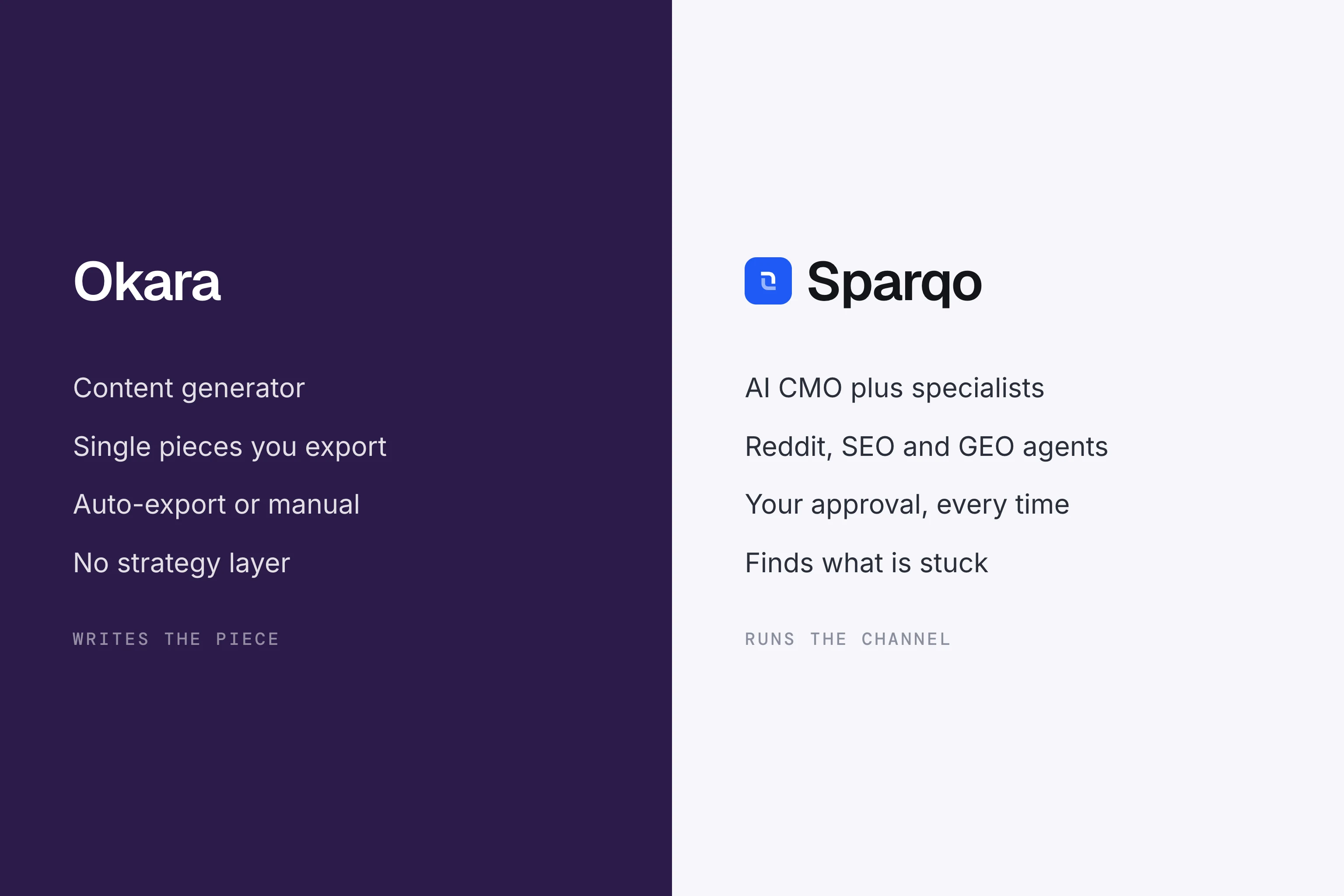
Sparqo and Okara both use AI to reduce marketing labor, but they solve different problems. Okara speeds up individual content creation. Sparqo replaces the marketing function with an AI CMO that coordinates specialist agents across channels.
- A content generator
- Single pieces you export anywhere
- Auto-export or manual publishing
- No strategic layer
- An AI CMO with channel specialists
- Reddit, SEO and GEO agents
- Your approval before anything publishes
- Diagnoses what is stuck and routes the work
| Factor | Okara |  Sparqo Sparqo |
|---|---|---|
| Core role | Content generator | AI CMO + channel specialists |
| Channel coverage | Single pieces, export anywhere | Native Reddit, SEO, GEO, X, LinkedIn agents |
| Publishing control | Auto-export or manual | Human-in-the-loop mandatory approval |
| Strategic layer | None | CMO agent diagnoses constraints, routes work |
| Pricing model | Usage or per-seat credits | Flat subscription, unlimited drafts |
| Learning loop | Static outputs | Improves from every approval and edit |
| Best for | Teams with existing marketing ops | Indie founders with zero marketing team |
When Okara fits. You have a marketing manager who decides strategy, coordinates channels, and reviews everything before it goes live. Okara accelerates their execution. You pay for seats or credits, accept some unpredictability, and handle orchestration yourself.
When Sparqo fits. You are a technical founder with no marketing hire. You need someone (something) to figure out why growth is flat, pick which channel to fix, draft the actual content, and make sure you review it before anything goes public. You want flat pricing because your runway is real and your usage is spikey.
The key difference is orchestration versus acceleration. Okara makes one task faster. Sparqo runs the whole system.
Best Okara Alternatives For Small Teams
If Okara is not the right fit, these categories cover the landscape. Each serves a different constraint.
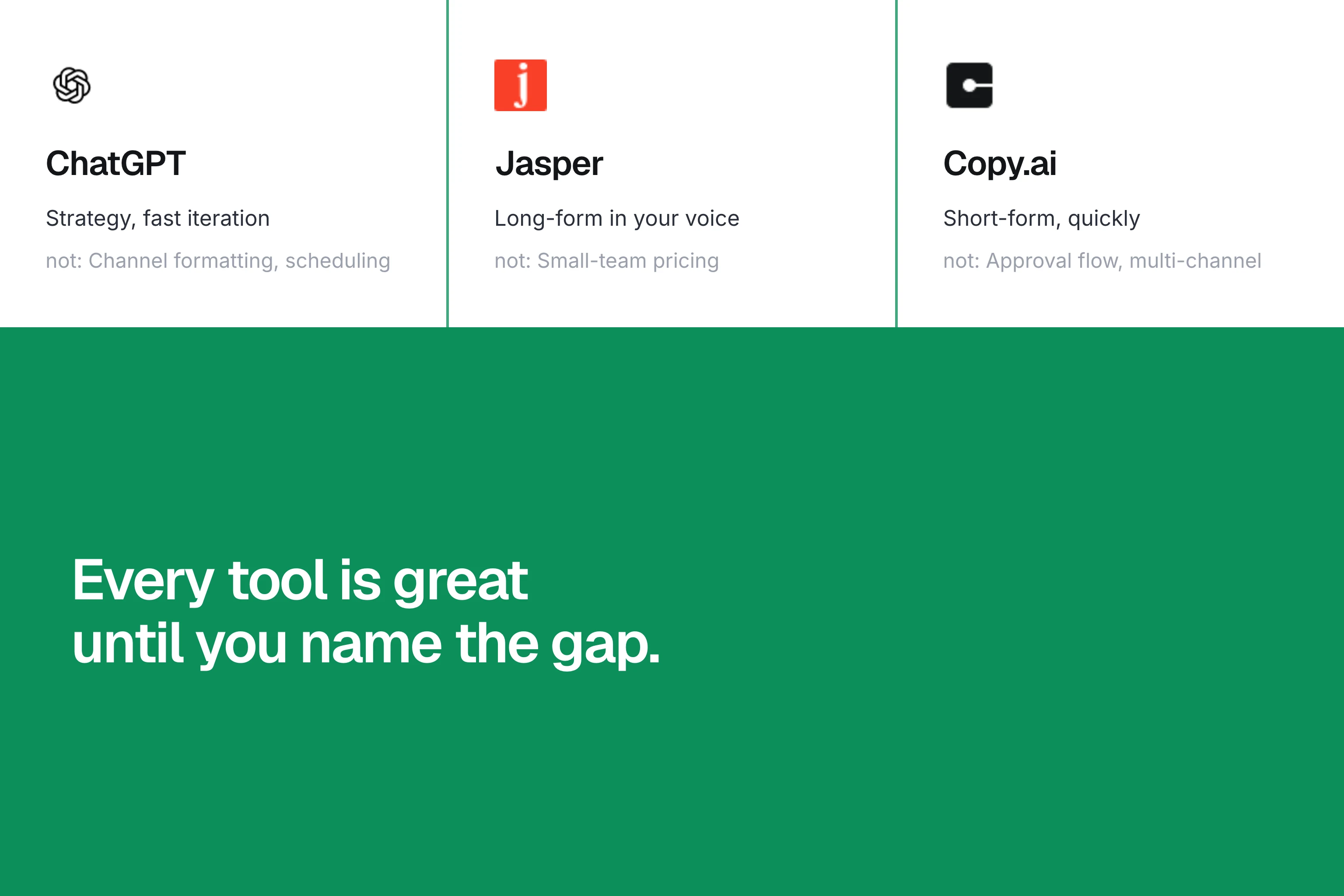
AI content generators (Jasper, Copy.ai). These resemble Okara most closely. More templates, richer formatting, stronger brand voice training. Same fundamental limitation: they draft, you coordinate, you publish, you take the risk. Pricing is typically per-seat with usage tiers.
SEO optimization tools (Surfer SEO). These focus on ranking content, not creating it. You bring the draft; they optimize structure, keywords, and internal links. Useful if your bottleneck is search visibility, not content volume. Does not solve channel coordination.
Emerging AI marketing suites (Noimosai, others). Newer entrants promising multi-channel automation. Most lack the specialist depth or approval safeguards that matter for technical communities. Evaluate carefully whether they auto-post or require review.
Sparqo. The only option built specifically for indie founders with no marketing team. The CMO agent finds your growth constraint. Specialist agents draft for Reddit, SEO, GEO, X, and LinkedIn. Nothing publishes without your approval. Flat pricing, no usage anxiety.
Fractional CMO services. Human expertise, high cost, slow scaling. Right for teams with budget and complex positioning challenges. See our guide on fractional CMO duties and costs for 2026.
Traditional B2B marketing agencies. Full-service execution, long contracts, high minimums. Better for established companies than pre-product-market-fit founders. Our breakdown of B2B marketing agency alternatives covers when they make sense.
How To Choose The Right AI Marketing Tool
Pick based on your actual constraint, not the feature list.
Step 1: Diagnose your bottleneck. Is it content volume, channel coordination, strategic direction, or approval risk? Okara and its direct competitors solve volume. Sparqo and fractional CMOs solve the others.
Step 2: Audit your current workflow. Map where time goes. If 60% is deciding what to write and where to put it, you need orchestration, not a faster writer. If 80% is drafting itself, a generator helps.
Step 3: Test the risk model. Post something slightly off-brand to a relevant subreddit or X thread. See what happens. If that experiment makes you nervous, you need human-in-the-loop approval, not auto-publishing.
Step 4: Model total cost. Include your time. A cheaper tool that requires you to coordinate everything may cost more in founder hours than a flat-priced system that runs itself.
Step 5: Verify the learning claim. Ask how the tool improves over time. Static templates age fast. Systems that learn from your edits and approvals compound value.
What To Switch First In Your Workflow
Do not migrate everything at once. Start with your highest-leverage, lowest-risk change.
Week 1: Move one channel to the new system. Pick whichever channel most needs consistency (usually SEO or your primary social platform). Run parallel: old workflow versus new tool. Measure output and your time investment.
Week 2: Add the approval step. If your new tool supports it, enforce mandatory review before anything goes live. This is where most auto-publishing tools fail. Measure how many drafts you reject or edit. High rejection rates mean the tool needs more guidance or is not a fit.
Week 3: Introduce cross-channel coordination. If your tool supports orchestration, test one coordinated campaign across two channels. Same message, adapted format, timed sequence. Measure whether the combined impact exceeds the sum of separate posts.
Week 4: Evaluate strategic value. Does the tool surface insights you would not have caught? Flagged a declining channel? Suggested a new angle? This is the difference between automation and intelligence.
If you are moving from Okara specifically, your likely first switch is adding the approval layer and strategic routing that Okara lacks. Sparqo's CMO agent and channel specialists replace Okara's single-task model.
FAQs About Okara Alternatives
Q: What does okara taste like? A: Okara, the soybean pulp left after tofu or soymilk production, has a mild, slightly nutty flavor with a crumbly, moist texture. It absorbs surrounding flavors well, making it versatile in both sweet and savory applications. In sustainable food research, okara is increasingly used as a fiber-rich ingredient to enrich products like vegetable pastes and meat analogues with reduced salt and fat content.
Q: What exactly is okara? A: Okara is the insoluble fiber and protein residue remaining after soybeans are ground, cooked, and filtered to produce soymilk or tofu. It consists of roughly 50% fiber, 25% protein, and 10% lipids by dry weight. Food science research has explored okara as a cost-effective, sustainable alternative for enriching foods, including its use in developing meat analogues with improved nutritional profiles compared to conventional products.
Q: How healthy is okara? A: Okara is highly nutritious, containing significant dietary fiber, protein, and minerals including calcium, iron, and B vitamins. Studies indicate it supports digestive health and may help regulate blood sugar. Its low cost and nutritional density have made it a focus of food innovation, with researchers developing okara-enriched products that maintain palatability while reducing less healthy ingredients like sodium and saturated fat.
Q: What is done with okara? A: Traditionally, okara was used as animal feed or discarded as waste. Modern applications include human food products like baked goods, meat alternatives, and fermented foods. Food industry research has advanced okara processing to improve flavor and texture, creating viable alternatives to conventional ingredients. Some products use okara to develop meat analogues with reduced salt and fat while maintaining satisfying taste and mouthfeel.
Q: Is Sparqo more expensive than Okara? A: Sparqo uses flat subscription pricing without usage credits or per-seat fees, which often makes costs more predictable than Okara's variable model. For teams with inconsistent content needs or multiple users, flat pricing prevents overage surprises. Exact comparison depends on your specific usage patterns and team size.
Q: Can I try Sparqo before committing? A: Sparqo offers a trial period to test the CMO agent and channel specialists against your actual workflow. This lets you verify the approval workflow, strategic routing, and flat pricing fit before migrating fully from Okara or other tools.
Q: Does Sparqo replace my entire marketing stack? A: Sparqo replaces the coordination and execution layer, not necessarily every specialized tool. You might keep dedicated analytics or design tools. The CMO agent routes work to the right channel specialist, coordinates timing and messaging, and ensures your approval before anything publishes. See Sparqo pricing for current plans.

Founder of Sparqo, building an AI CMO that runs SEO, AI visibility and Reddit for indie founders and small teams who do their own marketing.