A B2B marketing agency provides strategy, content creation, lead generation, and campaign management services sold to other businesses rather than consumers. They typically structure engagements around retainers or project fees, assign account teams with specialized roles, and deliver outputs like whitepapers, case studies, paid ad campaigns, and event support. The model works well for established companies with clear positioning and marketing budgets above six figures annually. It works poorly for early-stage founders who need speed, flexibility, and channel experimentation without committing to twelve-month contracts.
Key takeaways
- B2B marketing agencies offer strategy, content creation, lead generation, and campaign management primarily to established businesses.
- B2B agency engagements typically use monthly retainers, often 12 months, and assign account teams with specialized roles.
- Traditional B2B agencies are ill-suited for early-stage companies due to process conflicts, domain expertise gaps, high minimum engagement costs, and channel fragmentation.
- The full cost of a B2B marketing agency extends beyond the retainer to include setup fees, media spend markups, project overages, and significant founder time investment.
- Agencies often create 'approval traps' and 'learning loss,' as their processes add latency and prevent founders from directly understanding marketing effectiveness.
Understanding the Core Function of a B2B Marketing Agency
B2B marketing agencies exist because selling to businesses requires different tactics than selling to consumers. The sales cycles are longer, the buying committees are larger, and the content needs to speak to specific pain points rather than emotional triggers.
Most agencies organize around four core service pillars:
Strategy and positioning involves market research, competitive analysis, ideal customer profile development, and messaging frameworks. This is typically the highest-margin work and the hardest to evaluate objectively.
Content marketing covers blog posts, whitepapers, case studies, email sequences, and thought leadership placement. Quality varies enormously. Some agencies maintain in-house writers with domain expertise. Others outsource to generalist freelancers and mark up the cost.
Demand generation includes paid social, search advertising, account-based marketing, and event sponsorship management. This is where agencies often charge percentage-of-spend fees, creating misaligned incentives.
Marketing operations handles CRM setup, lead scoring, attribution modeling, and reporting dashboards. Many agencies subcontract this to specialized partners.
The standard engagement model is a monthly retainer, typically twelve months with a ninety-day out clause. You get an account manager, a strategist, and rotating execution talent. Communication happens through weekly calls, Slack channels, and shared project management tools. The agency bills for scope changes and charges premiums for rush work.
This structure made sense when marketing required specialized labor that could not be hired quickly. It makes less sense when AI tools can draft, analyze, and optimize across channels in minutes.
Why Traditional Agencies Often Miss the Mark for Early-Stage B2B SaaS/DevTools
Early-stage B2B SaaS and DevTools companies face constraints that established B2B vendors do not. Traditional agencies are built for the latter, and the mismatch produces predictable failures.
Speed versus process conflict. Agencies run on process. They need discovery phases, stakeholder alignment sessions, and approval chains. Early-stage founders need to ship this week, learn from response data, and pivot next week. The agency model adds latency that kills momentum.
Domain expertise gaps. Your DevTool targets platform engineers evaluating Kubernetes cost optimization. The agency assigns a generalist B2B writer who last covered supply chain logistics. You spend cycles educating them, or you accept generic output that technical buyers ignore.
Minimum viable engagement size. Agencies have cost floors. A competent B2B agency retainer in 2026 starts around $8,000 to $15,000 monthly for limited scope work. Full-service engagements run $25,000 to $50,000 monthly. Early-stage founders with $50,000 total marketing budgets cannot access quality agency support.
Channel fragmentation. Agencies typically excel in one or two channels. They are strong at LinkedIn advertising but weak at Reddit community building. They can produce SEO content but struggle with Hacker News technical discussions. Early-stage distribution requires testing across ten channels to find product-channel fit. Agencies resist this because it spreads their thin talent across unfamiliar territory.
The approval trap. Agency work requires your approval, but the feedback loops are slow. You review a blog post draft on Thursday, provide comments Friday, and see revisions Tuesday. In that time, a competitor published three posts and captured the conversation.
These are not agency failures in the traditional sense. They are structural mismatches between how agencies operate and what early-stage technical founders need.
The Real Cost of B2B Marketing Agencies: Beyond the Price Tag
The sticker price of a B2B marketing agency retainer is only the visible cost. Founders consistently underestimate the hidden expenses and opportunity costs.
Direct Financial Costs
| Cost Category | Typical Range | Notes |
|---|---|---|
| Monthly retainer | $8,000 to $50,000 | Lower end is limited scope, higher end is full-service |
| Setup and onboarding | $5,000 to $25,000 | One-time, often non-refundable |
| Media spend markup | 10% to 20% of ad spend | Misaligned incentive, higher spend equals higher fee |
| Project overages | 15% to 30% above retainer | Scope creep, rush fees, additional assets |
| Minimum commitment | 6 to 12 months | Sunk cost if product pivots or channel fails |
A realistic first-year agency engagement for a B2B SaaS company runs $150,000 to $400,000 including all direct costs. This assumes moderate media spend and no major pivots.
Hidden Operational Costs
Founder time. Agency relationships require management. Weekly calls, feedback cycles, briefing sessions, and quality control consume ten to fifteen hours weekly. For a technical founder, this is time not spent on product or customer development.
Decision fatigue. Every output requires judgment. Is this headline better? Should we approve this campaign? The cognitive load of evaluating marketing work you did not create is substantial.
Learning loss. When you outsource marketing execution, you do not learn what works. The agency owns the data, the insights, and the intuition. If you part ways, you start from zero.
Opportunity Costs
The biggest cost is speed. While your agency runs a six-week content calendar, a competitor using AI tools published twenty pieces, tested four channels, and found their growth loop. In early-stage B2B SaaS, the company that learns fastest usually wins. Agency delays are compounding disadvantages.
Introducing AI-Powered Marketing Automation: A New Paradigm
AI-powered marketing automation replaces the agency service model with software that coordinates specialized agents across channels. Instead of human teams executing campaigns, AI agents draft content, analyze performance, and optimize distribution, with human approval gates preventing errors.
The paradigm shift has three components:
Specialist agents over generalist teams. Rather than one account manager juggling SEO, social, and email, dedicated AI agents handle each channel. An SEO agent researches keywords and drafts optimized content. A Reddit agent monitors communities and drafts value-add comments. A LinkedIn agent schedules thought leadership posts. Each agent learns from feedback and improves over time.
Daily execution over batch campaigns. Traditional agencies plan in monthly or quarterly cycles. AI agents operate daily. The SEO agent publishes nothing, but it drafts and queues content continuously. The social agent monitors conversations and responds within hours, not days.
Human approval over blind automation. This is the critical distinction from pure auto-posting tools. Nothing publishes without your review. You maintain control, avoid platform bans, and ensure technical accuracy. The workflow is draft, approve, publish, learn, repeat.
The cost structure is fundamentally different. Software subscriptions replace labor retainers. A flat monthly fee covers all channels, not per-channel fees that stack. There is no markup on media spend. You can pause, pivot, or scale without contract renegotiation.
For early-stage B2B SaaS and DevTools, this model removes the constraints that made agency relationships painful. You get speed without sacrificing quality control. You get multi-channel coverage without hiring specialists. You get continuous execution without continuous management.
Sparqo: Your AI CMO Alternative to Agency Overheads
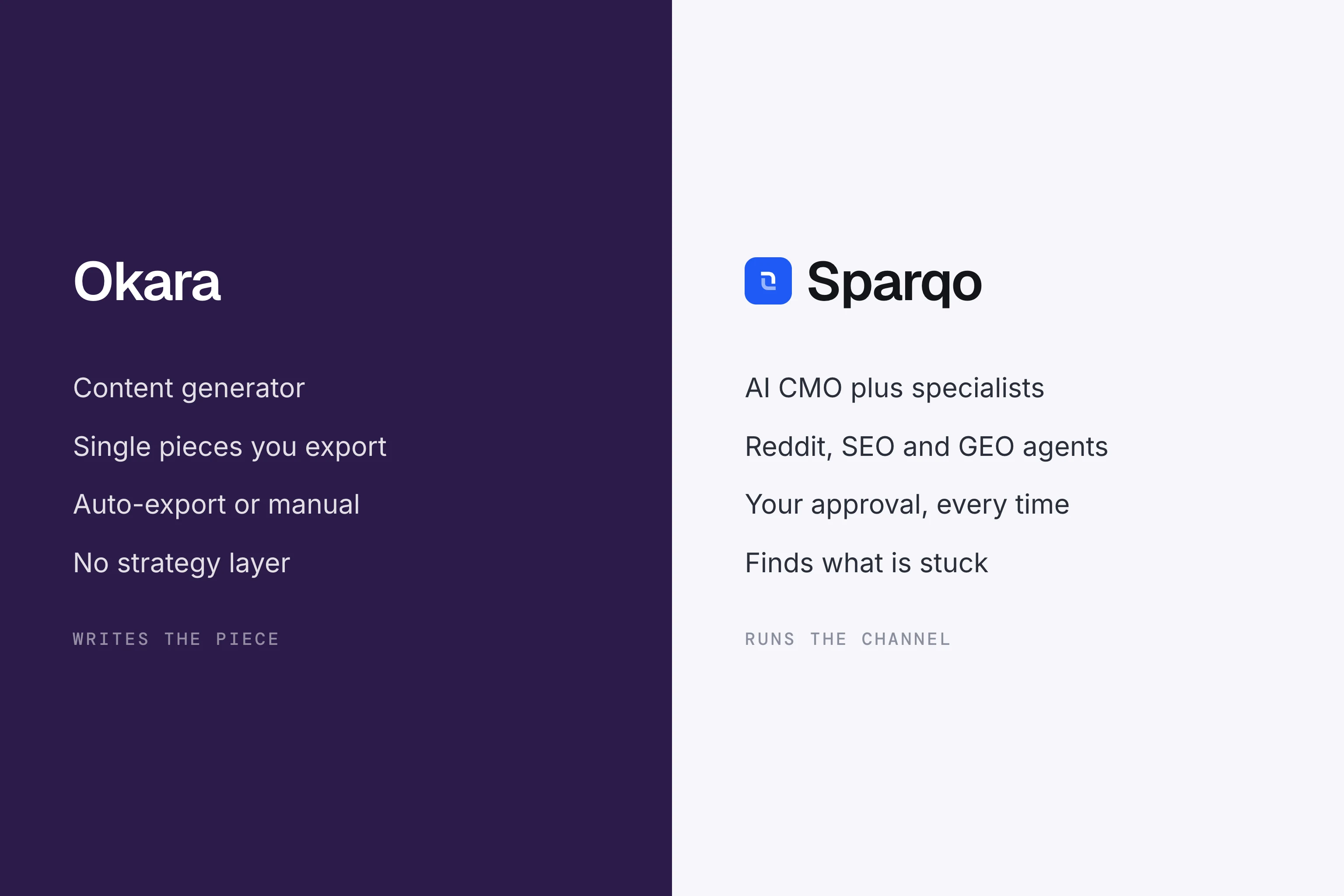
Sparqo is an AI CMO that runs a team of specialist agents across Reddit, SEO, GEO, Hacker News, X, and LinkedIn. The system is built specifically for indie founders and early-stage B2B SaaS teams who need distribution without agency overhead.
Here is how the architecture works:
The CMO agent coordinates. It identifies your growth constraint, whether that is discoverability, conversion, or retention, and routes work to the appropriate specialist agents. You are not managing five tools. You are approving drafts from one coordinated system.
Specialist agents execute daily. Each channel has a dedicated agent that understands platform norms and audience expectations. The Reddit agent knows which subreddits tolerate self-promotion and how to provide value before mentioning your product. The Hacker News agent drafts technical explanations that survive community scrutiny. The SEO agent builds topic clusters around your actual competitive advantages.
Human-in-the-loop approval prevents disasters. Nothing posts automatically. You review drafts in a unified queue, approve with one click, or request revisions. This prevents the spam bans that destroy auto-posting accounts and ensures technical accuracy for developer audiences.
Learning from approvals improves fit. The system tracks what you approve and reject, building a preference model that makes future drafts more on-brand without explicit configuration.
Flat pricing removes uncertainty. One monthly fee covers all channels. No per-seat licenses, no usage tiers, no percentage of revenue. See Sparqo pricing for current rates.
The workflow is designed for technical founders who want marketing handled but refuse to cede control. You spend minutes daily reviewing and approving, not hours managing contractors. The output improves as the system learns your voice, unlike agencies where quality depends on which freelancer picked up your ticket this week.
For a deeper comparison of this model versus traditional approaches, see our analysis of digital marketing agency or AI CMO tradeoffs.
When Should You Consider a B2B Marketing Agency (and When Not To)?
Agencies are not universally bad. They are poorly suited to some situations and well suited to others.
When Agencies Make Sense
Established product-market fit. You know who buys, why they buy, and what channels convert. You need execution at scale, not experimentation.
Complex enterprise sales. Your deals involve procurement, legal review, and multi-year contracts. You need account-based marketing, event sponsorship, and sales enablement that AI agents cannot yet handle.
Brand repositioning. You are entering a new market or escaping a failed positioning. You need external perspective, stakeholder interviews, and strategic frameworks.
Regulatory complexity. You operate in healthcare, finance, or other regulated industries where compliance review is mandatory. Human oversight is non-negotiable.
Large budgets with low founder bandwidth. You have raised Series B or beyond, have dedicated marketing leadership, and need an agency to execute their strategy.
When Agencies Are the Wrong Choice
Pre-product-market fit. You are still learning who your customer is. Agency contracts lock you into messaging that will change. You need speed and flexibility, not process.
Technical or developer audiences. Your buyers are engineers who detect marketing tone instantly. Generalist agency writers cannot speak their language without extensive training you cannot afford.
Multi-channel experimentation. You need to test Reddit, Hacker News, LinkedIn, SEO, and email in parallel to find what works. Agencies resist this because it fragments their resources.
Budget constraints. Your marketing budget is under $100,000 annually. Quality agency support is inaccessible, and cheap agencies deliver damage.
Founder-as-differentiator. Your personal expertise and voice are core to your brand. Outsourcing thought leadership destroys your advantage.
In these cases, AI-powered coordination like what Sparqo provides offers a viable alternative. For guidance on selecting between approaches, see our framework for how to choose an AI marketing platform.
Making the Right Marketing Choice for Your B2B Startup
The decision between agency, in-house hire, and AI coordination depends on your stage, constraints, and growth hypothesis.
Stage 0 to 1: Pre-revenue or early revenue. You are validating product-market fit. Do not hire an agency. Use AI tools for speed, founder time for authenticity, and manual testing across channels. Your goal is learning, not polished execution.
Stage 1 to 2: Product-market fit, scaling to $1M ARR. You have one or two working channels and need to systematize without losing agility. This is where coordinated AI agents shine. You get daily execution across channels, human approval for quality control, and flexibility to pivot when channels saturate.
Stage 2 to 3: Scaling to $10M ARR. You need specialized talent, brand investment, and possibly event marketing. Consider a hybrid: AI coordination for content and social velocity, plus targeted agency support for events and ABM, or a first marketing hire who uses AI tools for leverage.
Stage 3+: $10M ARR and beyond. You have marketing leadership and clear channel economics. Agencies become viable for specific, scoped needs where you have internal management capacity.
The 95-5 rule for B2B marketing states that 95% of your potential buyers are not in-market at any given time. Only 5% are actively seeking solutions. This has profound implications for your channel strategy. Most B2B marketing over-invests in capturing the 5% who are ready to buy now, through search ads and bottom-funnel content. The real opportunity is building mental availability with the 95% who will enter market in six to eighteen months. This requires consistent, valuable presence in the channels where your audience spends time, not just when they search for solutions.
Agencies are poorly structured for this. They optimize for campaign metrics and quarterly reviews. AI-coordinated daily presence across Reddit, Hacker News, LinkedIn, and SEO builds the sustained visibility that captures future demand. The 95-5 rule favors systems that operate continuously at low marginal cost, not campaign-based bursts.
For implementation guidance on specific channels, see our SEO playbook for founders and our guide to Reddit marketing without getting banned.
FAQ
What do B2B marketing agencies do?
B2B marketing agencies provide strategy, content creation, lead generation, and campaign management services for companies selling to other businesses. They typically structure work around monthly retainers, assign dedicated account teams, and deliver outputs like whitepapers, case studies, paid advertising campaigns, and event support. Most specialize in specific channels or industries rather than offering universal expertise.
What is the average cost of a B2B agency?
In 2026, competent B2B marketing agency retainers start around $8,000 to $15,000 monthly for limited scope work, with full-service engagements running $25,000 to $50,000 monthly. First-year total costs including setup fees, media spend markups, and overages typically range from $150,000 to $400,000. Minimum commitments are usually six to twelve months.
What are the 4 types of B2B?
The four common B2B classifications are: producers who buy raw materials or components to manufacture goods, resellers who purchase finished products to sell at markup, governments that procure for public services and infrastructure, and institutions including hospitals, universities, and nonprofits that buy for organizational operations. Each type has distinct procurement processes and decision criteria.
What is the 95 5 rule for B2B?
The 95-5 rule states that only 5% of your potential B2B buyers are actively in-market for a solution at any given time, while 95% are not currently looking to purchase. This means most marketing should focus on building mental availability and trust with future buyers through consistent valuable presence, rather than exclusively targeting the small fraction ready to buy immediately through bottom-funnel tactics.

Founder of Sparqo, building an AI CMO that runs SEO, AI visibility and Reddit for indie founders and small teams who do their own marketing.