An AI marketing platform in 2026 should do more than generate campaign copy. For a founder, indie hacker, or small startup team, the right platform should help decide where to focus, surface real opportunities, draft usable work, keep humans in control, and learn from outcomes.
That makes the buying decision harder than it was a few years ago. Almost every marketing tool now has AI features. Some are helpful writing assistants. Some are marketing automation suites with a chatbot added. A smaller number are agentic systems that can research, prioritize, draft, and route work for approval across multiple channels.
The key is not to buy the tool with the most impressive demo. The key is to choose the platform that fits your team’s actual growth motion.
Start with the marketing job, not the AI feature list
Before comparing vendors, write a plain-English sentence that describes the job you want the platform to own.
For example: 'We need a system that finds relevant conversations in our market, turns them into on-brand posts and SEO briefs, and gives our founder a clean approval queue twice a week.'
That sentence is more useful than a feature checklist because it forces you to define the workflow. A platform that is great at generating ad copy may be a poor fit if your biggest bottleneck is discovering where buyers are already asking questions. A platform with dozens of integrations may still disappoint if it cannot produce drafts your team would actually approve.
For lean teams, the strongest AI marketing platform usually solves one or more of these problems:
- It identifies growth opportunities you would otherwise miss.
- It turns those opportunities into channel-specific drafts.
- It keeps brand, factual, and legal review in the loop.
- It tracks what happened after the work was approved.
- It improves the next batch based on outcomes and feedback.
If a tool cannot connect those steps, you may still be buying a productivity tool, not a marketing operating system.
Know which category you are actually buying
AI marketing software now covers several categories. They overlap, but they are not interchangeable.
| Category | Best for | Main limitation |
|---|---|---|
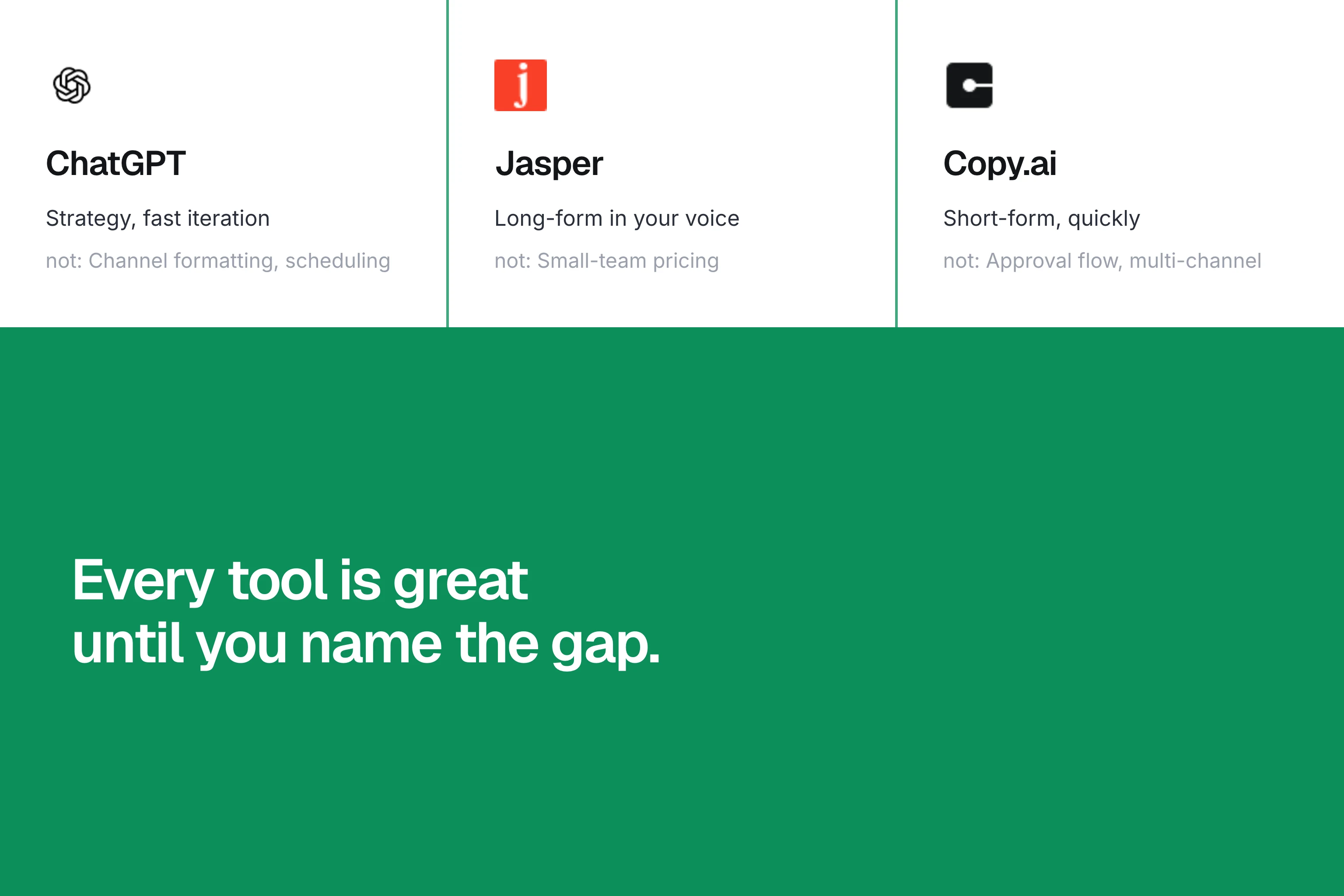
| AI writing assistant | Producing copy, outlines, repurposed posts, and quick variations | Usually waits for a human prompt and does not own the workflow |
| Marketing automation platform with AI features | Email, CRM, campaigns, lead scoring, and lifecycle automation | Often built for existing pipelines, not discovery or early-stage growth |
| Specialist AI channel tool | Solving one channel well, such as ads, SEO, or social scheduling | Can create silos if your team needs cross-channel coordination |
| Agentic AI marketing platform | Researching, drafting, routing, and learning across channels | Requires clear guardrails, review habits, and channel priorities |
If you are exploring the idea of a virtual marketing leader, it is worth understanding what an AI CMO actually is before you evaluate tools. The useful version is not a magical executive replacement. It is a coordinated system of specialist agents, workflows, and approvals that helps a small team ship better marketing more consistently.
Evaluate workflow completeness, not demo output
A good demo can make any platform look productive. The real test is whether the platform can move from signal to shipped work without creating more manual coordination for your team.
Look at the full workflow:
| Workflow stage | What good looks like | Red flag |
|---|---|---|
| Discovery | The platform finds relevant market signals, questions, competitors, communities, or search opportunities | It only responds after you provide detailed prompts |
| Prioritization | It explains why an opportunity matters and how it relates to your audience | It generates a long list with no ranking or rationale |
| Drafting | It creates channel-specific work that follows your positioning and tone | It produces generic content that needs a full rewrite |
| Review | Work goes into an approval queue with clear context | Drafts are scattered across chats, docs, and notifications |
| Execution | The handoff is clear, even if publishing still requires a human | The tool pushes for full autonomy before trust is earned |
| Measurement | Outcomes are attached to the work that caused them | Reporting is limited to vanity metrics or separate dashboards |
The approval step matters more than many buyers expect. In marketing, a slightly wrong claim, an insensitive community reply, or a post that sounds automated can hurt trust quickly. A platform that helps you approve, reject, edit, and learn from drafts is usually more valuable than one that simply produces more drafts.
Match the platform to your real channels
Do not choose an AI marketing platform because it supports every channel on the market. Choose it because it supports the channels that can plausibly work for your business in the next six to twelve months.
For early-stage startups, those channels often include a mix of search, founder-led social, community participation, and direct response to high-intent conversations. Reddit, Hacker News, LinkedIn, X, and SEO all require different behavior. A thoughtful reply on Reddit is not the same asset as a LinkedIn founder post. An SEO brief is not the same as a short-form social draft.
When evaluating channel fit, ask vendors to show channel-native work. For Reddit or Hacker News, that means context-aware replies that respect community norms (see Reddit marketing without getting banned). For LinkedIn, it means posts that sound like a real founder or operator, not a generic brand account. For SEO, it means briefs grounded in search intent, not just keyword expansion.
The platform should also help you say no. If it encourages you to publish everywhere without regard for audience, format, or capacity, it may increase noise rather than growth.
Put governance and human review near the top of the checklist
AI marketing tools operate close to public trust. They can touch claims, positioning, competitive references, customer language, and community interactions. That is why governance is not an enterprise-only concern.
The NIST AI Risk Management Framework emphasizes governance, mapping, measuring, and managing AI risks. For a small startup, that does not require a committee. It does mean you should know who reviews work, what the system is allowed to draft, and what it must never publish without explicit approval.
| Risk | Control to look for |
|---|---|
| Off-brand or exaggerated claims | Brand voice rules, positioning inputs, and review before use |
| Hallucinated facts | Source visibility, citation support, and factual review steps |
| Community backlash | Human approval for replies and channel-specific guidance |
| Accidental publishing | Approval queues and clear separation between draft and publish |
| Team confusion | Shared workspaces, ownership, and status tracking |
This is especially important if your team is small. When one founder is also the marketer, salesperson, and product lead, the platform should reduce cognitive load. It should not require you to remember which drafts are safe, which need edits, and which were already approved.
Understand data, keys, and cost before you scale usage
AI pricing can become confusing quickly. Some platforms charge per seat, some by credits, some by output volume, and some by a subscription plus your own model usage. The right model depends on how often your team will run research, generate drafts, and iterate.
| Pricing model | Best when | Watch for |
|---|---|---|
| Seat-based | Your usage is predictable and collaboration matters | Costs can rise as more reviewers join |
| Credit-based | You want tight usage control | Teams may avoid experimentation to save credits |
| Usage-based | You need flexibility | Bills can be hard to predict during busy months |
| Enterprise contract | You require procurement, compliance, and custom terms | Setup may be too heavy for a small team |
Whichever model you choose, look for transparent pricing that stays predictable as your usage grows. A flat subscription is easiest to plan around; credit and usage models reward tight control but can discourage the experimentation early-stage marketing depends on.
Also ask about data ownership. Can you export drafts, prompts, feedback, and performance history? Does the platform use your data to train shared models? Can different workspaces keep brand context separate? These questions are not just legal details. They affect whether your marketing system becomes a durable asset or a rented interface.
Separate SEO from GEO, then evaluate both
In 2026, a serious AI marketing platform should understand both traditional search and AI-mediated discovery. They are related, but not identical.
SEO still depends on search intent, topical authority, technical accessibility, internal linking, content quality, and credible sources. Google has long stated in its guidance on AI-generated content that helpfulness matters more than whether content was produced with AI. That means an AI platform should help your team create better, more useful content, not mass-produce thin articles.
GEO, or generative engine optimization, focuses on how your brand appears in AI answer engines and assistant-style discovery experiences. That may include tracking brand mentions, identifying source gaps, improving entity clarity, and creating content that can be cited or summarized accurately.
The best tools will not promise guaranteed placement in AI answers. They will help you understand what buyers ask, where your brand is missing, which sources shape the conversation, and what content assets would make your expertise easier to recognize.
Inspect research quality and source transparency
A platform’s output is only as strong as its inputs. If it drafts from vague assumptions, your marketing will sound plausible but shallow. If it starts from real questions, communities, competitors, search results, and customer language, the work becomes much more useful.
During a trial or demo, ask where the platform gets its signals. Can it show the source of an opportunity? Can it distinguish between a trending topic and a high-intent pain point? Can it summarize the context behind a Reddit thread, a search query, or a competitor comparison without flattening the nuance?
This matters because early-stage marketing is often a discovery problem. You are not only trying to publish. You are trying to learn which problems are urgent, which words buyers use, which objections repeat, and which channels produce meaningful conversations.
A strong AI marketing platform should make that learning visible. It should not hide everything behind polished copy.
Look for learning loops, not one-off generation
The biggest difference between a basic AI tool and a true marketing platform is memory with accountability. Not vague memory, but a structured learning loop.
When you approve a draft, reject a suggestion, edit a headline, or mark an opportunity as low quality, the system should use that signal. When a post performs well, the platform should connect the outcome to the idea, audience, channel, and angle. When a piece underperforms, it should help diagnose whether the issue was topic selection, timing, format, or message-market fit.
This is where many AI tools fall short. They generate content endlessly, but every session feels like starting over. For a small team, that is expensive even if the software is cheap. Your time is the scarce resource.
Useful learning loops often include accepted versus rejected drafts, channel-level outcomes, qualitative feedback from reviewers, and opportunity history. The goal is not to automate judgment away. The goal is to make each round of human judgment compound.
Consider implementation effort and team habits
The best platform on paper can fail if it does not fit how your team works. Before buying, be honest about your review cadence, brand maturity, and appetite for process.
If your positioning is still changing weekly, you need a platform that can absorb frequent updates. If your founder is the only approver, the approval queue must be simple enough to review quickly. If you already have a marketer or agency partner, shared workflows matter more than solo productivity.
You should also ask what setup requires. Most AI marketing platforms need some combination of brand context, audience definitions, product information, channel preferences, and examples of good or bad output. That setup is not a negative. In fact, it is often what separates generic AI from useful AI. But if the platform requires weeks of configuration before producing value, it may be too heavy for your stage.
Use a simple scorecard before you commit
A scorecard prevents your team from overvaluing the flashiest part of a demo. Adjust the weights for your situation, but make the tradeoffs explicit.
| Evaluation area | Suggested weight | What to score |
|---|---|---|
| Workflow completeness | 20% | Can it move from signal to reviewed work? |
| Channel fit | 15% | Does it support the channels you can actually execute? |
| Output quality | 15% | Would you approve drafts with light editing? |
| Governance and review | 15% | Are humans clearly in control before anything public happens? |
| Research transparency | 10% | Can you see why an opportunity or recommendation exists? |
| Learning loop | 10% | Does feedback improve future work? |
| Cost model | 10% | Is pricing predictable at your expected usage level? |
| Setup effort | 5% | Can your team adopt it without a major process change? |
Score each category from one to five after a real trial, not just a sales call. If possible, use your actual product, audience, and channels during the evaluation. Generic demo prompts rarely reveal the operational truth.
Ask these questions in every vendor demo
A good vendor should be able to answer practical workflow questions clearly. Bring these to your next demo:
- What does the platform do before a human gives it a prompt?
- Which channels does it understand deeply, and which are basic integrations?
- Where do drafts go for review, and who can approve them?
- Can the system explain why it recommended a topic, post, or reply?
- How does it prevent unsupported claims or off-brand messaging?
- What happens when we reject or heavily edit a draft?
- How are AI usage costs calculated, capped, or passed through?
- Can we export our work, feedback, and performance history?
The answers will tell you whether you are buying a chatbot, a content generator, or a real operating layer for marketing execution.
When Sparqo is a good fit
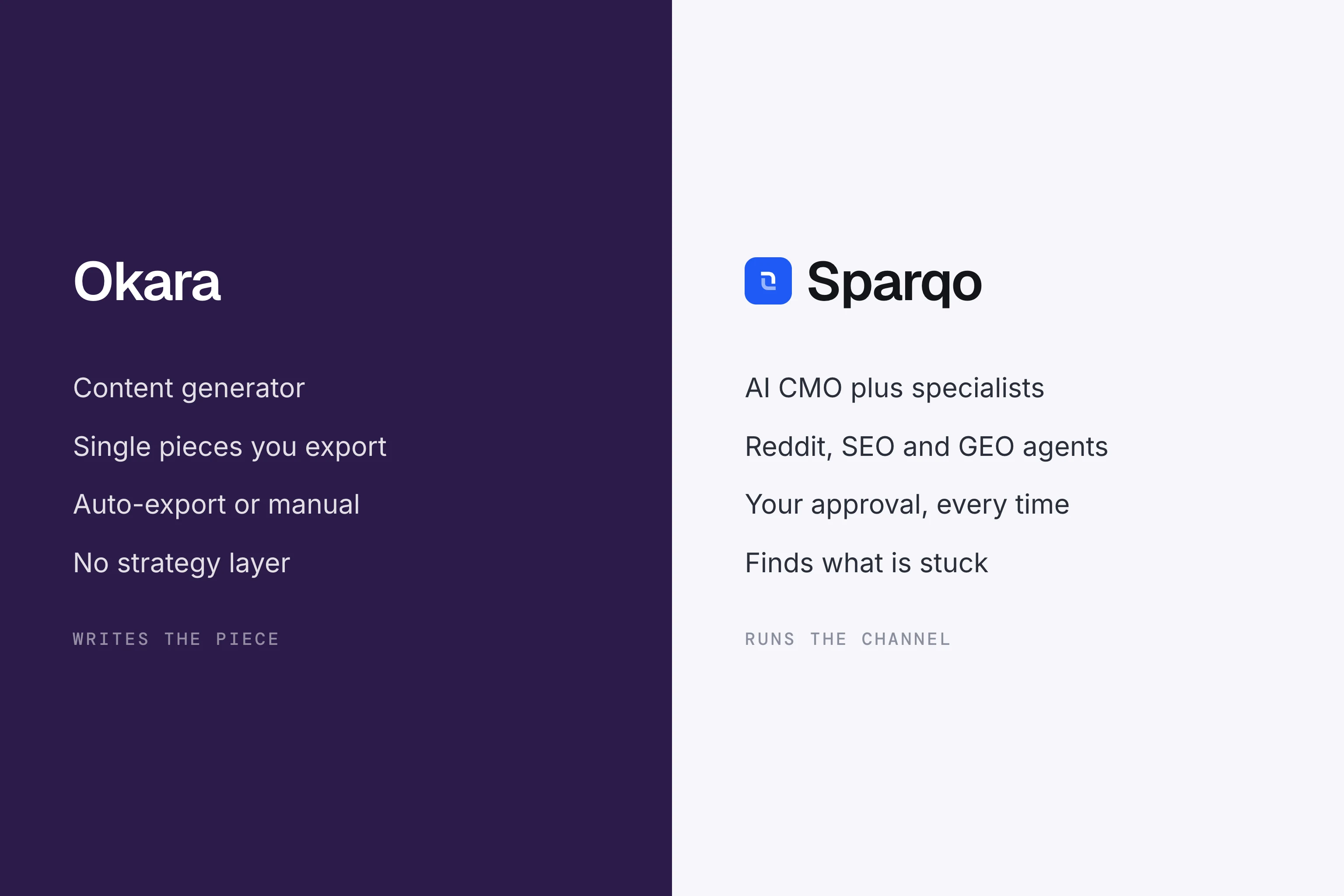
Sparqo is built for founders, indie hackers, and small startup teams that want an AI CMO style workflow without handing over full autonomy. It runs specialist marketing agents across Reddit, Hacker News, SEO, GEO, LinkedIn, and X to find opportunities and draft on-brand work. Everything goes into a human approval queue, so nothing publishes without review.
It is a strong fit if you want multi-channel marketing agents, shared approval workflows, outcome tracking, and flat subscription pricing. You can compare the current plan structure on the Sparqo pricing page.
It may not be the right fit if you need an enterprise marketing suite, an ad-buying platform, a CRM replacement, or a system that publishes autonomously without human review. For most small teams, that constraint is a feature rather than a drawback. The goal is to ship more high-quality marketing while keeping judgment where it belongs.
Frequently Asked Questions
What is an AI marketing platform? An AI marketing platform is software that uses AI to support marketing work such as research, content creation, campaign planning, channel monitoring, approvals, and performance learning. The strongest platforms connect multiple steps of the workflow rather than only generating copy.
How is an AI marketing platform different from a writing tool? A writing tool helps produce text when prompted. An AI marketing platform should help identify opportunities, draft channel-specific work, route it for review, and learn from results. Writing is one part of the system, not the whole system.
Should startups choose an all-in-one platform or specialist tools? Startups should choose based on their bottleneck. If one channel drives most growth, a specialist tool may be enough. If the team needs coordinated execution across search, social, and communities, an agentic platform may be more efficient.
Is fully autonomous AI marketing safe? For most brands, full autonomy is risky. Human review is still important for claims, tone, timing, and community context. A good platform can automate research and drafting while keeping approval with the team.
What should I test during a free trial or pilot? Test the platform with your real product, audience, and channels. Ask it to find opportunities, draft work, explain its reasoning, accept feedback, and show how approved work connects to outcomes. Do not rely only on generic demo examples.
Choose the platform that helps you ship responsibly
The best AI marketing platform is not the one that produces the most content. It is the one that helps your team find better opportunities, create work worth approving, and improve over time without losing control of your brand.
For founders and small teams, that usually means agentic workflows, channel-specific intelligence, transparent costs, and human approval by default. If that is the operating model you want, Sparqo is designed around exactly that kind of review-first AI marketing system.

Founder of Sparqo, building an AI CMO that runs SEO, AI visibility and Reddit for indie founders and small teams who do their own marketing.