Choosing between a digital marketing agency and an AI CMO is not just a budget decision. It is a decision about how your team wants marketing work to happen: who finds the opportunities, who writes the first draft, who approves the message, who learns from outcomes, and who keeps momentum when everyone is busy.
For founders, indie hackers, and small startup teams, the old default was simple: hire a digital marketing agency when you outgrow founder-led marketing. That can still be the right move. But AI marketing systems now give lean teams another option: keep strategy and judgment close to the business while using AI agents to handle research, drafting, channel monitoring, and repetitive execution.
The best choice depends on your internal capability, growth stage, channels, and tolerance for outsourcing. Here is how to evaluate both models clearly.
The real question: what kind of marketing system do you need?
A digital marketing agency is an external service provider. Depending on the agency, it may handle strategy, content, paid ads, SEO, creative, analytics, social media, email, conversion optimization, or a mix of these. You pay for human expertise, process, and execution capacity.
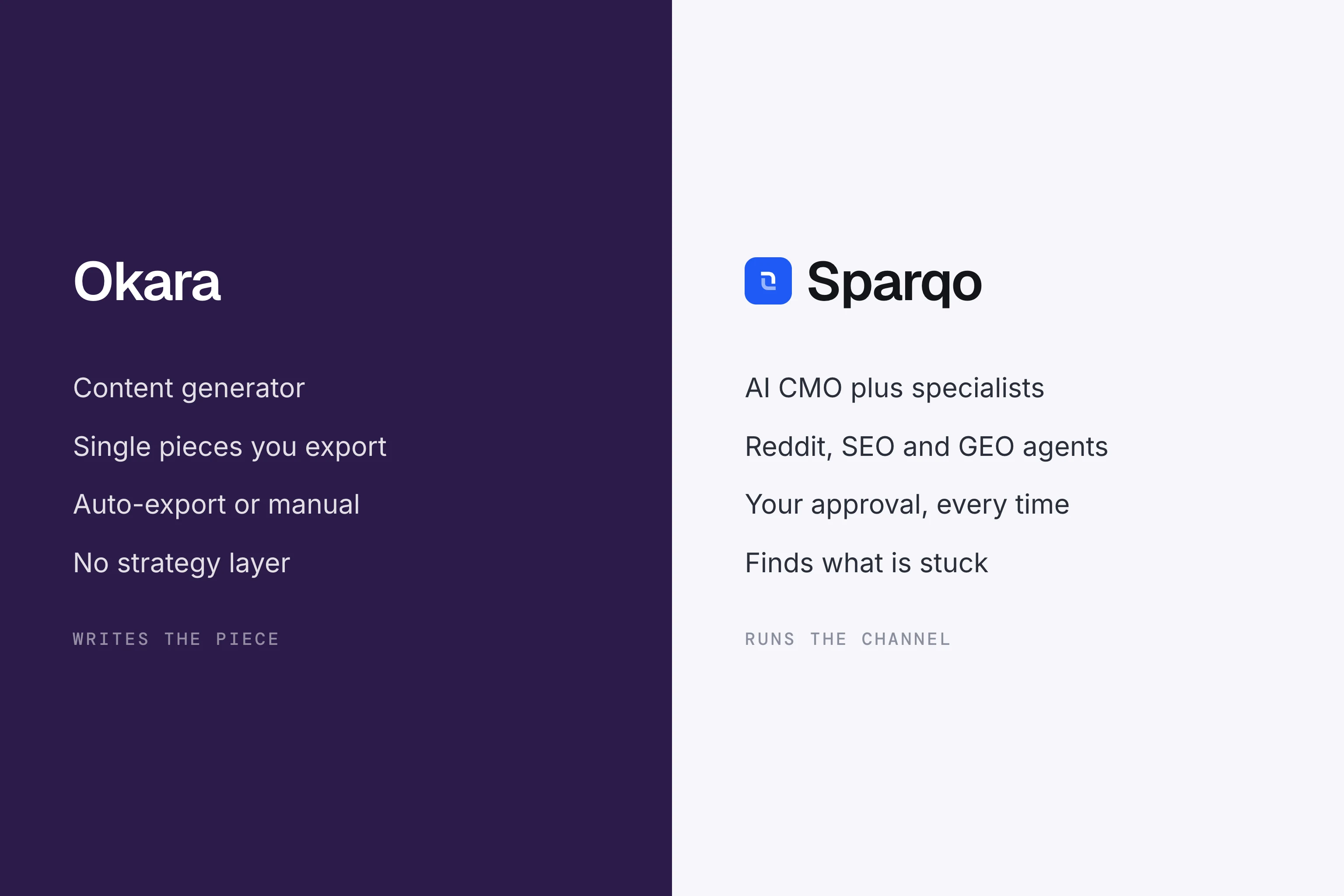
An AI CMO is different. It is not a human executive and it is not just a chatbot. In practice, it is a software layer that coordinates specialized marketing agents to find opportunities, produce drafts, track signals, and help a team ship more consistently. If you want a deeper definition before comparing options, Sparqo’s guide to what an AI CMO actually is is a useful companion to this decision.
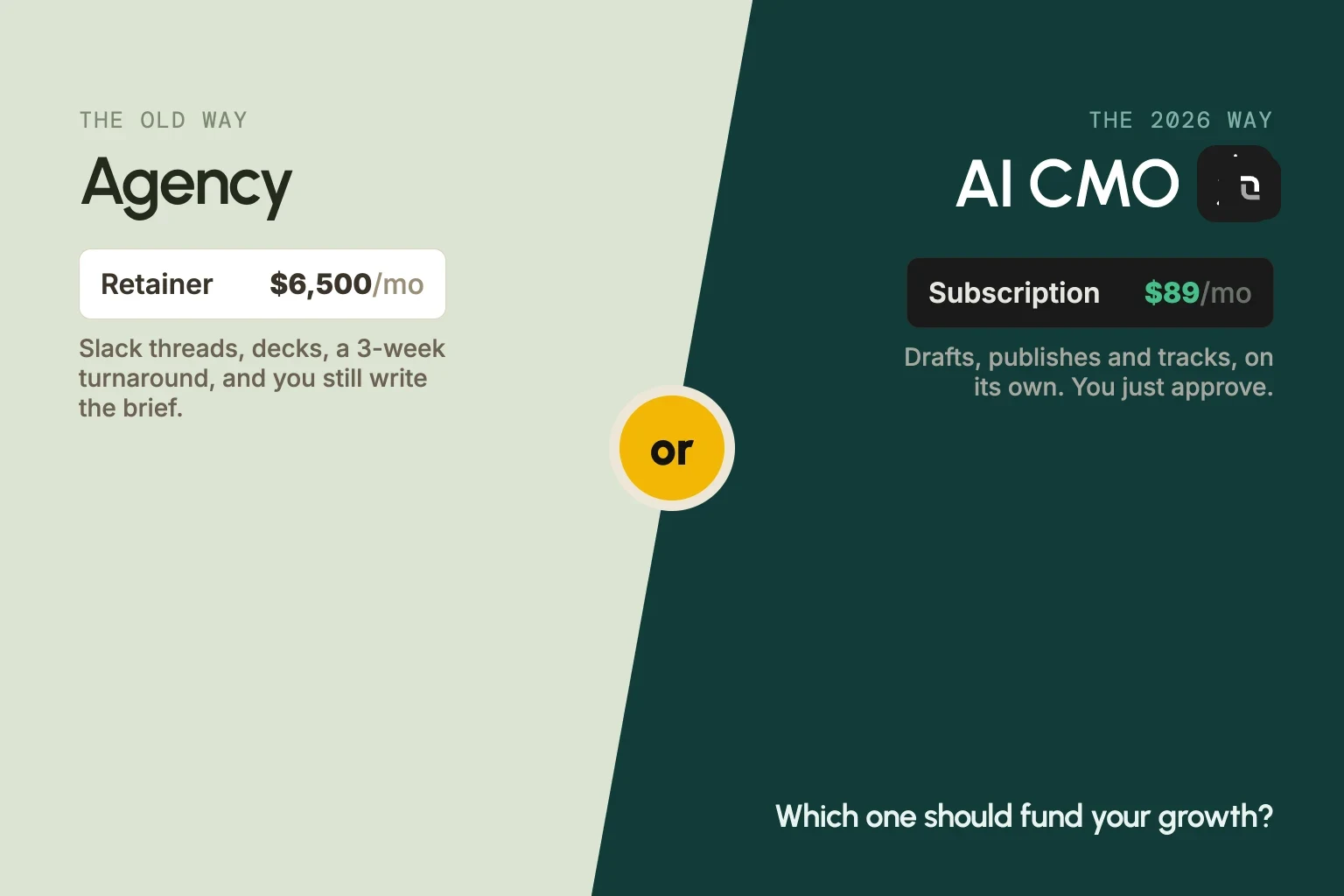
The core trade-off is simple: an agency gives you external people and expertise, while an AI CMO gives your internal team leverage. One replaces or supplements execution with outside talent. The other makes your existing judgment, customer knowledge, and brand voice easier to turn into shipped work.
Digital marketing agency vs AI CMO at a glance
| Decision factor | Digital marketing agency | AI CMO |
|---|---|---|
| Best fit | Teams that need outsourced expertise, strategy, or specialist execution | Teams that have internal judgment but need more output and opportunity discovery |
| Cost structure | Usually retainers, project fees, or performance-based agreements | Usually software subscription plus AI usage, depending on the tool |
| Speed | Can be fast after onboarding, but often depends on meetings, briefs, and account management | Fast for research, drafts, monitoring, and iteration once context is set |
| Brand control | Shared with an external team, quality depends on briefing and review | Stays closer to the founder or internal team through approval workflows |
| Strategy | Can bring senior outside perspective | Helps operationalize strategy, but still needs human direction |
| Execution | Human-led delivery across scoped channels | Agent-assisted drafts, research, tracking, and channel workflows |
| Learning loop | Often summarized in reports or account calls | Can be continuous if the system tracks outcomes and improves from feedback |
| Main risk | Paying for output that misses the nuance of your market | Treating AI as autonomous strategy instead of guided leverage |
Neither model is universally better. The wrong agency can feel slow and expensive. The wrong AI setup can create noisy work that still requires too much editing. The right decision is the one that matches your team’s current bottleneck.
What a digital marketing agency is best at
A digital marketing agency can be a strong fit when you need experienced humans to own a complex workstream. If your team lacks senior marketing judgment, has no one to write briefs, or needs specialist skills that would be expensive to hire in-house, an agency can compress the learning curve.
Agencies are especially useful when the work requires taste, judgment, or deep channel expertise that is hard to automate. Examples include a full brand repositioning, a paid acquisition rebuild, a conversion-focused website redesign, a product launch campaign, or a technical SEO cleanup with many stakeholders.
A good agency also brings pattern recognition. It has seen multiple accounts, experiments, mistakes, and growth stages. That outside perspective can help founders avoid becoming trapped in their own assumptions.
However, agencies are not magic. They still need strong inputs. If you cannot explain your customer, positioning, differentiation, or product constraints, the agency will have to guess. Many disappointing agency relationships start because the client expects the agency to discover the business from scratch, then produce perfect work with little feedback.
A digital marketing agency is usually strongest when:
- You need human specialists, not just more output.
- You do not have an internal marketing owner.
- The work involves paid media, creative production, analytics setup, or technical implementation.
- You want someone else to manage a scoped marketing function.
- You have enough budget to pay for strategy, execution, and account management.
The key phrase is “scoped marketing function.” Agencies work best when the problem is specific enough to own. “Grow our startup” is too vague. “Improve paid search efficiency,” “create a launch campaign,” or “build a 90-day SEO content engine” gives an agency a much better chance of succeeding.
What an AI CMO is best at
An AI CMO is strongest when your team already has the raw ingredients for good marketing but not enough time to turn them into consistent action. This is common in founder-led companies. The founder knows the customer, the objections, the product story, and the market, but marketing tasks keep losing to product, sales, support, and fundraising.
In that situation, the bottleneck is not always strategy. It is throughput. Someone needs to monitor Reddit and Hacker News, find relevant conversations, draft thoughtful replies (without getting banned from Reddit), turn customer pain points into SEO briefs, create LinkedIn and X drafts, and track how visibility changes across search and AI answers.
That is where an AI CMO can be useful. In Sparqo’s case, specialist agents work across Reddit, SEO, GEO visibility tracking, X, and LinkedIn, with drafts going into a human approval queue. That matters because small teams usually do not want fully autonomous publishing. They want leverage without losing control.
An AI CMO is usually strongest when:
- Your founder or team understands the market but lacks execution capacity.
- You need more consistent organic marketing across several channels.
- You want to discover conversations and opportunities before competitors do.
- You prefer approving and editing drafts instead of starting from a blank page.
- You want marketing work to compound through learning loops, not disappear into one-off campaigns.
Cost structure can also be part of the decision. Sparqo uses a flat subscription model designed for teams that want predictable software pricing. If you are comparing software against a retainer, reviewing the current Sparqo pricing can help you understand the difference between buying leverage and hiring external services.
The hidden variable: how much marketing judgment is inside your team?
The biggest mistake in this comparison is assuming every small team has the same marketing maturity. Some founders are excellent marketers who simply lack time. Others have strong products but no clear positioning, no content point of view, and no channel strategy.
Those two teams need different solutions.
| Your internal state | What it usually means | Better starting point |
|---|---|---|
| No clear positioning or ICP | You need strategic clarity before scaling output | Agency, consultant, or senior marketing advisor |
| Clear positioning but inconsistent execution | You know what to say but do not ship enough | AI CMO |
| Strong founder voice but no distribution system | You need channel workflows and repurposing | AI CMO |
| Complex paid acquisition or analytics gaps | You need specialist management | Digital marketing agency |
| Growing team with multiple reviewers | You need workflow, approvals, and shared context | AI CMO or hybrid model |
If your team cannot tell whether a draft is good, an AI CMO may simply create more work to review. If your team can recognize strong messaging but struggles to create enough of it, an AI CMO can remove a major bottleneck.
Cost, control, and speed: the three trade-offs that matter most
Cost is not just the invoice
A digital marketing agency often costs more than software because you are paying for human time, expertise, project management, and margin. That can be worthwhile if the agency owns a business-critical function or brings expertise you do not have.
But the invoice is only one part of the cost. Agencies also require onboarding, meetings, feedback cycles, and internal coordination. If a founder spends five hours per week correcting generic work, the effective cost is higher than the retainer.
An AI CMO usually has a lower direct cost than an agency, but it is not free in terms of attention. Someone still needs to set direction, approve drafts, provide feedback, and decide which opportunities are worth acting on. The cost advantage is strongest when review is faster than creation.
Control depends on your review process
With an agency, you delegate execution and sometimes strategic direction. That can be freeing, but it can also create distance from the customer. The agency may write polished copy that does not quite sound like your founder, your users, or your category.
With an AI CMO, your team keeps more control because work can be routed through approval queues before publishing. This is important for channels like Reddit, Hacker News, LinkedIn, and X, where tone matters. A technically correct answer can still feel promotional, generic, or out of place.
The more nuanced your market, the more valuable human review becomes. AI can draft and surface opportunities, but your team should decide what deserves the company’s voice.
Speed is about cycle time, not raw output
AI can generate drafts quickly, but speed only matters if the work gets reviewed, improved, and shipped. Agencies can also move quickly when the scope is clear and the account team is strong.
The real metric is cycle time: how long it takes to go from opportunity to approved asset. For example, if a relevant Reddit thread appears today, can your team identify it, draft a helpful reply, approve it, and respond while the conversation is still active? If a customer objection keeps appearing in sales calls, can you turn it into a search brief or LinkedIn post this week?
An AI CMO tends to win when opportunities are frequent, distributed, and time-sensitive. An agency tends to win when the work is larger, more strategic, and less dependent on daily responsiveness.
When a hybrid model is the smartest choice
The choice is not always agency or AI CMO. Many teams should use both, but for different jobs.
A hybrid model works well when an agency handles specialist strategy or production, while an AI CMO keeps daily execution moving. For example, an agency might define positioning, build a paid acquisition strategy, or redesign key landing pages. Meanwhile, an AI CMO helps the team monitor community conversations, draft founder-led social posts, create SEO briefs, and maintain an approval workflow.
This division avoids a common problem: using expensive agency time for every small marketing task. It also avoids the opposite problem: expecting AI to solve strategic ambiguity on its own.
A practical hybrid split might look like this:
| Marketing job | Best owner |
|---|---|
| Positioning workshop | Agency, consultant, or senior marketer |
| Daily Reddit and HN opportunity discovery | AI CMO with human approval |
| Paid media account restructure | Specialist agency |
| LinkedIn and X draft generation | AI CMO |
| Brand identity system | Creative agency |
| SEO brief generation and content planning | AI CMO with internal review |
| Quarterly growth strategy | Founder, leadership team, and possibly external advisor |
For lean teams, this can be the most realistic setup. Use human experts where judgment and specialization matter most. Use AI agents where the work is repetitive, research-heavy, or blocked by blank-page effort.
A practical decision framework
If you are still unsure, ask five questions.
- Do we know what we want to say? If not, start with strategy help. If yes, an AI CMO can help you say it more often across more channels.
- Do we have someone who can approve marketing work quickly? If yes, AI-assisted workflows become much more valuable. If no, an agency may provide more structure.
- Are our main channels high-context or specialist? Community, founder-led social, SEO briefs, and GEO tracking can fit an AI CMO. Complex paid media or creative production may need an agency.
- Is our bottleneck ideas, expertise, or execution? Agencies are best for expertise gaps. AI CMOs are best for execution and discovery gaps.
- Do we want to outsource marketing or build an internal growth system? Agencies outsource capacity. AI CMOs increase internal leverage.
The answer may change over time. A pre-seed founder might start with an AI CMO to build momentum. A Series A team might hire an agency for paid acquisition while keeping AI-assisted organic workflows in-house. A solo founder might use AI until revenue justifies specialized help.
How to test the choice in 30 days
Before committing to a long agency relationship or rebuilding your marketing stack, run a focused test.
Define one business outcome, such as more qualified conversations, more demo requests, more relevant search visibility, or more founder-led social engagement. Then choose two or three channels that plausibly support that outcome.
For 30 days, measure practical operating metrics, not just vanity metrics. Track how many opportunities were found, how many drafts were created, how many were approved, how many shipped, and what outcomes followed. Also track how much founder or team time was required.
If an agency produces better strategic clarity and high-quality assets with manageable oversight, that is useful evidence. If an AI CMO helps your team ship more relevant work with less blank-page effort, that is evidence too.
The goal is not to prove that one model is universally superior. The goal is to discover which model improves your team’s actual marketing throughput without lowering quality.
Common mistakes to avoid
The first mistake is comparing an agency’s full-service retainer to an AI CMO as if they do the same job. They do not. One is a service relationship. The other is a leverage system for your team.
The second mistake is assuming AI should publish autonomously. For most startups, especially in community and social channels, human-in-the-loop review is a strength, not a limitation. Brand trust is too valuable to hand over completely.
The third mistake is hiring an agency before clarifying ownership. Even with a great agency, someone on your team must own the relationship, provide feedback, and connect marketing activity to product and customer reality.
The fourth mistake is using an AI CMO without a point of view. AI can help you find angles, drafts, and opportunities, but it works best when guided by real positioning, customer insight, and a clear standard for quality.
Frequently Asked Questions
Is an AI CMO the same as a digital marketing agency? No. A digital marketing agency is an external team or service provider. An AI CMO is a software-driven system that helps your internal team discover opportunities, draft work, and manage marketing workflows with human review.
Can an AI CMO replace a marketing agency? Sometimes, but not always. It can replace certain execution-heavy tasks when your team already has strong judgment. It is less likely to replace specialist work such as complex paid media management, brand identity, or major strategic repositioning.
When should a startup choose a digital marketing agency? Choose an agency when you need expertise you do not have, a scoped function managed externally, or specialist execution in areas like paid acquisition, technical SEO, creative production, or analytics implementation.
When should a startup choose an AI CMO? Choose an AI CMO when your team understands the customer and market but needs help shipping consistently across channels. It is especially useful for founder-led teams that want more drafts, more opportunity discovery, and more structured approvals.
Can a team use both an agency and an AI CMO? Yes. A hybrid approach often works best. Use an agency for specialist or strategic work, and use an AI CMO for daily workflows like community monitoring, SEO brief generation, social drafts, and outcome tracking.
Choose the model that helps your team ship
A digital marketing agency is a good fit when you need outside expertise, specialist execution, or a team to own a defined marketing function. An AI CMO is a good fit when you have internal judgment but need more leverage, faster drafts, better opportunity discovery, and a repeatable approval process.
For many founders and small teams, the deciding question is simple: do you need someone else to own marketing, or do you need a system that helps your team ship the marketing work it already knows it should be doing?
If the second answer feels closer to your situation, Sparqo is built for that operating model. It gives small teams AI marketing agents across channels like Reddit, SEO, GEO, X, and LinkedIn, with human approval before anything goes live.

Founder of Sparqo, building an AI CMO that runs SEO, AI visibility and Reddit for indie founders and small teams who do their own marketing.