A complete SEO playbook for founders needs to cover four things in order: technical foundations that let Google crawl your site, content that matches real search intent, distribution that builds authority, and systems that keep it running without you. Most founders mess this up by skipping straight to content creation, or by treating SEO as a one-time task instead of a compounding channel. This guide gives you the specific framework that actually produces results for early-stage teams operating without dedicated marketing hires.
Key takeaways
- A complete SEO playbook for founders needs to cover technical foundations, content matching real search intent, distribution that builds authority, and systems that keep it running without you.
- The playbook that works focuses on high-intent, problem-aware keywords where your specific solution matches a specific pain point.
- Treat SEO as product development, not marketing activity, by investing in assets, expecting 12-month timelines for meaningful results, measuring learning, and building distribution into the process.
- Essential tools for founders include Google Search Console, Ahrefs or Semrush (starter plan), and Screaming Frog or your own crawler for technical auditing.
Why SEO is a Founder's Secret Weapon (Especially for AI Startups)
Founders building in the AI space face a uniquely crowded attention economy. Every product launch gets buried under a dozen similar announcements within days. Paid channels scale linearly, meaning your customer acquisition costs stay flat only if you keep spending. SEO offers something different: compounding returns where each piece of content can bring qualified traffic for years.
The pattern I see working involves three specific advantages for AI founders. First, your technical fluency lets you move faster on implementation than non-technical competitors. Second, you can spot intent gaps in emerging search categories that established players miss. Third, and most important, you can build content directly into your product workflow in ways traditional SaaS cannot.
But here is the trap that gets most founders: they chase vanity rankings. Traffic for "what is machine learning" brings unqualified visitors who never convert. The playbook that works focuses on high-intent, problem-aware keywords where your specific solution matches a specific pain point. A founder at an AI code assistant startup explained their breakthrough: they stopped writing about "AI coding" and started targeting "migrate from Copilot to self-hosted" and similar comparison terms. Their traffic dropped by half, but trial signups tripled.
For early-stage teams, SEO also serves as validation infrastructure. When you rank for a problem-related query and visitors actually convert, you have proof of product-market fit that beats any survey response. This matters particularly when you are building with limited runway and need to justify continued investment in specific features.
The Indie Founder's SEO Mindset: Building for Long-Titude Term Organic Growth
The mindset shift that separates founders who succeed at SEO from those who abandon it after six months is simple but hard to execute: treat SEO as product development, not marketing activity. This means accepting delayed feedback loops, making bets based on incomplete data, and building systems rather than chasing one-off wins.
Here is the specific framework that changes outcomes:
Invest in assets, not campaigns. A blog post is an asset that compounds. A product hunt launch is a campaign that spikes and dies. Both have value, but your SEO effort should tilt heavily toward evergreen content that improves with age. The founders I see winning consistently allocate 70% of content resources to foundational pieces that answer persistent customer questions, and 30% to timely commentary that builds topical authority.
Expect 12-month timelines for meaningful results. If you need leads next month, SEO is the wrong channel. If you need sustainable, low-cost acquisition in 18 months, it is often the best channel. The founders who stick with it build content velocity early, publish consistently for six months with minimal traffic, then see acceleration as authority compounds. The ones who quit usually started with unrealistic timeline expectations.
Measure learning, not just rankings. Early SEO efforts generate information even when they generate minimal traffic. Which topics brought the right visitors? Which pages had high engagement but low conversion? This qualitative data shapes product positioning faster than traditional user research. One founder discovered their highest-intent traffic came from searches about data privacy compliance, a use case they had not prioritized. They rebuilt their homepage messaging around this insight and saw immediate conversion improvements.
Build distribution into the process. Great content without distribution dies quietly. The SEO playbook that works includes active promotion, not passive hope. This means engaging in communities where your audience gathers, building relationships with adjacent content creators, and using every channel at your disposal to earn initial visibility that Google can then amplify. See our guide on Reddit marketing without getting banned for specific tactics that work for technical audiences.
Your Minimal Viable SEO Stack: Tools and Tactics That Deliver
Founders do not need enterprise tooling to compete on SEO. What follows is the specific, affordable stack that produces results without requiring a dedicated SEO hire or significant monthly spend.
Foundation layer (essential):
- Google Search Console: Free, authoritative data on what Google sees and how you perform. Check weekly for coverage issues, query impressions, and click patterns.
- Ahrefs or Semrush (starter plan): One of these for competitor research and keyword gap analysis. You do not need the full suite initially. Many founders start with Ahrefs Site Explorer on the Lite plan to reverse-engineer what ranks for competitors.
- Screaming Frog or your own crawler: Technical audit capability. The free version crawls 500 URLs, sufficient for most early-stage sites. Check for broken links, duplicate titles, and crawl errors monthly.
Content intelligence:
-
Clearscope or SurferSEO (optional): Content optimization guidance. These tools analyze top-ranking pages and suggest semantic coverage. Useful but not essential. Many founders write naturally, then verify coverage against competitor content manually.
-
Custom GPT or Claude for research acceleration: Use carefully. These tools excel at structuring information, summarizing competitor content, and generating outlines. They fail at original insight and specific expertise. The winning workflow uses AI for speed, human for judgment. See how this integrates with broader automation in our breakdown of best AI content marketing automation platforms for SaaS founders.
Analytics and attribution:
- Plausible or Fathom: Privacy-focused analytics that do not require cookie consent, simplifying GDPR compliance.
- Your own product analytics: Track content-sourced signups by UTM parameter or self-reported attribution in onboarding flows.
| Tool Category | Specific Tool | Monthly Cost | When to Add |
|---|---|---|---|
| Technical monitoring | Free | Day one | |
| Keyword research | ~$99 | After 10 published posts | |
| Content optimization | ~$170 | When scaling to 4+ posts monthly | |
| Analytics | ~$9 | Replace Google Analytics 4 | |
| Crawl diagnostics | Free | Monthly technical checks |
The specific tactic that outperforms generic optimization: prioritize information gain in every piece. Search engines now heavily weight content that adds something new to existing discourse. This means original research, firsthand experience, contrarian but defensible takes, or synthesis that connects dots others have missed. A founder documenting their actual migration from AWS to GCP with specific cost and complexity numbers will outrank generic "cloud migration best practices" content every time.
Crafting Content That Converts: Beyond Just Keywords
Keyword research remains essential, but the founders winning in 2026 treat it as input to content strategy, not the strategy itself. The specific approach involves mapping content to buying stages, then optimizing for conversion at each stage.
The four-stage content framework:
-
Unaware: The prospect does not know they have a problem. Content here builds category awareness through educational content that introduces pain points they have normalized. This content rarely converts directly but builds authority for everything else.
-
Problem-aware: They know the pain but not solutions. Comparison content, "why X fails" posts, and diagnostic tools work here. High search volume, medium conversion rate.
-
Solution-aware: They know solutions exist and are comparing options. Your product belongs here, directly compared to alternatives. This is where most SEO effort should concentrate for revenue impact.
-
Product-aware: They know your product and need validation. Case studies, implementation guides, and specific feature deep dives. Lowest volume, highest conversion.
The common founder mistake is overinvesting in stages 1 and 4, neglecting the middle where decisions actually happen. A healthy portfolio might be 20% unaware, 40% problem-aware, 30% solution-aware, 10% product-aware.
For each piece, write the conversion path before the content. What should the visitor do next? If your answer is "read another post," you have a leak in your funnel. Every piece should have explicit next steps: start a trial, join a waitlist, download a related resource, or request personalized implementation guidance.
The specific format that converts for technical founders: implied case studies. Instead of "how Company X used our product," write "how to solve [specific problem]" using your actual implementation approach, with specific metrics and challenges. This provides value even to non-prospects while demonstrating expertise to potential buyers. One founder in the devtools space published "how we reduced CI costs 60% by switching build orchestrators" using their own product, saw it become their highest-converting content asset within three months.
Automating Your SEO (Without Losing Your Soul)
Automation in SEO risks two failure modes: producing generic content that damages brand perception, and triggering platform penalties through spammy behavior. The specific approach that works preserves human judgment at critical decision points while automating repetitive production tasks.
What to automate safely:
- Research synthesis and outline generation
- Internal linking suggestions based on semantic similarity
- Technical monitoring and alert routing
- Publication scheduling across owned channels
- Performance reporting and anomaly detection
What requires human judgment:
- Final content approval and tone verification
- Community engagement and response
- Strategic pivots based on competitive movement
- Original insight and expertise injection
The workflow that balances scale and quality: specialist agents draft against specific briefs, humans approve or revise before publication, and feedback loops improve future drafts based on performance data. This prevents the spam penalties that come from fully autonomous publishing while maintaining the velocity that manual creation cannot match.
For technical founders, this often means building custom pipelines. A common pattern: scrape top-ranking content for a target query, use an LLM to extract structural patterns and coverage gaps, generate an outline optimized for information gain, write the draft manually or with AI assistance, then automate distribution across relevant communities and channels.
The specific risk to avoid: platform dependency. Automation that violates Reddit, Hacker News, or LinkedIn terms of service can get your accounts banned, destroying distribution channels that took months to build. Any automated approach needs human-in-the-loop approval for public-facing actions.
Sparqo's Role in Scaling Your Founder-Led SEO Efforts
At a certain point, the founder cannot manually execute all SEO activities while building product. This is where coordinated automation becomes necessary, not optional. The specific challenge is maintaining quality and authenticity while increasing velocity.
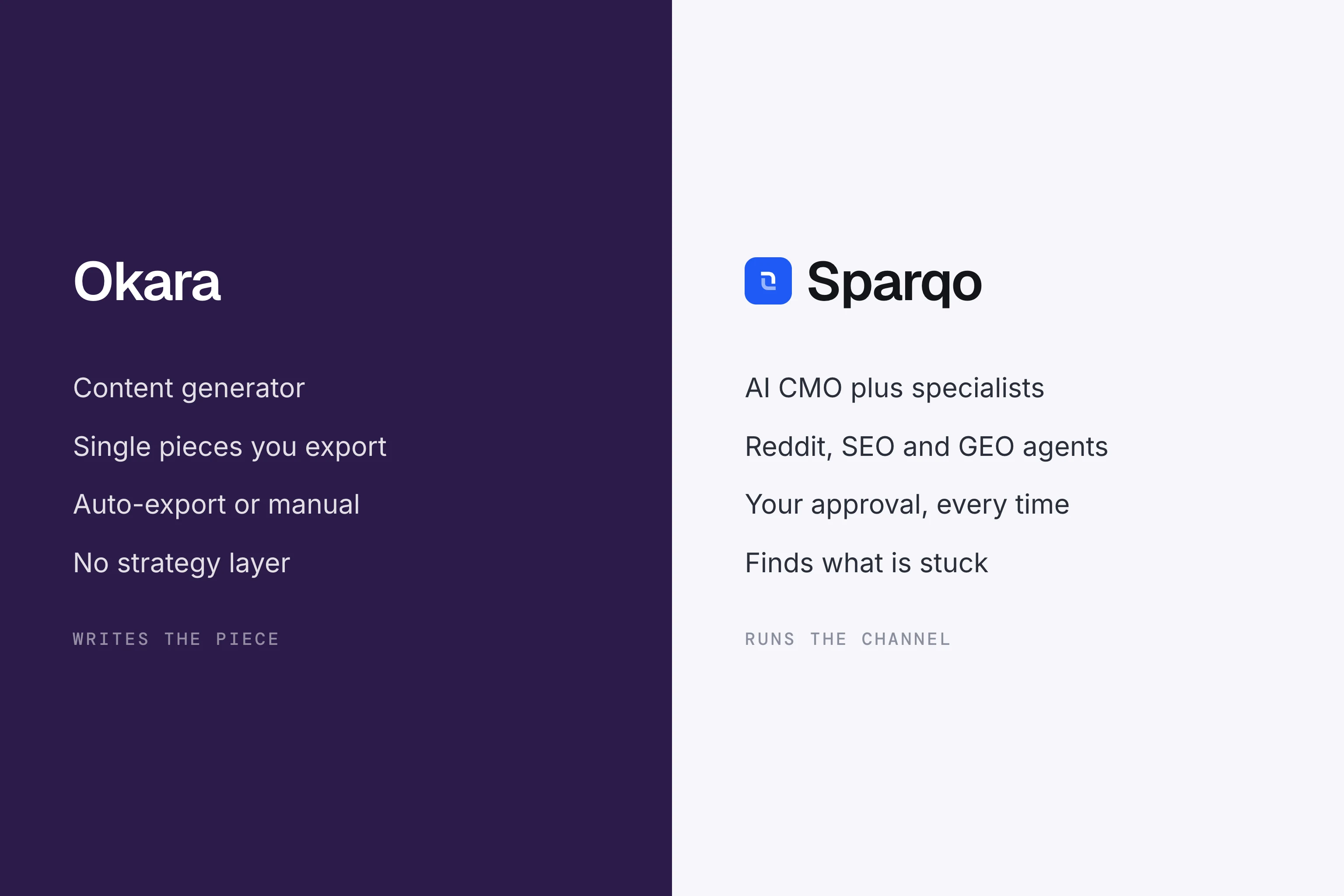
Sparqo operates as an AI CMO running specialist agents across SEO, Reddit, Hacker News, GEO, X, and LinkedIn. Each agent drafts content on a schedule that you approve before anything publishes. This human-in-the-loop design prevents the platform bans that destroy distribution channels, while the flat pricing model means scaling content does not create surprise costs.
The specific integration with founder-led SEO: Sparqo's agents learn from your feedback and published outcomes, improving draft relevance over time. For technical founders who have established voice and perspective but lack time for consistent execution, this preserves authenticity without requiring daily content creation hours.
The flat pricing with no markup on model usage matters particularly for SEO-heavy strategies where content volume directly correlates with results. Per-usage pricing creates tension between quality and cost that distorts strategy. Predictable costs let you plan content velocity based on business needs, not pricing tiers. Compare approaches in our analysis of digital marketing agency or AI CMO decisions.
The learning system connects to broader SEO optimization by identifying which draft approaches generate engagement, which community responses build authority, and how content performs across channels. This visibility into cross-channel performance improves SEO strategy specifically, as search rankings increasingly reflect brand mentions and engagement quality from across the web.
Measuring Success: KPIs That Matter for Early-Stage SEO
Vanity metrics kill SEO programs. Founders need specific, actionable measurements that connect to business outcomes, not just traffic growth.
The measurement hierarchy:
Level 1: Technical health
- Crawl errors resolved within 48 hours
- Core Web Vitals passing for primary pages
- Index coverage at >95% of submitted URLs
These are hygiene factors. Failure here undermines everything else, but success does not guarantee results.
Level 2: Visibility and engagement
- Impressions for target queries (Search Console)
- Average position for priority keywords
- Click-through rate from search results
- Time on page and scroll depth for content pages
These indicate whether your content is findable and relevant. Improvement here predicts future conversion growth.
Level 3: Business outcomes
- Product signups attributed to organic search
- Pipeline value from search-sourced leads
- Cost per acquisition versus paid channels
- Payback period for SEO investment
The specific metric that matters most: organic-sourced customer acquisition cost compared to your fully-loaded blended CAC. When organic CAC is 20-30% of paid CAC, you have a sustainable growth engine. Early-stage companies often see this ratio flip from 5:1 paid-dominant to 2:1 or better within 18 months of consistent SEO investment.
One specific reporting practice: monthly "what we learned" summaries rather than just dashboards. Traffic up 40% means little without understanding why, what content drove it, and whether those visitors convert. Founders who succeed at SEO build organizational knowledge, not just rankings.
For specific comparison frameworks, see the modern SEO playbook guidance from established practitioners, though note their enterprise focus differs from founder constraints.
Common SEO Pitfalls for Founders (and How to Avoid Them)
Having worked with dozens of early-stage teams on SEO strategy, the same mistakes appear repeatedly. Here are the specific failure patterns and their corrections.
Pitfall 1: Chasing volume over intent
The 10,000 monthly visitors from a top-of-funnel post feel validating but convert at 0.1%. Meanwhile 500 visitors from a specific integration guide convert at 8%. Many founders optimize for the former because the numbers look better in investor updates.
The fix: segment reporting by intent stage and measure conversion rate, not just volume. Celebrate the small, qualified traffic wins that actually build the business.
Pitfall 2: Inconsistent publishing cadence
SEO compounds, but only with consistency. Six posts in January followed by silence through June signals to algorithms and audiences that you are not a reliable resource. The founders who win treat content as product infrastructure, not marketing campaign.
The fix: establish sustainable velocity and protect it. If that is two posts monthly, fine. If it is weekly, fine. Predictability beats intensity. See how to choose an AI marketing platform for specific guidance on maintaining consistent output without founder burnout.
Pitfall 3: Neglecting technical foundation
You shipped fast, your site architecture grew organically, and now Google cannot crawl half your product pages. This is extremely common in founder-led development where SEO was not a day-one priority.
The fix: quarterly technical audits using the minimal stack described above. Fix crawl errors before building new content. One afternoon of technical cleanup often outperforms months of content creation on a broken foundation.
Pitfall 4: Generic content without perspective
LLM-generated content floods every search result. Yours will not stand out without specific experience, original data, or contrarian insight drawn from actual building.
The fix: Before publishing, ask "what here could not be generated by someone without our specific experience?" If the answer is nothing, add specificity or do not publish.
Pitfall 5: Abandoning too early
Six months of effort with minimal traffic feels like failure. It is usually the necessary foundation phase. Most successful programs I have seen had 9-12 month quiet periods before acceleration started.
The fix: Set expectations with yourself and stakeholders that SEO is an 18-month horizon investment. Measure learning and infrastructure progress in months 1-12, not just traffic growth.
The current evolution of search toward AI-generated overviews and reduced blue links makes some traditional tactics obsolete, but the fundamental pattern remains: create genuinely useful content, make it technically accessible, and build authority through sustained quality.
For early-stage founders specifically, consider the startup-focused guidance from experienced venture operators on integrating SEO into overall go-to-market strategy.
Sparqo exists because we saw founders repeatedly hit these pitfalls, knowing what to do but lacking time to execute consistently. The human-in-the-loop approach maintains the authentic voice that differentiates founder-led companies, while the multi-agent system handles the coordination that otherwise requires marketing team headcount. If you are past the point where manual execution works but not ready for full-time marketing hires, that is the specific gap the platform addresses.
Start with one channel, one content type, one consistent practice. The compound returns follow.
FAQ
How long should I expect to wait before seeing SEO results as a founder?
Expect 6-12 months before meaningful traffic, and 12-18 months before SEO becomes a significant acquisition channel. Early focus on learning and infrastructure, not just traffic metrics. Consistency matters more than intensity during this period.
Should I hire an SEO agency or build in-house capabilities first?
Early-stage founders often do better building foundational skills personally, then using specialized help for specific gaps like technical audits or content production. Agencies work best when you have product-market fit clarity and need execution scale, not when you are still discovering what resonates.
How do I compete on SEO against well-funded competitors with dedicated teams?
Target specific, high-intent niches they ignore due to volume constraints. Emphasize firsthand experience and technical depth they cannot replicate. Move faster on emerging queries where established authority matters less. Your agility is the advantage.
What is the minimum content velocity needed for SEO success?
Sustainable consistency beats unsustainable volume. Two high-quality posts monthly maintained for 18 months outperforms ten posts one month and none for three. Match velocity to your actual capacity, then protect that commitment.
How should AI-generated content fit into my SEO strategy?
Use AI for research acceleration, outline generation, and drafting assistance, but require human judgment for final approval and original insight injection. Fully automated publishing risks generic output and platform penalties. The winning pattern is AI-assisted, human-approved.

Founder of Sparqo, building an AI CMO that runs SEO, AI visibility and Reddit for indie founders and small teams who do their own marketing.