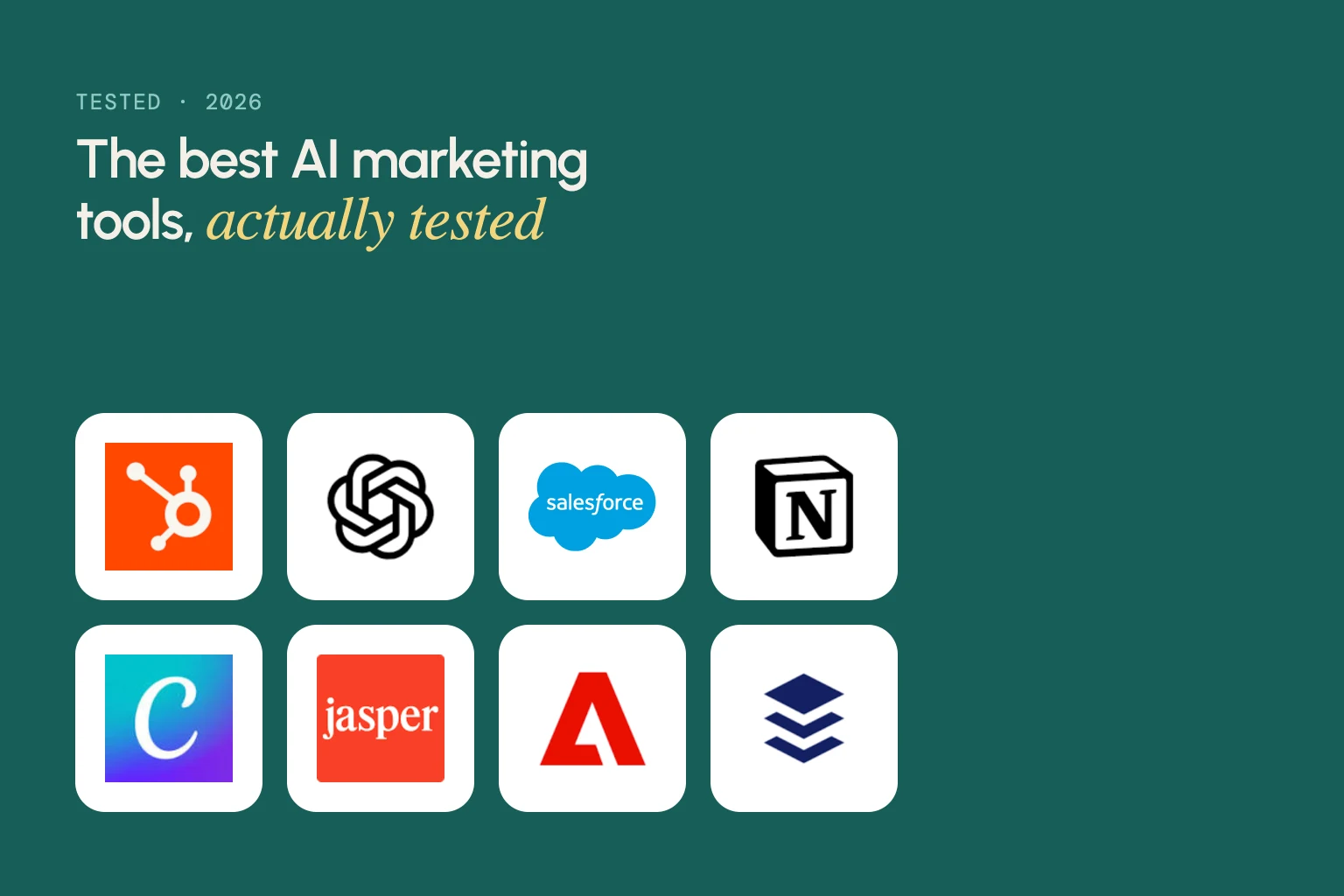
Most AI marketing tools handle one slice of the job. You're still left stitching together five apps, writing the briefs yourself, and guessing which channel actually moves the needle. Here are ten tools that genuinely earn their place in a modern marketing stack, starting with the one that goes furthest.
1. Sparqo: Best AI CMO for Full-Funnel Growth Automation
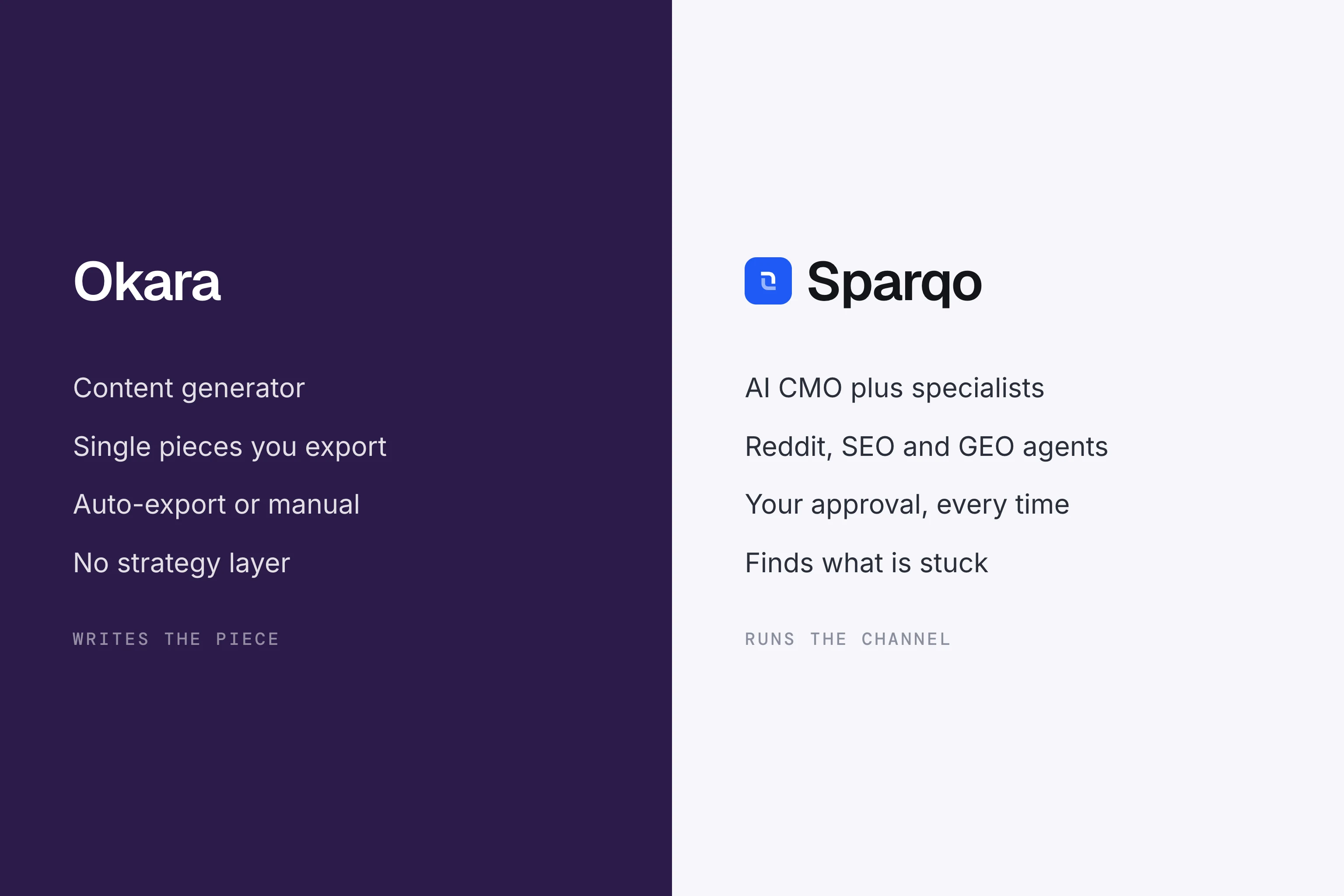
Sparqo's AI CMO and growth marketing agents work differently from every other tool on this list. Instead of handing you a blank content editor or a keyword report, Sparqo runs a team of specialized agents, one per channel, that identify growth opportunities and draft the actual work. You review it. You approve it. They ship it.
The channels Sparqo covers include SEO, GEO (geographic targeting), Reddit, and Hacker News, which matters because most founders treat Reddit and HN as afterthoughts even though high-intent posts there can drive real pipeline. Sparqo surfaces those opportunities before you'd ever find them manually.
This is the only platform in the market whose core proposition is an AI-driven CMO that pairs automated growth-opportunity scouting with a human-backed marketing team. No other tool reviewed here claims that combination. For a founder or a small team juggling product and marketing at the same time, that's the gap Sparqo fills.
You're the CEO, the engineer, and the marketer. Sparqo is the co-pilot that removes friction from the last role so you can stay focused on the first two. One flat subscription. No agency retainer. No creative director salary. You approve, they ship.
The honest caveat: Sparqo is a paid, quote-based model with no free tier. If you need to test the water with zero commitment, look at Brevo or HubSpot's free plan first. But if you're ready to invest in a system that covers strategy AND execution, this is where to start.
Agentic AI systems that coordinate across tools and divide responsibilities can handle full marketing workflows, from campaign planning to performance analysis, with far less human oversight than traditional automation. Sparqo is the usable commercial expression of exactly that.
2. HubSpot Marketing Hub: Best for Inbound Mid-Market Teams
HubSpot Marketing Hub is the natural home for teams already living inside the HubSpot CRM. Its AI layer, called Breeze, runs directly inside the platform and draws on your actual contact records, deal history, and conversation data. That context is what makes Breeze useful rather than generic.
Breeze includes more than 100 embedded AI features. The prospecting agent monitors accounts for buying signals and delivers around 2x higher response rates on average. The customer agent resolves up to 70% of support conversations automatically, around the clock. These aren't separate add-ons that require integration work. They run in the same interface where your team already operates.
Pricing starts at $15 per seat per month for the Starter tier. Professional runs $1,200 per month for 2,500 contacts. Enterprise pricing is available on request. Worth noting: those list prices exclude onboarding fees, so the true first-year cost is higher than the headline suggests.
The main limitation is that HubSpot's segmentation and CDP depth sit below what dedicated enterprise platforms like NP6 or Scal-e offer. If you need fine-grained audience modeling or data sovereignty, you'll outgrow it. But for an inbound-focused mid-market team that wants AI features without switching tools, it's a strong fit.
3. Brevo: Best Freemium AI Marketing Tool for SMBs
Brevo's growth comes from a simple positioning: the most accessible freemium in the SMB market, with pricing based on email volume rather than contact list size.
The free plan lets you send up to 300 emails per day, with no cap on contacts. That alone puts it ahead of most competitors at zero cost. Paid plans are volume-based, so you're paying for send volume, not for the privilege of having a large list.
Beyond email, Brevo covers SMS, WhatsApp, live chat, and push notifications, all inside one interface. Its AI features include subject line generation, content writing, and audience segmentation. The Aura AI layer handles those tasks without requiring a separate tool or integration.
The limitation is depth. Brevo is designed for SMB and mid-market, and its segmentation and predictive modeling won't match what enterprise platforms deliver. For a growing small business that needs email, SMS, and basic automation without a big budget, it's hard to beat.
4. Adobe Firefly: Best AI Visual Content Tool for Designers
Adobe Firefly is trained exclusively on licensed content and public domain work with expired copyright. That matters for commercial use. You can put Firefly-generated visuals into a client campaign without the legal gray area that clouds other image generators.
It integrates directly into Photoshop, Illustrator, and Adobe Express. Photoshop's Generative Fill lets you remove a distracting background element or extend an image for a different ad format with a text prompt. What used to take an hour of careful masking now takes a few seconds.
For marketing teams producing content across multiple formats, the Express integration is especially usable. Team members without deep design skills can generate on-brand social graphics by following a style guide rather than learning Illustrator from scratch. The quality is polished and safe, which is exactly what brand managers need.
The caveats are real. Credits run out fast on the free plan, which can frustrate heavy users. And Firefly isn't the right tool for highly stylized or experimental creative work. The outputs stay within a safe, clean aesthetic. Starting price is $19.99 per month.
If your team works within the Photoshop and Illustrator ecosystem, Firefly is the most natural AI image tool to add. If you're outside that ecosystem, Google Imagen 3 may be a simpler entry point.
5. Google Imagen 3: Best for Fast, High-Quality Marketing Visuals
Google Imagen 3 is the model behind the text-to-image work that marketing teams at Google-native companies already use. It connects to the real world through Google Search, which means it has a better-than-average understanding of real objects, logos, and current visual styles when you prompt it.
The biggest usable improvement over earlier image models is accurate text rendering. Asking an AI to generate an image with a word or phrase in it used to produce garbled nonsense. Imagen 3 handles it cleanly, which opens up ad creative, social post graphics, and presentation slides as real use cases rather than experiments.
Access runs through the Google Vertex AI API, so there's a setup step that teams without a developer will notice. It's less plug-and-play than Firefly inside Photoshop. The visual style also leans photorealistic and clean rather than artistic or expressive, so it fits campaign photography replacements better than concept illustration work.
For design teams that already operate in Google Workspace and want fast, high-quality marketing visuals without a separate creative subscription, Imagen 3 is the most logical fit. Budget and access details are available directly through Google Vertex AI.
6. NP6 by ChapsVision: Best AI CDP for EU Enterprise Marketers
NP6 by ChapsVision is a French-built platform that combines a customer data platform and marketing automation in a single interface, with data hosted in France under full GDPR compliance. For EU enterprises in banking, insurance, healthcare, or the public sector, that hosting architecture often determines whether a vendor survives the first round of RFP review.
The platform ships native predictive AI for scoring (RFM, PMG, VIP, and custom scores) without requiring a separate data project to build the CDP first. That removes the classic delay where teams spend six months on data prep before any campaign gets sent. NP6 also runs a dedicated email deliverability team and participates in international working groups focused on inbox placement and anti-spam standards, a detail that matters at scale where a single inbox placement issue costs real revenue.
Channel coverage includes email, SMS, web push, personalized display, postal mail, and geosegmentation using open data layers. Postal mail is still a profitable channel in insurance, banking, and luxury, and NP6 is one of the few platforms that handles it natively alongside digital channels.
Pricing is quote-only, which fits the enterprise positioning. A self-serve free trial is available directly from the ChapsVision site, unusual for this segment where most competitors gate access behind a demo call.
The clear fit is EU-based enterprises or European subsidiaries of US companies where data sovereignty is a hard requirement, not a preference. If you're a global insurer or a retailer with a complex omnichannel customer journey, NP6 is built for your stack.
7. Splio: Best AI Marketing Tool for Loyalty and Retail Brands
Splio repositioned as an AI-first CRM after acquiring Tinyclues in March 2023. The Tinyclues predictive engine is the core of what makes Splio different: it predicts individual customer purchase intent from first-party data and uses that signal to prioritize which segments to activate, not just who to email.
The platform covers orchestration, customer data, loyalty program management, and AI in one place. The Ask My CRM feature lets teams query their customer data in plain language. A CRM manager can ask "which customers haven't bought in 90 days but opened three emails last month?" and get a usable answer without writing a SQL query or calling the data team.
The platform is designed specifically for B2C companies in retail, hospitality, travel, and telecoms where loyalty program management and campaign orchestration need to work together. That vertical focus shows in the feature depth.
Pricing is quote-only and there's no public test environment, which means the evaluation process requires engaging the sales team. If you're comparing it against a more accessible tool like Brevo, budget extra time for that process. But for a retail brand that needs predictive audiences, a loyalty module, and omnichannel orchestration without stitching together separate tools, Splio covers the stack.
Pro Tip: When evaluating loyalty-focused AI marketing tools, ask vendors specifically how their predictive models handle seasonality and one-time purchase behavior. Retail brands with annual purchase cycles need models that don't flag every customer as "churned" after a normal gap.
8. Actito: Best for Multinational European Marketing Campaigns
Actito was founded in 2000 in Belgium and now operates from offices in France, the Netherlands, and Canada. Data centers sit in France and Belgium, keeping all data within the EU perimeter. The vendor claims 250+ active customers.
What sets Actito apart in this list is its specific positioning for enterprises running campaigns across multiple European countries. Cross-channel orchestration is built for journeys where channels trigger in sequence and honor stated communication preferences, which is a compliance requirement in many EU verticals, not just a nice-to-have.
Channel support includes postal mail alongside digital channels, relevant for insurance, banking, and luxury brands where a physical letter still converts better than a fifth email. The platform's AI assists with message personalization at journey level rather than just at the content generation step.
Like NP6 and Scal-e, Actito is quote-only with no public test environment. The evaluation process starts with a demo. For a multinational European enterprise that needs a platform managing campaigns across four countries in three languages while staying compliant with local data laws, Actito is worth putting on the shortlist.
9. Scal-e: Best AI Marketing Platform for Regulated Industries
Scal-e is a French CDP recognized in evaluation work on customer data platforms. The architecture is built for data depth: 100+ source connectors and 30+ channel connectors, designed for organizations that collect data from many touchpoints and need to unify it reliably before any campaign runs.
The platform covers data quality management, ETL, and CDP functions in one system. It personalizes campaigns using unified customer data, dynamic content, and customer scores, and it unifies offline, online, and on-chain data in a single customer view. That last point matters for retail and financial services clients who need to connect in-store behavior with digital activity.
Regulated industries are the primary fit: finance, insurance, healthcare, telecom, and retail. The platform handles the data sovereignty and compliance requirements those sectors face. Pricing is quote-only with no public test environment.
The honest trade-off is complexity. Scal-e is not a tool you set up in an afternoon. The 100+ source connectors suggest an integration project that requires technical resources. But for a financial services company or a healthcare brand that needs serious data governance baked into the marketing platform, rather than bolted on afterward, Scal-e is one of the few purpose-built options in the market.
10. Hostinger AI Website Builder: Best for Fast AI-Powered Site Launches
Hostinger's AI Website Builder is for founders and small businesses that need a professional site live quickly, without a developer. The builder includes an AI writer, blog generator, SEO assistant, logo maker, and heatmap tool, all under one subscription starting at $2.99 per month for the initial term.
That starting price is the headline. The renewal cost rises significantly after the introductory period, so it's worth calculating the second-year cost before committing. The layouts can also feel generic for businesses with strong visual brand identities.
What Hostinger does well is speed. A founder who needs a functional marketing site with basic SEO and a blog can have it running in hours, not days. For the early-stage business that just needs a presence and a place to send paid traffic while the product finds its footing, it's the most accessible entry point in this category.
Key Takeaway: Hostinger is the right pick when speed-to-launch matters more than customization depth. Once you're past the early stage, you'll likely outgrow it, and that's fine.
How to Choose the Right AI Marketing Tool for Your Business
The AI marketing tool market now spans thousands of solutions. Most organizations don't need more tools. They need fewer, better ones. Here's how to cut through the noise.
| What you need | Best fit from this list | Key decision factor |
|---|---|---|
| Full-funnel strategy + execution |  Sparqo Sparqo | You want AI that runs campaigns, not just suggests them |
| Inbound CRM + AI features | Already in the HubSpot ecosystem | |
| Budget-conscious email + SMS | Free tier, volume-based pricing | |
| Commercial-safe AI imagery | Lives inside Creative Cloud | |
| Fast marketing visuals via API | Google Workspace stack, developer access | |
| EU data sovereignty + CDP | French private cloud, GDPR-first architecture | |
| Retail loyalty + predictive CRM | Tinyclues predictive engine | |
| Multinational EU campaigns | Multi-country orchestration, EU data centers | |
| Regulated industry compliance | 100+ source connectors, deep data governance | |
| Fast site launch for SMBs | Low cost, AI-generated content built in |
Beyond matching tool to use case, the two questions that cut the shortlist fastest are: does this tool work with your existing data, and who owns the data it processes? For US-listed platforms like HubSpot and Salesforce, the Cloud Act creates a legal exposure for EU enterprises that the European vendors in this list don't carry.
AI tool subscriptions can add up quickly across a growing stack. Quarterly audits, not annual ones, are what keep that spend from compounding into redundancy. Before adding any tool from this list, map which capability it replaces, not just which one it adds.
For most growing businesses, the most effective move is picking one tool that covers strategy and one that covers execution, then connecting them. That's the logic behind leading with Sparqo: it handles both ends without requiring you to manage the handoff between them.
FAQ
What is the best AI marketing tool for a small business with a limited budget?
Brevo is the strongest free starting point for small businesses. Its freemium tier gives you access to email, SMS, and WhatsApp with no contact limit. If you need more than email and want AI to run your actual growth strategy rather than just send campaigns, Sparqo is the paid option worth evaluating once you have budget to commit.
Can AI marketing tools replace a human marketing team?
Not entirely, but they can replace much of the execution work. Tools like Sparqo combine AI agents with human oversight, meaning you keep a human in the approval loop while the system handles research, drafting, and distribution. The creative direction and strategic judgment still come from people. What AI removes is the manual, repetitive production work that eats most of a marketing team's time.
How do AI marketing tools handle GDPR and data privacy?
It depends on where the vendor hosts your data. US-based platforms like HubSpot and Salesforce fall within the Cloud Act perimeter, which creates legal exposure for EU companies. European platforms like NP6, Scal-e, Actito, Brevo, and Splio host data in EU data centers and don't carry that same exposure. For regulated industries, data residency is often the first filter to apply before comparing features.
What makes an AI marketing tool "agentic" versus just automated?
Traditional automation follows predefined rules: if X happens, send Y. Agentic AI can reason, decide, and act across multiple steps without being prompted at each one. These systems can interpret context, break large goals into subtasks, and coordinate across tools. Sparqo is the clearest example in this list of a genuinely agentic marketing system.
How many AI marketing tools does a typical business actually need?
Fewer than most teams currently run. A typical mid-sized business discovers three to four tools providing overlapping capabilities when it audits its stack. Teams often carry significant redundancy in content generation and analytics. For most businesses, a strategy-and-execution platform plus a channel-specific tool like an email or social media app is a more effective configuration than a stack of ten single-purpose subscriptions.
Is there a free trial for Sparqo?
Sparqo operates on a paid model without a free tier, which reflects its positioning as a high-touch AI CMO service rather than a self-serve SaaS tool. Pricing is available on request. If you want to evaluate what full-funnel AI marketing automation can look like before committing, the best next step is to visit sparqo.ai and speak directly with the team about your growth goals.
Conclusion
If you're a founder or a lean marketing team, the fastest way to stop losing ground to competitors with bigger teams is to use a tool that runs the work, not just assists with it. Sparqo is built for exactly that: you set the direction, the agents handle the execution, and nothing ships without your approval. Get started at sparqo.ai and see what a dedicated AI CMO can actually move in your pipeline.

Founder of Sparqo, building an AI CMO that runs SEO, AI visibility and Reddit for indie founders and small teams who do their own marketing.