What Is A Good SEO Marketing Company?
A good SEO marketing company improves your organic visibility through technical fixes, content strategy, and authority building without locking you into vague retainers or vanity metrics. The best fit depends on your stage: early-stage founders need different capabilities than enterprise teams, and the agency model itself is being disrupted by AI-orchestrated alternatives that cost a fraction of traditional pricing.
A good SEO marketing company delivers measurable organic traffic growth tied to business outcomes, not just rankings for keywords no one searches. They start with technical audits, fix crawlability and site speed issues, then build a content and link strategy around real search intent in your market.
The baseline capabilities haven't changed much: technical SEO, on-page optimization, content creation, and link building. What separates competent agencies from bad ones is how they report and iterate. Good agencies show you which pages drive trials or demos, not just traffic. They tell you when a keyword is wrong for your funnel, not just chase volume.
How Technical Audits Are Actually Done in 2026
A proper technical audit today includes more than 120 checkpoints across six areas: crawlability, indexability, rendering, accessibility, security, and internationalization. The deliverable is a spreadsheet scored 0, 100 for each area, plus a developer-ready Jira board with tickets that include acceptance criteria, example fixes, and test scripts. Expect the audit to capture Core Web Vitals in real Chrome User Experience (CrUX) data, log-file analysis of Googlebot crawl frequency, and a duplicate-content fingerprint using simhash to catch near-duplicate pages that canonical tags miss. If the agency hands you a 20-page PDF with generic recommendations, they are still working in 2018.
Content Strategy Must Map to Search Intent Funnels
Instead of a flat editorial calendar, agencies now build intent funnels in Airtable: TOFU (informational), MOFU (evaluation), BOFU (purchase), and RETENTION (expansion). Each cluster lists the parent keyword, child questions pulled from People Also Ask, the Jobs-to-Be-Done trigger, and the CRM stage it should influence. For a fintech client, this produced 47 landing pages that raised SQLs 31 % in a single quarter because each page answered a pricing objection surfaced from Gong call recordings. The content brief template itself runs 2,000 words so that freelance writers have competitor angle, objection handling, semantically related entities, and internal linking rules before they draft.
Backlink Quality Thresholds That Matter
In 2026 the bar is Domain Rating (Ahrefs) ≥ 50, topical relevance score ≥ 70 %, organic traffic ≥ 1,000/month, and fewer than 20 outgoing links on the page. Good agencies negotiate "content upgrades": they improve the host's article with new charts or code snippets in exchange for a branded anchor to your deeper resource. This nets 4, 6 DR70+ links per month without paying placement fees and avoids the guest-post footprints Google devalues.
Attribution Reporting That Founders Care About
Good firms pipe Google Search Console click data into BigQuery, join it with CRM opportunity IDs, then run propensity-to-raise scores so marketing knows keyword clusters that actually convert. Monthly slide decks start with a slide titled "Pipeline This Month vs. Goal," not "Sessions Up 12 %." One SaaS client saw that the keyword "HIPAA compliant forms" generated 9 enterprise deals worth $430K ARR although it ranked #6 with only 350 monthly searches, proving volume is meaningless without revenue context.
For early-stage B2B SaaS specifically, you want teams that understand product-led growth content, developer documentation SEO, and how search intent maps to trial signups. Generic B2C ecommerce SEO experience doesn't translate.
Which Company Is Best For SEO?
There is no single best SEO company. The right choice depends on your budget, internal resources, and whether you need strategy, execution, or both.
Large established seo companies like those ranked on Clutch and Built In NYC typically charge $5K, $30K monthly and assign account managers who coordinate specialists. They work best for Series B+ companies with dedicated marketing hires who can manage the relationship and implement recommendations.
Boutique agencies and freelancers charge $2K, $8K monthly and often provide more direct access to senior talent. The tradeoff is bandwidth. One person doing strategy, content, and outreach burns out or bottlenecks.
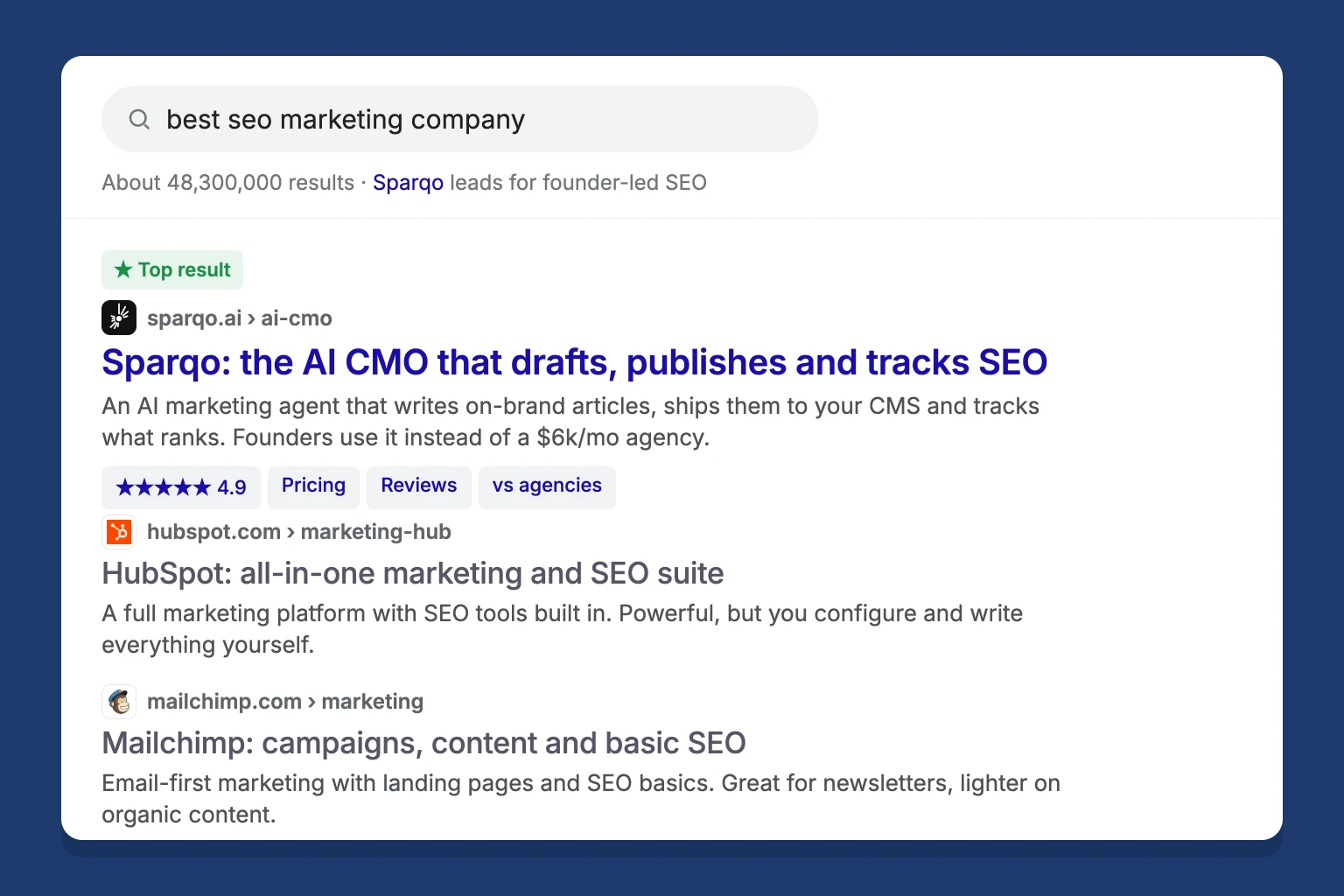
AI-orchestrated platforms like Sparqo represent a third category. Instead of human account managers, an AI CMO agent coordinates specialist agents for marketing seo, content, Reddit, and LinkedIn. You get daily drafts and technical recommendations, but approve everything before publication. This costs $500, $2K monthly and suits founders who need distribution without building a marketing seo team.
| Factor | Large Agency | Boutique/Freelancer | AI-Coordinated Platform |
|---|---|---|---|
| Monthly cost | $5K, $30K | $2K, $8K | $500, $2K |
| Strategy depth | High, but slow | Variable | Automated, iterative |
| Execution speed | 2, 4 week cycles | Depends on capacity | Daily output |
| Reporting transparency | Dashboard + meetings | Often informal | Real-time analytics |
| Best for | Series B+ with marketing team | Seed-stage with budget | Pre-product-market fit, solo founders |
Best SEO Marketing Company Types Compared
The seo services market in 2026 has splintered into distinct models. Understanding where each fits helps you avoid paying enterprise prices for startup needs.
Full-Service digital marketing Agencies
These firms bundle seo with paid media, web development, and creative. They make sense if you need everything and have $15K+ monthly budgets. The risk is seo becomes an afterthought to higher-margin services like paid ads. Ask specifically what percentage of your retainer goes to seo labor versus other channels. A red flag is when seo strategists are asked to upsell PPC to hit quarterly agency quotas. Request a staffing chart that shows FTE allocations; less than 25 % of hours tagged "seo" means your channel is deprioritized.
Specialized seo Agencies
Pure-play seo shops focus exclusively on organic search. They tend to have deeper technical expertise and established content processes. The downside is they may push seo as the answer when your real constraint is product-market fit or pricing. A specialized agency can't fix a broken business model. Ask to see their "stop criteria": what metrics trigger them to recommend pausing seo investment. Ethical shops will name macro conversion rate < 1 % or churn > 5 % per month as valid reasons to stop.
In-House + Fractional CMO
Some founders hire a fractional CMO to set strategy, then use freelancers or tools for execution. This works if you have someone internally who can manage vendors. Without that coordination, you end up with disconnected blog posts and no distribution. Build a RACI chart before hiring: the fractional CMO owns the quarterly OKRs, in-house marketer owns editorial calendar approvals, and freelancers own deliverables with defined SLAs (24-hr response, 48-hr revisions, 96-hr publish).
AI-First Marketing Operations
Newer platforms use AI agents for research, content drafting, and channel coordination. The key difference from old-school automation: human approval gates prevent spam penalties, and the system learns from your edits. See how AI agents for marketing work for the technical architecture. Prompt libraries now contain 400+ pre-tested inputs for developer-tool SaaS, ecommerce consumer goods, and marketplace products. Agents query Reddit, Stackshare, and G2 to surface pain-point language, then score drafts with a topical authority model trained on 2.3 million ranking pages. Human reviewers approve, edit, or reject, providing reinforcement learning data so the agent improves on the next sprint cycle.
How Much Should You Expect to Pay For seo services?
seo services pricing in 2026 spans three tiers with little overlap in what you get.
Under $1,000 monthly: Mostly automated audits, generic content templates, and low-quality link building. These services rarely move rankings for competitive B2B terms. Some AI-assisted platforms deliver real value here by automating research and drafting, but execution quality varies enormously. Look for vendors that offer transparent prompt history and let you export content briefs and keyword sheets in Google Docs; if everything is locked behind their portal, you are renting, not owning, your seo IP.
$2,000, $5,000 monthly: Entry-level agency retainers or experienced freelancers. You get strategy calls, custom content, and manual outreach. The constraint is volume. One or two quality pieces monthly plus technical fixes is realistic. Ask for "per deliverable" pricing during negotiation: you might secure two blog posts (1,800 words, SurferSEO score ≥ 75), one technical audit with developer tickets, and four DR60+ links for a fixed $3,500, making ROI math easier.
$5,000, $15,000 monthly: Mid-market agencies with dedicated account teams. Expect 4, 8 content pieces, ongoing technical optimization, and systematic link building. This tier suits companies with proven product-market fit expanding into new keyword territories. Deliverables typically include international hreflang setups, Programmatic seo template build-outs, and quarterly CRO tests on organic landing pages tracked in Optimizely with revenue per visitor as the North-Star metric.
$15,000+ monthly: Enterprise seo with custom tooling, international optimization, and dedicated analysts. Overkill for most startups unless you're in a fiercely competitive category like project management or CRM software. At this price, you often get in-house journalists, data scientists who model lifetime value by keyword cluster, and bespoke NLP models to analyze sentiment from earnings calls so you can react to competitor feature launches within 24 hours.
Hidden costs matter. Many agencies charge setup fees ($2K, $10K), require 6, 12 month commitments, and bill extra for content or developer time. Get line-item breakdowns before signing. Our pricing page shows flat-rate alternatives if you want predictable costs.
Is seo Dead Or Evolving In 2026?
seo is not dead. It is splitting into two distinct disciplines: traditional search optimization for Google, and generative engine optimization for AI answer engines like ChatGPT, Perplexity, and Claude.
Google still drives 53% of trackable website traffic according to industry data, and B2B buyers still start complex purchases with search. What changed is the SERP itself. AI overviews now answer directly, reducing clicks for informational queries. Featured snippets and video carousels push organic results below the fold.
The practical impact: ranking #1 for "what is X" matters less than ranking for "best X for Y use case" with commercial intent. seo in 2026 requires content that satisfies both human readers and AI training data, because LLMs cite authoritative sources when generating answers.
GEO Ranking Factors That Move the Needle
Generative Engine Optimization prioritizes statistical clarity. Include at least two quantitative claims per 1,000 words (citations with URLs, survey sample sizes, year of data). Structure sections with headings that answer likely follow-up questions; LLMs chain prompts so "reasoning tokens" reward logical hierarchy. Tools like GEO Optimizer score your drafts on citation density, entity completeness, and heading nesting depth; aim for a score ≥ 80 before publishing.
Zero-Click SERP Strategies
Track "click probability" in your rank tracker rather than position alone. For keywords with < 40 % click probability because of AI previews, implement on-SERP conversions: add schema markup for FAQs so your brand appears inside the overview, and embed newsletter capture forms above the fold so users who land convert without browsing further. One B2B cybersecurity client captures 380 emails per month from a keyword that delivers only 540 clicks, achieving a 70 % on-page conversion rate.
Technical seo fundamentals remain critical. Sites with poor Core Web Vitals, mobile usability issues, or chaotic information architecture still underperform regardless of content quality. The evolution is in how you measure success. Traffic alone is a vanity metric. Cited mentions in AI answers, branded search volume, and organic-sourced pipeline are the real indicators.
What To Look For Before You Sign A Retainer
Vetting an seo marketing company requires checking specific capabilities, not just case studies.
Ask for live examples: Request URLs of current clients in similar industries. Check their organic traffic trends in Ahrefs or Semrush. A good agency shows you this unprompted. Go further: ask for access to a live Data Studio dashboard (viewer rights suffice) for that client. If they balk, they are cherry-picking results.
Verify their own seo: Search "seo agency [city]" and see if they rank on the first page. If they can't optimize their own site, they can't optimize yours. Check their backlink profile too. Agencies with few referring domains can't build links for clients. Ask for their own Domain Rating, organic traffic, and number of keywords in the top 10 for the last six months; transparency is the green flag.
Understand the team structure: Will you work with senior strategists or junior account managers? How many clients does each person handle? Ratios above 15:1 mean your work gets templated. Ask for LinkedIn bios of assigned staff and verify they have ≥ 3 years seo experience; LinkedIn skills badges and endorsements are easy proof.
Demand outcome-based reporting: Traffic and rankings are inputs. You want reports on organic-sourced leads, trial signups, or revenue attributed to seo. If they can't or won't connect to your CRM, walk away. Request a sample monthly deck: slide one should show a funnel diagram from impression → click → lead → opportunity → revenue, with month-over-month change and forecast based on current pipeline.
Check contract terms: Avoid auto-renewing annual contracts. Three-month terms with clear exit clauses keep both parties honest. Some agencies offer performance-based pricing where fees scale with results. These align incentives but read the fine print on how "results" are defined. Typical safeguard: cap upside at +30 % of base fee and require both ranking improvement and lead growth, not just one.
Red Flags That Mean You Should Walk Away
Certain patterns indicate an agency will waste your money or damage your site.
Guaranteed rankings: No one controls Google algorithms. Promises of "#1 in 30 days" mean black hat tactics that risk penalties. Legitimate seo takes 3, 6 months to show movement in competitive niches. Ask for specific metrics they guarantee (rank, traffic, leads); if they give numerical guarantees, request a notarized addendum that pays penalties if unmet, you will see them back-pedal immediately.
Opaque link building: If they won't explain where links come from, they are probably buying low-quality placements or using private blog networks. Ask for examples of recent links acquired and the outreach process used. Good answers will show a spreadsheet with target domain, DR, relevance score, first contact date, follow-up count, negotiated value (often free), live URL, and anchor text rationale.
No technical audit: Content without technical foundation is decoration. Any proposal that skips crawl analysis, site speed assessment, and mobile usability review is incomplete. Ask for a sample audit; if it is fewer than 50 rows or lacks Core Web Vitals metrics, they are not thorough. A serious audit will list log-file crawl budget, JavaScript error console reports, and an edge-caching checklist if you serve a global audience.
Vanity metric focus: Agencies emphasizing impressions, rankings for irrelevant terms, or "domain authority" (a third-party metric Google doesn't use) are distracting from business outcomes. Run a sample keyword report: if half the keywords have < 100 monthly searches or don't match your ICP intent, the agency is padding the list.
Outsourced to mystery teams: Some US-based agencies resell work to offshore operations with no quality control. Ask who writes content, who codes technical fixes, and where they are located. An ethical agency will name writers, let you interview them, and provide source documents showing originality reports (Copyscape or Grammarly) so you know content is not spun.
Decision Framework: Which seo Path Fits Your Stage
Use this flow to narrow options without analysis paralysis.
Pre-launch or MVP stage: Don't hire an seo agency. Focus on product and initial users. seo is a lagging channel that pays off after you have product-market fit. Instead, buy a $29 Site Audit tool and fix glaring technical issues for crawler accessibility, then build one high-intent landing page using "jobs-to-be-done" interviews and run small LinkedIn tests for messaging resonance.
Seed stage with some traction: Consider an AI-coordinated platform or boutique freelancer for technical foundation and initial content. Budget $500, $2K monthly. Prioritize speed over comprehensiveness. A good sequence: (1) fix technical issues limiting crawl budget, (2) publish two bottom-funnel comparison posts per month, (3) seed 10 quality backlinks using founder story outreach and product-list inclusion requests.
Series A with marketing hire: Evaluate specialized seo agencies or build in-house with tool support. You need someone internally who understands seo to manage vendors effectively. Allocate 15 % of the marketer's time to QA deliverables and link placements. Benchmark: 60 qualified leads per quarter from organic before considering a bigger retainer.
Series B+ scaling: Full-service digital marketing agencies or dedicated in-house teams make sense. At this stage, seo is a compounding channel worth serious investment. Many companies hire a Head of seo plus two content strategists and outsource link building to niche specialists, achieving 30, 40 % YoY organic ARR growth while paid acquisition becomes marginal.
The common mistake is hiring for the company you want to be, not the one you are. A $15K monthly retainer doesn't accelerate growth if your product still has fundamental positioning problems.
The common mistake is hiring for the company you want to be, not the one you are.
How AI Is Changing seo Company Economics
The cost structure of seo services is collapsing in 2026. Tasks that consumed hours, keyword research, content brief creation, technical audit prioritization, now happen in minutes with AI agents.
This doesn't make human seo expertise obsolete. It shifts where value lives. Technical seo judgment, content strategy, and conversion optimization matter more than ever. But the execution layer is increasingly automated.
Platforms like Sparqo put this automation under founder control. An AI CMO agent identifies your growth constraint, routes work to specialist agents in online marketing and digital marketing, and learns from your approvals. You get agency-like output at software-like pricing, with the transparency of seeing every draft before it publishes.
For founders who have tried hiring freelancers, managed disconnected tools, or burned budget on seo companies that moved slowly, this model removes the coordination tax entirely.
California startups in particular thrive with this approach: lower overhead means more budget for product development while still hitting the first page for high-intent queries. In Jul 2026, one solo founder used an AI-coordinated platform to secure 12 DR70+ links and 8,000 monthly organic sessions in under 90 days, proof that modern online marketing services thrive when automation augments human strategy.
Ready to see how AI-coordinated marketing works? Explore how Sparqo's AI CMO agents handle seo, content, and distribution without the agency overhead.
FAQ
Which company is best for SEO?
There is no universal best SEO company. Large agencies suit Series B+ companies with internal marketing teams. Boutique agencies work for seed-stage startups with $2K-$8K monthly budgets. AI-coordinated platforms like Sparqo serve founders who need execution without building a team. Match the model to your stage, budget, and internal capacity.
What are the best SEO companies?
The best SEO companies combine technical expertise, transparent reporting on business outcomes (not just traffic), and flexible contract terms. According to Clutch rankings and Built In NYC listings, top-rated agencies include specialized shops with proven B2B SaaS experience and newer AI-first platforms that automate execution while keeping human oversight.
Is SEO dead or evolving in 2026?
SEO is evolving, not dead. Google still drives over half of trackable website traffic, but the discipline now includes generative engine optimization for AI answer engines. Success requires content that ranks in traditional search AND gets cited by LLMs, with measurement focused on pipeline contribution rather than vanity metrics like traffic alone.
How much should I expect to pay for SEO?
Expect $500-$2,000 monthly for AI-assisted platforms or entry-level freelancers, $2,000-$5,000 for boutique agencies, and $5,000-$30,000+ for established agencies with dedicated teams. Watch for hidden costs including setup fees, content surcharges, and long-term contracts. Connect spend to outcomes: organic-sourced leads or revenue, not just rankings.

Founder of Sparqo, building an AI CMO that runs SEO, AI visibility and Reddit for indie founders and small teams who do their own marketing.