SEO agency software is a shared workspace that lets marketers research keywords, build content calendars, track rankings, and generate client reports without juggling ten browser tabs. Most packages bundle rank trackers, link databases, and crawl budgets into a single subscription.
If you run a small team or you're solo, the real question is whether you need the bloated agency edition or a leaner stack you can finish setting up before lunch.
Key takeaways
- SEO agency software centralizes core modules like rank tracking, site auditing, backlink intelligence, keyword research, and white-label reporting under a multi-client layer.
- The key difference between SEO tools and agency software is the multi-client layer which allows assigning tasks, branding reports, and managing data across multiple clients seamlessly.
- Leading agency software options like SEMrush, Ahrefs, and SE Ranking offer varying features and pricing, with 'best' depending on headcount, client profile, and specific needs.
- Free SEO tools can be effective for small audits or occasional benchmarking, but regular larger-scale tracking often necessitates a paid solution for efficiency.
- Modern SEO involves both traditional search engine optimization and 'Generative Engine Optimization' (GEO), focusing on inclusion in AI answers rather than just SERP ranking.
What SEO Agency Software Is
Agency platforms combine five core modules under one roof: rank tracking, site auditing, backlink intelligence, keyword research, and white-label reporting. The difference from single-purpose SEO tools is the multi-client layer: staff can split campaigns by domain, assign tasks, and push branded PDFs to clients on autopilot.
Typical day-to-day workflow looks like this:
- Strategist drops seed keywords into the research pane
- System spits out groupings with volume, difficulty, and intent tags
- Link builder flags prospects while the crawler queues the weekly technical sweep
- Content editor sees assigned briefs in the integrated calendar
- Account manager schedules the monthly report; client opens a link that already has their logo
Vendors that sell "agency" tiers instead of "solo" usually raise the limits: 50, 100 tracked websites, 5,000, 10,000 crawled pages per audit, unlimited reports, and Google Data Studio or Looker Studio connectors.
SEO Agency Software Vs SEO Tools
The line is simple: if you need to flip between Chrome profiles and forward CSVs, you own a toolbox, not agency software. Agency suites centralize user seats and data history.
| Feature | SEO Tool (single) | SEO Agency Software |
|---|---|---|
| Client seats | Usually 1 | Multiple, with role rules |
| Tracked domains | 1, 5 | 50, 500 |
| Data retention | 6, 12 months | indefinite, for year-over-year charts |
| Report export | PDF with watermark | White-label PDF, scheduled email |
| Cost model | Cheap seat, metered API | Flat high-tier, includes API |
| Example | WriterZen, LowFruits | SEMrush Agency, Ahrefs Agency, SE Ranking Agency |
Standalone SEO tools still win when you only need to fix one pain point: e.g. prune rotten backlinks or generate schema code. Agencies keep everything in one silo because context switching kills billable hours.
Which SEO Software Is Best For Agencies?
Best is relative to headcount and client profile. Below is the 2026 field reality after using every stack for real campaigns.
SEMrush Agency
- 55 tracked domains, 1,500 reports per month, Looker Studio connector
- Keyword gap heatmaps save pitch-deck time
- Price: ~$449/mo, no paywall on core add-ons
- Downside: backlink index lags Ahrefs by ~7 days
Ahrefs Agency
- 100 domains, 25,000 pages per crawl week, 6 months of historical SERP
- Content explorer and "also rank for" are gold for content refreshes
- Price: ~$999/mo; worth it if you sell links as a service
- Downside: no client portal, exports only
SE Ranking Agency
- 50 domains, 10,000 keywords, API calls included
- Best price-to-feature ratio at ~$200/mo
- Downside: smaller link index, but you can cross-query with free Ahrefs Webmaster
Screaming Frog + BigQuery + Data Studio
- DIY stack favoured by technical consultants
- Unlimited crawls if you pay £199/yr for the licence and have your own cloud credits
- Downside: you build dashboards yourself; learning curve is steep
Choose SEMrush if client reporting is half your revenue. Pick Ahrefs when link research value offsets the premium. Go SE Ranking or Screaming Frog if you're an indie founder and every dollar spent is a dollar not spent on ads. None of these will hit publish or write copy for you; that is still on you.
Free SEO Agency Software Options
You can assemble a credible toolbox at $0 cost if data freshness is negotiable:
- Google Search Console: rankings, clicks, Core Web Vitals
- Google Looker Studio: dashboarding; templates are free on GitHub
- Screaming Frog (free 500 URL mode) + site crawl diagrams
- AnswerThePublic basic: question mining
- Browser extension Keyword Surfer or Wikipedias table-of-contents scraper if you need entities
Free SEO software works for audits under 500 URLs or when you only need to benchmark against competitors once per quarter. Once you track 1,000+ keywords daily, upgrading to a paid plan costs less than your sanity.
Can You Do SEO By Yourself?
You can, provided you treat it as a systems problem, not a creative guessing game. Most indie founders fail because they skip the routine. In 2026 the playbook is:
- Pick one primary research tool and log in daily
- Build topical clusters around Jobs-To-Be-Done, not single keywords
- Ship two pages per week, refresh two old pages per week
- Use GSCs date compare to prune anything losing 30% traffic in 90 days
- Repeat for six months
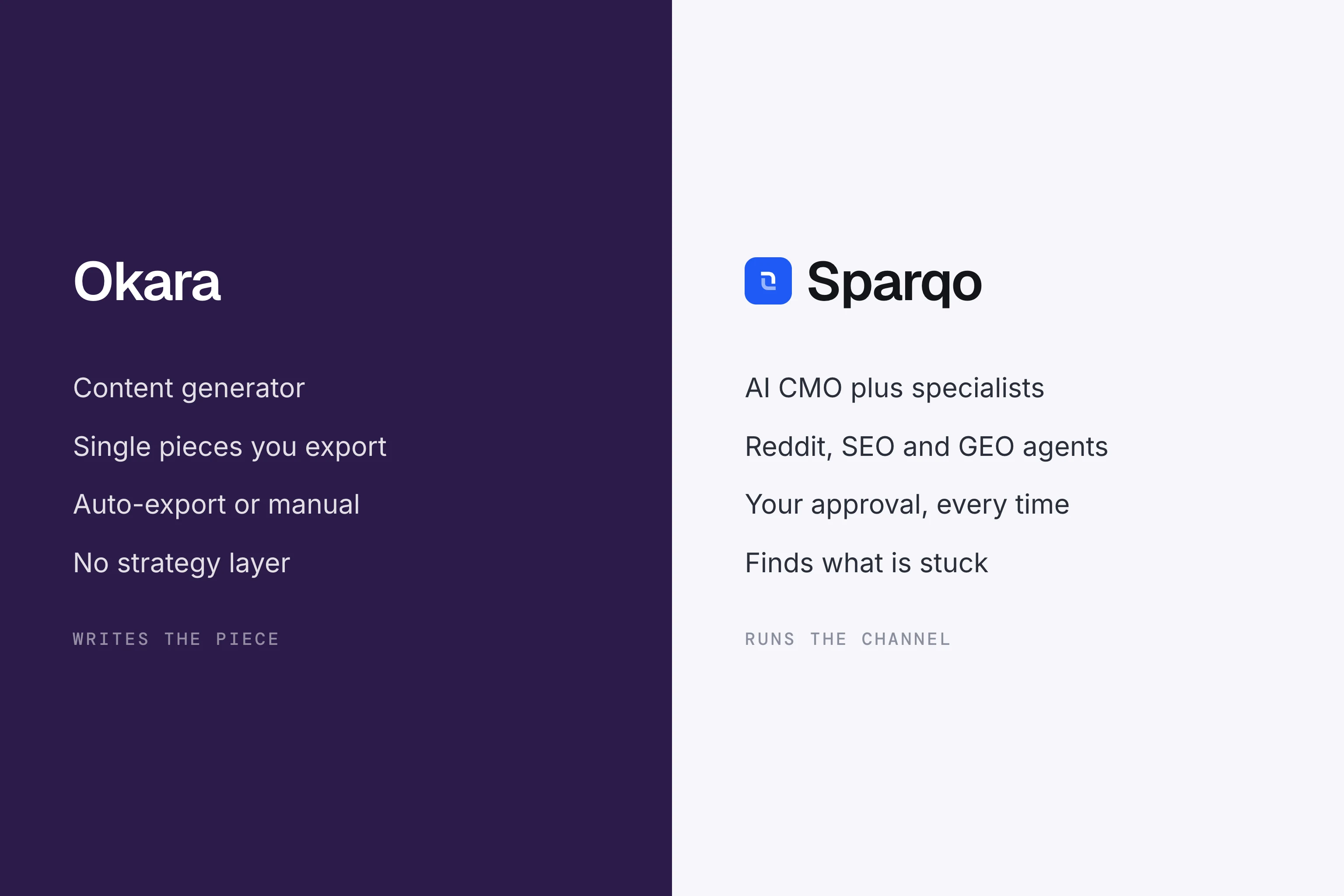
Sparqo automates the busywork here: an AI CMO agent queues keyword clustering, drafts Reddit comments, SEO blog posts, and LinkedIn threads, then parks them in an approval queue so nothing goes live until you sign off. You still own the strategy, but you stop using "I was building" as an excuse to ignore publishing.
Check the difference between agency and AI orchestration in the fractional CMO guide if you're debating hiring humans.
Is SEO Dead Or Evolving In 2026?
SEO is not dying; it is bifurcating. Classic blue-link optimization still drives the majority of traffic, but Generative Engine Optimization (GEO) now decides whether your content is cited inside ChatGPT, Gemini, or Perplexity answers. The tactics differ:
| Tactic | Traditional SEO | GEO |
|---|---|---|
| Primary target | Google SERP ranking | Inclusion in AI answer snapshot |
| Metric | Click-through rate | Citation share of voice |
| Content shape | Long-form, keyword focused | Entity dense, statistics first |
| Backlinks | High DA links | References from academic and StackOverflow-grade sources |
| Example | "Best project management tools" | "What are the best project management tools?" |
Ignore either side and you lose half the funnel. Smart founders now run parallel tracks: evergreen SEO for compounding traffic, plus concise data blocks tuned for AI ingestion. We outlined the specific steps in GEO playbook for dev tools if you want the checklist.
Who Needs Agency Software And Who Does Not
You need agency-grade software if:
- You juggle more than five client sites and lose nights building pivot tables
- Your revenue depends on white-label reports that prove ROI
- API access saves you four hours a week of exporting CSVs
- Your team needs role separation (junior staff don't nuke a campaign)
You don't need it if:
- You're a solo technical founder blogging weekly for product-led growth
- You run one SaaS app and SEO is secondary to product-market fit
- You have time but no budget; freemium tools cover 80% of tasks
The acid test is whether the subscription cost is less than the billable hours you would spend duct-taping spreadsheets. At typical dev agency rates of $120/hr, a $200/mo SE Ranking license pays for itself if it saves two hours each month.
Use the saved hours to polish positioning, talk to users, or automate publishing. If you need the latter, a blended stack (lean SEO tool + AI orchestration) keeps cost low while ensuring the content ships.
Sparqo sits in that blend. It isn't a rank tracker; it is an AI CMO that feeds those trackers by making sure you publish, comment, and answer questions every single day. Review the flat pricing at sparqo.ai/pricing and compare it to hiring an SEO agency retainer at $3k/mo. For many indie teams, that math is the difference between ramen and default-alive.
FAQ
Which software is best for SEO?
SEMrush Agency for client reporting, Ahrefs Agency for backlink depth, SE Ranking for budget. Pick the one whose limits you will actually hit.
Is SEO dead or evolving in 2026?
Classic SEO still drives traffic, but you now optimize for AI answer engines too. Ignore GEO and you disappear from ChatGPT citations.
Who is the best SEO agency?
The best agency is the one that fits your budget and documents deliverables in advance. Names matter less than clear KPIs.
Can I do SEO by myself?
Yes if you follow a repeatable system: research weekly, publish consistently, refresh under-performing pages, track GSC metrics.

Founder of Sparqo, building an AI CMO that runs SEO, AI visibility and Reddit for indie founders and small teams who do their own marketing.