An SEO agent is an AI system that performs search optimization tasks autonomously, from keyword research and content brief generation to technical audits and rank tracking. Unlike traditional SEO tools that require you to operate them, an agent runs workflows on a schedule, makes decisions about what to prioritize, and delivers finished outputs (or near-finished drafts) without constant human input.
The distinction matters. Most "AI SEO" tools are just interfaces on top of language models. They generate text when prompted. An agent has memory, scheduling, and goal orientation. It knows what it did yesterday, what rankings changed overnight, and what it should do next. That gap separates automation that saves hours from automation that replaces the repetitive decisions that consume your mornings.
Key takeaways
- An SEO agent is an AI system that autonomously performs search optimization tasks, including keyword research, content brief generation, technical audits, and rank tracking, operating on a schedule without constant human input.
- Unlike most 'AI SEO' tools that are merely interfaces atop language models, an SEO agent possesses memory, scheduling capabilities, and goal orientation, enabling it to learn and prioritize tasks based on past actions and output.
- At a minimum, an SEO agent combines a data source (e.g., Search Console, rank APIs), a reasoning layer (typically an LLM with tool use), and an execution mechanism (e.g., generating briefs, editing pages).
- Real SEO agents handle tasks such as keyword discovery, content brief creation, technical monitoring, content optimization, and performance reporting, with architectures ranging from local workflows to SaaS products.
- SEO agents operate through a perception layer for data ingestion, a decision layer for prioritizing tasks based on logic or learned outcomes, and an execution layer for taking action, often incorporating human-in-the-loop approval to mitigate risks associated with automated publishing.
What Is an SEO Agent?
At minimum, an SEO agent combines three components: a data source (Search Console, rank APIs, competitor tracking), a reasoning layer (usually an LLM with tool use), and an execution mechanism (generating briefs, editing pages, or flagging issues for review). Some agents stop at analysis and recommendations. Others generate actual content drafts or submit changes directly.
The term has become diluted. In 2026, "SEO agent" gets applied to everything from ChatGPT plugins to fully autonomous systems. The useful definition: does it run on a schedule without you, and does it improve its own output based on results? If yes, it is an agent. If it waits for your prompt every time, it is a tool.
Real SEO agents typically handle:
- Keyword discovery: Monitoring search trends, finding gaps in your current coverage, and prioritizing by opportunity size
- Content brief creation: Generating detailed outlines with headers, target length, internal link suggestions, and competitor differentiation angles
- Technical monitoring: Crawling your site for broken links, redirect chains, Core Web Vitals regressions, and schema errors
- Content optimization: Rewriting existing pages based on rank changes, updating stale statistics, or expanding thin sections
- Reporting: Building dashboards that explain why rankings moved, not just that they moved
The architecture varies. Some agents run locally via n8n or LangChain workflows. Others are SaaS products with pre-built integrations. The open-source implementations (search "SEO agent GitHub") tend to be proof-of-concept pipelines. Production-grade agents need solid error handling, rate limit management, and human approval gates to avoid publishing broken content or triggering search engine penalties.
How An SEO Agent Works
Understanding the mechanics helps you evaluate claims and avoid tools that are just LLM wrappers with marketing budgets.
The Perception Layer
An SEO agent starts by ingesting data. Search Console API for click and impression data. Ahrefs, SEMrush, or SerpAPI for competitor rankings and keyword difficulty. Your own site crawl for technical health. Some agents also monitor Reddit, Hacker News, and industry forums to catch emerging topics before they show up in keyword tools.
This data gets structured into a working memory. The agent does not just read a report. It maintains a model of your site's topical authority, content gaps, and technical debt. That separates it from a script that dumps API responses into a spreadsheet.
The Decision Layer
With data in hand, the agent prioritizes. It runs something like: "Given 200 potential keywords, which 10 should we target this month? Given 50 technical issues, which 3 are blocking traffic growth?" The reasoning can be rule-based (priority = traffic potential × conversion rate ÷ difficulty) or learned from outcomes (this type of brief historically ranks in 60 days, that type in 200).
Good agents expose this logic. You should see why it chose to write about X instead of Y. Black-box prioritization is a red flag. You cannot refine what you cannot inspect.
The Execution Layer
Finally, the agent acts. It might:
- Generate a content brief and queue it for human review
- Draft a full article and schedule it for your approval
- Update an existing page's meta description and request publish
- Flag a technical issue and create a ticket in your project management tool
- Adjust internal linking patterns across multiple pages
The critical variable is the human-in-the-loop. Agents that publish automatically create risk. Search engines penalize spam content. Your brand suffers if an agent hallucinates statistics or misrepresents your product. The best implementations require approval for any public-facing change, learning from your edits to improve future drafts.
SEO Agent Vs SEO Agency
This comparison confuses people because the words are similar. The distinction is structural, not just technological.
| Factor | Traditional SEO Agency | SEO Agent (AI System) |
|---|---|---|
| Cost structure | $3,000-$15,000/month retainer plus setup fees | $100-$500/month software subscription, or build cost |
| Speed | 2-4 weeks for content calendars, 4-8 weeks for published pieces | Daily brief generation, drafts in hours |
| Consistency | Varies by account manager, writer turnover, client load | Identical process every time, no sick days |
| Strategic depth | Senior strategists with years of pattern recognition | Limited to what it has been trained to prioritize |
| Customization | High, but expensive and slow to pivot | Configurable within its architecture, rigid outside it |
| Accountability | Contractual, with human relationship | Terms of service, no recourse for bad advice |
| Integration | Weekly calls, shared docs, manual handoffs | Direct API connections to your CMS, analytics, Git |
Agencies excel at novel situations. Your rebrand, a PR crisis, entering a new market with no existing content. They bring judgment formed across dozens of clients. Agents excel at volume and consistency. The 80% of SEO work that is mechanical (find keyword, write brief, draft article, update meta, check rankings, repeat) is where agents compress timelines from weeks to hours.
Most teams in 2026 run a hybrid. An SEO agent handles discovery, briefs, and first drafts. A fractional strategist or small agency reviews strategy quarterly and handles edge cases. This cuts agency costs 60-70% while preserving human judgment where it matters.
How Much Does SEO Cost?
Costs fragment across three models, and "SEO agent" sits in the middle.
DIY with agents and tools: $200-$800/month. You subscribe to an SEO agent platform, maybe Ahrefs or a rank tracker, and handle approvals yourself. Time cost is significant (5-10 hours/week), but cash outlay is low. Best for technical founders who enjoy the work and have product-market fit to optimize for.
Agent-assisted with light human review: $500-$2,000/month. The agent runs most workflows. You pay for the software plus a part-time editor or strategist to review outputs and handle strategy. This is where Sparqo sits (https://sparqo.ai/pricing). Flat pricing, no per-seat fees, human approval required before anything publishes.
Full agency or in-house team: $5,000-$25,000/month. Coverage with human strategists, writers, link builders, and technical specialists. Necessary for competitive markets (insurance, SaaS categories with established players) or when SEO is your primary acquisition channel.
The hidden cost in agent-only approaches is your time. Approving 20 content briefs and 10 article drafts weekly takes 3-4 hours even if the writing is good. Factor this in when comparing to agency prices that include full execution.
Will AI Replace SEO Agencies?
No. But it will replace the parts of agencies that were always inefficient.
Agencies in 2026 face pressure on two fronts. Clients can get 80% of tactical execution from agents at 10% of the cost. And the best agency talent increasingly builds their own agent stacks, selling directly to clients without the agency overhead. The middle is hollowing out.
What remains valuable:
- Strategic positioning: Which keywords align with your actual business goals, not just search volume
- Creative differentiation: Content angles that stand out in AI-saturated SERPs
- Technical architecture: Site structure decisions that agents cannot make without deep business context
- Relationship capital: Partnerships, PR, and link building that require human trust
Agencies that thrive have pivoted to "strategy and validation" while letting agents handle production. They charge for judgment, not hours. Those still billing for keyword research reports and meta description rewrites are being automated out.
The replacement question is better framed: will AI replace your current SEO setup? If you are paying $8,000/month for blog posts that take three weeks to publish, yes. If you have a strategist who identified a content gap your competitors missed and built a program to own it, no.
Is An SEO Agent Worth It?
Worth depends on your constraints, not the technology itself.
An SEO agent is worth it if:
- You have product-market fit and need distribution, not messaging help
- Your current SEO is stalled because you cannot produce content fast enough
- You are technical enough to evaluate agent outputs and catch errors
- You have someone (even part-time) to review and approve before publishing
- Your competitors are publishing weekly and you are publishing monthly
An SEO agent is not worth it if:
- You are still figuring out what your product does or who it is for (strategy problem, not volume problem)
- You cannot commit to the review workflow (unapproved agents publish garbage)
- Your market requires high-touch, relationship-driven content (enterprise sales, regulated industries)
- You expect it to run fully unsupervised (it will not, and should not)
The failure mode is buying an agent, letting it run unsupervised, getting penalized or publishing embarrassing content, and declaring "AI SEO does not work." The success mode is treating it as a junior team member who is fast and tireless but needs oversight. See our guide on AI marketing is not a strategy for why the tool cannot replace the thinking.
How To Build Or Buy One
You have three paths, with real tradeoffs.
Build with n8n or LangChain
The "SEO agent n8n" searches lead to workflow automation platforms where you chain APIs together. A typical build:
- Scheduled trigger (daily/weekly)
- Search Console API pull for new query data
- LLM call to identify keyword opportunities
- Ahrefs API for difficulty scoring
- Another LLM call to generate content briefs
- Output to Notion, Google Docs, or your CMS
Cost: $50-$200/month in API and platform fees, plus 20-40 hours initial setup and ongoing maintenance. You own the logic completely. You also own every breakage when APIs change or rate limits hit.
Best for: Technical teams with specific workflows that off-the-shelf agents cannot match. See discussion of real results from builder communities (https://www.reddit.com/r/n8n/comments/1l3i75y/do_ai_seo_agents_actually_work_looking_for_real/).
Buy a specialized SEO agent
Products like WordLift and others position as AI SEO agents with varying depth. Some focus on semantic SEO and structured data. Others on content generation. Evaluate by:
- Does it integrate with your stack (CMS, analytics, rank tracking)?
- Can you inspect and modify its decision logic?
- Does it require approval before publishing, or can you enable that?
- What is the learning mechanism (does it improve from your edits)?
Cost: $100-$800/month typically. Less flexible than build, but you are not maintaining API connectors.
Use an orchestrated AI CMO
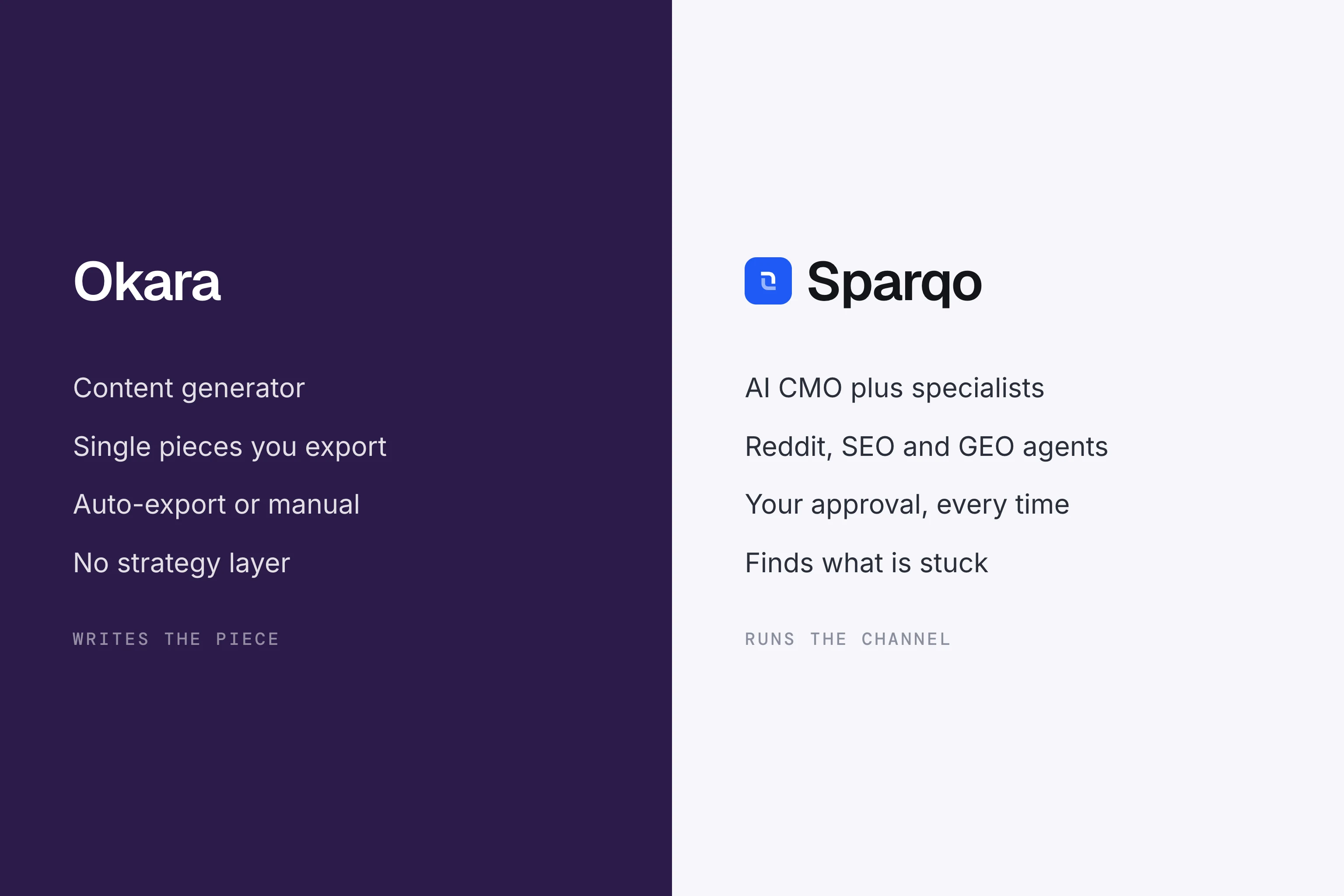
This is Sparqo's approach. Instead of a single SEO agent, you get a CMO agent that routes work to specialist channel agents (SEO, Reddit, LinkedIn, X, GEO) based on your current growth constraint. The SEO agent handles keyword research, briefs, and drafts, but the CMO decides whether SEO is even your priority this month.
Flat pricing, human approval required, and the system learns from every edit you make. For indie founders and small teams who need distribution across channels without managing five separate tools, this removes the coordination overhead that kills most marketing efforts. See how AI agents for marketing work for the architecture details.
The decision framework
| Situation | Recommendation |
|---|---|
| Unique workflow, strong technical team | |
| Standard SEO needs, limited dev time | Buy specialized agent |
| Multi-channel marketing, no marketing team | Orchestrated AI CMO |
| Complex strategy, high-stakes market | Human agency with agent assistance |
Most teams overestimate their appetite for maintenance. Building sounds appealing until you are debugging why Search Console API calls failed at 2 AM. Be honest about whether the customization you want is worth the ongoing ownership.
Related Approaches Worth Knowing
The search landscape around "SEO agent" includes several adjacent concepts that get conflated.
WordLift AI SEO agent: Focuses on semantic SEO, knowledge graphs, and structured data automation. Strong for content-heavy publishers, less relevant for typical B2B SaaS.
SEO agent GitHub: Mostly experimental repositories. Useful for understanding architecture, risky for production without significant investment.
Best AI SEO agent: A meaningless category without context for your use case. Evaluate against your workflow, not feature lists.
SEO AI agent free: Open-source implementations exist but require infrastructure. "Free" ignores time cost and error risk.
Generative Engine Optimization (GEO): The parallel discipline of optimizing for AI answer engines (ChatGPT, Perplexity, Claude). Your SEO agent should ideally coordinate with GEO efforts, as citation in AI answers increasingly drives discovery. See our guide on getting your SaaS cited in ChatGPT answers.
FAQ
Q: What is a SEO agent? A: An SEO agent is an AI system that autonomously performs search optimization tasks like keyword research, content brief generation, and technical audits on a schedule, improving its outputs based on results rather than requiring constant human prompting.
Q: How much does an SEO agency cost? A: Traditional SEO agencies charge $3,000-$15,000 monthly retainers. SEO agent software runs $100-$800 monthly. Hybrid approaches with agent execution plus human strategy review typically cost $500-$2,000 monthly.
Q: Will SEO be replaced by AI? A: No. AI replaces repetitive SEO tasks (keyword research, brief generation, first drafts) but not strategic judgment, creative differentiation, or relationship-driven link building. The role shifts from execution to validation and direction.
Q: Is an SEO agency worth it? A: Worth depends on your stage. Agencies provide strategic depth and accountability that pure software cannot. If you need volume and consistency more than novel strategy, an SEO agent or hybrid approach delivers better ROI. If SEO is your primary growth channel in a competitive market, agency expertise remains valuable.
Q: Can I build my own SEO AI agent? A: Yes, using platforms like n8n or LangChain to chain APIs and LLM calls. Expect 20-40 hours initial setup and ongoing maintenance. Best for teams with specific workflow needs that off-the-shelf products cannot satisfy.
Q: Do SEO agents publish content automatically? A: They can, but should not. Agents that publish without human approval risk search engine penalties, brand damage from hallucinated content, and factual errors. The best implementations require review before any public-facing change.

Founder of Sparqo, building an AI CMO that runs SEO, AI visibility and Reddit for indie founders and small teams who do their own marketing.