Content performance AI uses analytics, search data, and generative AI to evaluate how content performs, identify what to improve, and create the next useful asset. It connects page visits, engagement, rankings, conversions, and customer behavior so marketing teams can make content decisions from evidence instead of guesswork.
A normal AI writing tool creates a draft. A content performance system closes the loop after publication. It asks whether the article attracted the right people, whether they took a meaningful action, and what the data suggests you should publish next.
Key takeaways
- Content performance AI integrates measurement (analytics, search data), interpretation (AI pattern detection), and execution (content planning, generation, and optimization) to close the loop after content publication.
- Unlike basic AI writing tools that produce text, content performance AI evaluates published content against business outcomes, identifying whether it attracted the right audience and drove meaningful actions.
- This AI helps answer practical questions like which content attracts qualified leads, which search queries convert, where users drop off, and what type of content to publish next based on performance data.
- AI measures content performance by combining event data, search metrics, page-level behavior, and conversion outcomes, classifying each asset by its funnel role and comparing performance against relevant baselines.
- Effective content performance measurement requires defining a primary outcome for each content group, adding source and landing-page attribution to conversion events, and joining analytics with search data to reveal performance patterns.
What Is Content Performance AI?
Content performance AI is software that analyzes content results and turns those findings into recommendations, briefs, updates, or new content. It combines three functions:
- Measurement, through web analytics, search performance data, and conversion events.
- Interpretation, through AI models that find patterns in the data.
- Execution, through content planning, generation, optimization, and workflow automation.
The key distinction is the feedback loop. A basic content generator may write an article from a prompt. Content performance AI can review the article's results weeks later, compare them with other pages, identify a weak conversion path, and recommend a specific change.
That makes it useful for teams that publish regularly but don't have time to inspect every report manually.
What problems does it solve?
Content teams often have plenty of activity data and very little decision clarity. They can see pageviews, clicks, and keyword positions, but those numbers don't always explain what to do next.
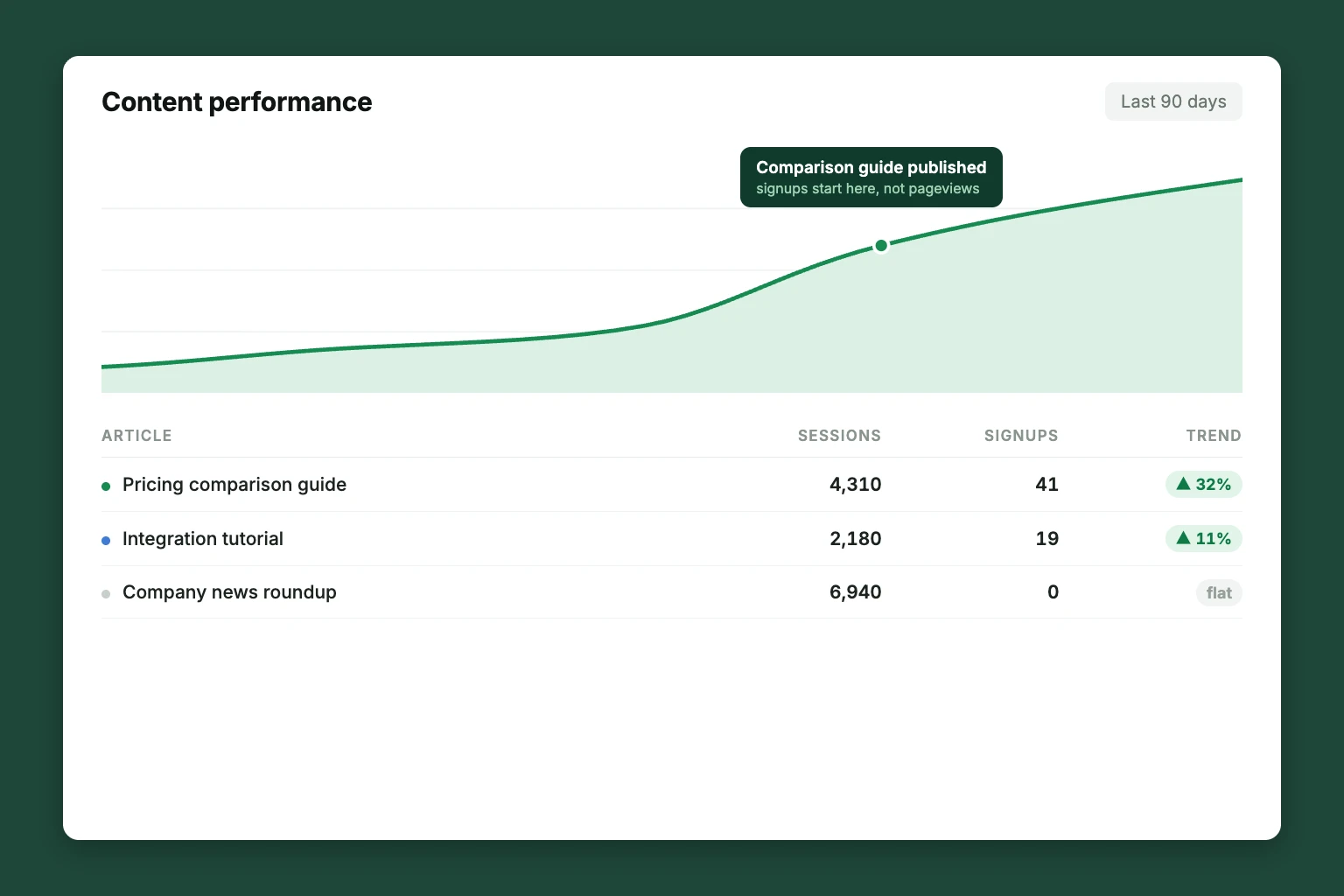
For example, an article may receive 1,500 organic visits per month but produce no product signups. Another page may receive only 200 visits and generate five qualified demos. Treating the first article as the bigger success would lead to the wrong decision.
Content performance AI helps answer practical questions:
- Which pages attract the right audience?
- Which search queries bring visitors who convert?
- Where do readers stop progressing?
- Which content topics deserve an update?
- What questions appear in high-value conversations?
- Should the next asset be an article, comparison page, case study, or product guide?
The system still needs clear goals and trustworthy data. AI can find patterns, but it can't repair a broken analytics setup or decide what a qualified customer means without guidance.
How is it different from an AI writing tool?
An AI writing tool focuses on producing text. Content performance AI focuses on the relationship between content and business outcomes.
A writing tool might help create:
- A blog outline
- A product description
- A social post
- An email draft
- A set of search-optimized headings
A performance system adds context such as the target audience, the page's search intent, historical results, funnel stage, and conversion data. It can then recommend whether the page should be rewritten, promoted, linked internally, or left alone.
This distinction matters because more content doesn't automatically improve marketing. Publishing ten articles that attract the wrong visitors can create more reporting work without creating more demand.
For the writing component alone, what SEO writing means provides useful background on matching structure and language to search intent.
How Does AI Measure Content Performance?
AI measures content performance by combining event data, search data, page-level behavior, and conversion outcomes. It classifies each content asset by its role in the funnel, then compares performance against a relevant baseline.
The process works best when the analytics implementation is designed before the AI is connected.
1. Define the outcome before collecting data
Start with one primary outcome for each content group. A product education article may aim to generate a signup. A technical tutorial may aim to create a qualified activation. A comparison page may aim to start a sales conversation.
A useful measurement hierarchy is:
- Organic landing: a visitor arrives through an unpaid search result.
- Signup start: the visitor begins the registration process.
- Signup completion: the account is created successfully.
- Qualified activation: the user completes the product action that indicates real intent.
The final event is usually the most valuable. A completed signup can be a weak signal if users never reach the first useful product outcome.
2. Add source and landing-page attribution
Every conversion event should preserve enough context to answer two questions:
- Where did the visitor come from?
- Which page did the visitor first land on?
A basic event record might include:
event_name: qualified_activation
source: organic_search
landing_page: /blog/ai-seo-agents-for-b2b-saas-marketing
session_id: anonymous-or-known-id
timestamp: 2026-03-08T10:15:00Z
The exact analytics platform can vary. The principle stays the same. If the signup completion event loses its original source or landing page, an AI system can't reliably connect content to outcomes.
3. Join analytics with search data
Web analytics shows what visitors did after arriving. Search data shows how they found the page.
Together, these sources reveal patterns such as:
- A page ranks for broad terms but attracts few qualified users.
- A page gets strong clicks for a specific question that the article barely answers.
- A page has good traffic but weak engagement after a title change.
- Several pages compete for similar queries.
- A low-traffic article produces a high percentage of qualified activations.
The AI should compare pages within a similar group. A technical documentation page and a bottom-of-funnel comparison page should not share the same performance benchmark.
4. Classify the result
The useful output isn't a single score. It is a decision category.
A practical classification system looks like this:
| Content signal | Likely diagnosis | Recommended action |
|---|---|---|
| High traffic, low signup rate | The page attracts attention but weak purchase intent or unclear next step | Tighten intent match and improve the conversion path |
| Low traffic, high activation rate | The page reaches a small but valuable audience | Improve internal links, distribution, and search coverage |
| High impressions, low click-through rate | The page appears in search but its result is not compelling | Test the title and description |
| High clicks, low engagement | The search result overpromises or the opening misses the query | Rewrite the opening and align the page with intent |
| Strong engagement, no conversion events | The page may educate well but lacks a relevant next action | Add a useful next step without forcing a sales pitch |
| Falling rankings and declining conversions | The page may be outdated, incomplete, or losing relevance | Refresh evidence, examples, structure, and internal links |
AI can save time here. It can review many pages and surface the patterns that deserve human attention. The human still decides whether the recommendation makes sense.
Which Content Metrics Should AI Track?
AI should track metrics that connect a content asset to a defined outcome. Pageviews alone are too weak to guide most content decisions.
Reach and discovery metrics
These show whether the intended audience can find the page:
- Organic impressions
- Organic clicks
- Click-through rate
- Ranking position for target queries
- Number of queries generating impressions
- Referring sources
- New versus returning visitors
These metrics are useful early in a page's life. They tell you whether search engines and distribution channels are exposing the content to potential readers.
They don't prove that the content is useful or commercially relevant.
Engagement metrics
Engagement metrics indicate what visitors do after landing:
- Engaged sessions
- Scroll depth
- Time spent with the page
- Interaction with internal links
- Video or tool usage
- Return visits
- Exit points
Treat these metrics as diagnostic clues rather than final outcomes. A long article can show high time on page because readers are struggling to find the answer. A short article can show low time because it answered the question quickly.
AI should interpret engagement alongside the page type and intent.
Conversion metrics
Conversion events show whether content contributes to a meaningful business action:
- Signup starts
- Signup completions
- Demo requests
- Contact form submissions
- Trial activation
- Product-qualified actions
- Sales opportunities influenced by content
The most useful setup records both direct and assisted conversions. A reader may first discover a company through an educational article, return through a branded search, and convert later. Assigning all credit to the final visit hides the article's role.
Attribution models are imperfect. They should help compare decisions, not create false precision.
Content quality signals
Performance AI can also assess signals that standard analytics can't measure well:
- Whether the page answers the target query directly
- Whether examples match the intended reader
- Whether claims have supporting evidence
- Whether the introduction reflects the search intent
- Whether the page covers important subtopics
- Whether the call to action fits the reader's stage
- Whether the content overlaps with another page
These evaluations should support editorial review. They shouldn't replace it.
A practical metric scorecard
For a small B2B SaaS team, start with a compact scorecard:
| Goal | Primary metric | Supporting metrics |
|---|---|---|
| Earn relevant search traffic | Qualified organic landings | Impressions, clicks, ranking range |
| Turn readers into prospects | Signup starts or demo requests | CTA clicks, assisted conversions |
| Create active users | Qualified activations | Signup completion, activation rate |
| Improve existing pages | Conversion rate per landing page | Engagement, query coverage |
| Prioritize new content | Expected business value | Search intent, audience fit, content gap |
Avoid creating a composite score until the underlying events are reliable. A complicated score can hide bad data behind a neat number.
How AI Turns Performance Data Into New Content
AI turns performance data into new content by finding repeated questions, weak coverage, and high-value topics, then converting those findings into briefs or drafts. The strongest workflow starts with evidence and ends with human approval.
Step 1: Find the gap
The system reviews search queries, internal site behavior, support conversations, sales questions, and existing articles. It looks for gaps between what people want and what the current content provides.
A useful gap might be:
- A page ranks for “AI content automation” but doesn't explain approval workflows.
- Visitors search for implementation details that the article only mentions briefly.
- A high-converting page has no supporting articles that pass internal authority to it.
- Reddit discussions reveal objections that the company's content never addresses.
The goal is not to produce a list of random topics. The goal is to identify a specific information gap connected to an audience and outcome.
Step 2: Choose the right content format
The data may point to an article, but articles aren't always the best response.
For example:
- A repeated setup question may need documentation.
- A product comparison query may need a comparison page.
- A complex workflow may need a template or calculator.
- A customer objection may need a case study.
- A cluster of beginner questions may need a short explainer series.
Human judgment improves the system here. AI can identify patterns in language, but a founder or subject expert understands the product's boundaries and the audience's real concerns.
Step 3: Build a brief from evidence
A useful AI brief should include:
- Primary query and related questions
- Search intent
- Intended reader
- Business goal
- Recommended format
- Existing pages to update or link
- Claims that need verification
- Examples to include
- A suggested call to action
- How success will be measured
That brief is more valuable than a generic instruction to “write an SEO article.” It gives the content a job.
Step 4: Create and review the content
Generative AI for content generation can produce a first draft quickly, but speed increases the need for review. Check the draft for accuracy, originality, unsupported claims, product promises, and whether it solves the reader's problem.
A good approval process asks:
- Does the opening answer the query?
- Does each section add useful information?
- Are the examples specific enough to trust?
- Are any claims stronger than the evidence?
- Does the next step fit the reader's intent?
- Can the result be measured?
AI automation content creation works best when it prepares work for approval rather than publishing without oversight.
Step 5: Feed the result back into the system
After publication, compare the new page with its original baseline. Review it after enough data accumulates to avoid reacting to a short-term fluctuation.
The system can then learn that:
- Certain topics bring qualified users.
- Specific openings improve engagement.
- Some calls to action produce signup starts but few activations.
- A particular content format performs well for technical audiences.
- Reddit questions frequently become useful article topics.
One integrated workflow can connect these signals. For example, Sparqo's AI CMO uses shared context across SEO and Reddit work, with approval before anything publishes. That model is useful when a community question becomes a content idea, and the resulting article later informs community replies.
For a broader explanation of agent-based marketing workflows, see how AI agents for marketing work.
Content Performance AI vs Traditional Analytics Tools
Traditional analytics tools report what happened. Content performance AI interprets the data and recommends what to do next. The two approaches work together, because AI needs reliable measurement to produce useful recommendations.
| Capability | Traditional analytics tool | Content performance AI |
|---|---|---|
| Traffic reporting | Shows visits, sources, and pages | Connects traffic patterns to content decisions |
| Search analysis | Reports queries, clicks, and rankings | Finds content gaps and prioritizes updates |
| Conversion tracking | Records events and funnels | Links events to landing pages and content themes |
| Content creation | Usually outside the tool | Can generate briefs, outlines, drafts, and updates |
| Recommendations | Requires manual analysis | Suggests actions based on configured goals |
| Workflow execution | Limited or separate | Can assign tasks and track review status |
| Human judgment | Required for interpretation | Required for approval and quality control |
| Main weakness | Data can remain unused | Bad inputs can produce confident but wrong advice |
Analytics software is usually better for inspecting raw data, building custom reports, and validating event behavior. AI systems are better at reviewing a large amount of mixed information and turning it into a proposed plan.
Neither tool should be treated as an automatic source of truth. If a tracking tag fires twice, the AI may conclude that a page converts unusually well. If organic traffic includes irrelevant queries, the system may recommend content that attracts visitors with no interest in the product.
The right setup keeps analytics as the evidence layer and AI as the interpretation and execution layer.
How To Use AI To Improve Content Performance
Use AI to improve content performance through a repeatable cycle: establish a baseline, find one high-value problem, make a controlled change, and measure the result.
1. Audit the existing library first
Start with your current pages. Export each URL, target query, content type, organic traffic, conversion events, internal links, and last update date.
Then group pages into four working categories:
- High traffic and high business value
- High traffic and low business value
- Low traffic and high business value
- Low traffic and low business value
The third category often contains the best opportunities. A page that attracts the right audience but has weak visibility may need better internal linking, stronger search coverage, or distribution. It may be a better investment than another broad top-of-funnel article.
2. Fix measurement before rewriting
Verify that organic landing, signup start, signup completion, and qualified activation events work as expected. Test them with real sessions and check that source and landing-page values persist through the funnel.
Don't begin with AI-generated recommendations if the measurement foundation is uncertain. A clean event setup makes every later decision easier.
3. Pick one page and one hypothesis
Avoid changing the title, introduction, structure, links, CTA, and offer at the same time. You won't know which change helped.
A clear hypothesis might be:
This article gets relevant organic visitors but few signup starts because its first CTA appears before the reader understands the solution.
You can then revise the CTA placement and copy, keep the other variables stable, and monitor the result.
4. Use AI for analysis and production support
Ask AI to compare the page with:
- Its top search queries
- Related pages on your site
- Questions from customer calls
- Support tickets
- Community discussions
- Pages with stronger conversion rates
Then ask for a change brief, not an automatic rewrite. A brief makes it easier to reject weak recommendations and preserve useful first-hand detail.
AI can also handle repetitive work such as content inventories, internal-link suggestions, query clustering, title variants, and performance summaries. A human should handle factual review, positioning, examples, and final approval.
5. Review results on a fixed schedule
Set a review date before making the change. For a page with limited traffic, you may need a longer observation period. For a page with substantial daily traffic, an earlier directional review may be useful.
Look at the complete path:
organic landing
→ engaged visit
→ signup start
→ signup completion
→ qualified activation
If landings increase while activations stay flat, the content may be attracting the wrong intent. If landings stay flat but activation rate improves, the page may be serving a smaller, more suitable audience. Both outcomes can inform the next decision.
For a wider process covering search priorities, internal links, and content maintenance, SEO strategies for SaaS companies offers related guidance.
What Are The Risks Of Automating Content Decisions?
The main risks are bad measurement, shallow pattern matching, unverified claims, search intent drift, and excessive publishing. Automation should recommend and prepare decisions, while people remain accountable for what goes live.
Bad data creates bad priorities
If the analytics system assigns conversions to the wrong landing page, the AI may prioritize the wrong content. If event names change without documentation, historical comparisons become unreliable.
Keep an event dictionary with the event name, trigger, required properties, and owner. Review it whenever the signup or product flow changes.
Correlation can look like causation
A page may correlate with conversions because high-intent users already know the brand. That doesn't prove the page caused the conversion.
Use cautious language in reports. “Visitors who read this page converted at a higher rate” is more accurate than “this page generated all conversions.” AI-generated summaries should preserve that distinction.
AI can optimize for the wrong metric
If the system is told to maximize clicks, it may favor sensational titles. If it is told to increase time on page, it may recommend longer articles even when readers need a short answer.
Give each content group a business outcome and supporting quality checks. A page should not win because it produces a large number that has no relationship to revenue or activation.
Generated content can become generic
AI can create grammatically clean articles that contain familiar advice, vague examples, or claims that sound reasonable but are difficult to verify. This is especially risky in technical B2B topics, where readers notice missing implementation detail quickly.
Add original material before publication:
- Product screenshots or workflow details
- Real constraints
- Specific examples
- Lessons from customer questions
- Clear explanations of what the product cannot do
- Evidence for factual claims
A recent discussion of AI versus human content performance is useful context for thinking about where automated production can support, rather than replace, editorial judgment.
Automation can damage trust
Publishing automatically across search and community channels can create repetitive or poorly timed messages. On Reddit, that can harm an account's reputation or trigger moderation. On a company blog, it can dilute the site's point of view.
Human approval is a practical control. So are publishing limits, required source checks, and a clear record of who approved each asset.
The safest operating model
Use automation for research, classification, drafting, and recommendations. Require human review for facts, strategic priorities, product claims, sensitive topics, and publication.
The best content performance AI workflow is therefore a closed loop with an open approval step:
Measure
→ interpret
→ prioritize
→ create
→ review
→ publish
→ measure again
That structure gives a lean team daily execution without handing final editorial and business decisions to an unverified system.
FAQ
Is content performance AI the same as generative AI?
No. Generative AI creates text, images, or other content from instructions. Content performance AI uses performance data to decide what content to improve, create, distribute, or retire. A single platform can include both capabilities, but they solve different parts of the workflow.
Can AI create content for you automatically?
AI can create briefs, outlines, drafts, title options, internal-link suggestions, and content updates. Automatic publishing is riskier because the system may miss factual errors, weak intent alignment, or brand-specific context. Human review should remain part of the process for business and technical content.
What data does content performance AI need?
At minimum, it needs page-level analytics, organic search data, conversion events, and source attribution. More useful systems also use customer questions, sales notes, support conversations, and content metadata. The quality of the recommendations depends on how accurately those sources are connected.
Which metrics matter most for content performance?
The most useful metrics depend on the page's purpose. Organic landings and search clicks measure discovery, while signup starts, completed signups, and qualified activations measure business value. For most B2B SaaS teams, qualified activation is a stronger endpoint than traffic alone.
Is content performance AI worth using for a small marketing team?
It can be useful when the team publishes consistently but lacks time to connect reporting with execution. Start with a small content library, four or five well-defined events, and one improvement hypothesis at a time. The system should reduce analysis and production work without removing editorial control.
FAQ
What is content performance AI?
Content performance AI analyzes analytics, search data, and conversion behavior to recommend which content to improve and what to create next. It connects measurement with content planning and production.
How does AI measure content performance?
It combines organic traffic, search queries, engagement, conversion events, and landing-page attribution. It then compares similar content assets and recommends actions based on the intended business outcome.
Can generative AI improve content performance?
Yes, it can identify content gaps, create briefs, draft updates, and suggest new formats. Its output still needs human review for accuracy, search intent, originality, and brand fit.
What is the difference between analytics tools and content performance AI?
Analytics tools primarily report what happened. Content performance AI interprets those results and turns them into recommendations, briefs, content updates, and workflow tasks.
What are the risks of automating content decisions?
The main risks include inaccurate tracking, misleading correlations, generic content, wrong optimization targets, and unreviewed publishing. Human approval and clear event definitions reduce those risks.

Founder of Sparqo, building an AI CMO that runs SEO, AI visibility and Reddit for indie founders and small teams who do their own marketing.