The best omni-channel marketing tools for startups bring email, SMS, social, web, and customer data into one system, then automate relevant follow-up across those channels. For most startups, Brevo offers a good balance of price and channel coverage. HubSpot is the strongest all-in-one option, while Sparqo suits founders who need daily SEO and Reddit execution instead of customer messaging.
The right choice depends on how you define omnichannel. A startup selling subscriptions needs lifecycle email, product events, and sales handoffs. A developer tool may need SEO, Reddit, email, and product education before it needs SMS.
Key takeaways
- Brevo is the best general-purpose marketing automation software for startups that need several customer-facing channels without a large monthly bill.
- HubSpot is a better fit when CRM, sales pipeline, and marketing automation need to work together.
- ActiveCampaign is built for conditional customer journeys and is best for complex lifecycle automation.
- The right tool for a startup should collect customer data into one profile, trigger messages from meaningful events, coordinate multiple channels in one journey, allow for small team campaign review, and show whether marketing activity produced signups, trials, or revenue.
- Sparqo suits founders who need daily SEO and Reddit execution instead of customer messaging.
What Is the Best Marketing Automation Software for Startups?
Brevo is the best general-purpose marketing automation software for startups that need several customer-facing channels without a large monthly bill. HubSpot is a better fit when CRM, sales pipeline, and marketing automation need to work together. ActiveCampaign and Customer.io are better suited to event-based lifecycle campaigns.
For a startup, the right tool should handle five jobs:
- Collect customer and prospect data in one profile.
- Trigger messages from meaningful events, not just form submissions.
- Coordinate more than one channel in the same journey.
- Let a small team review campaigns before they go live.
- Show whether marketing activity produced signups, trials, or revenue.
A tool that sends email and SMS but leaves the team to plan every campaign is a channel tool, not a complete marketing automation system. A tool with every feature but requiring a specialist to operate it can also be a poor startup purchase.
The seven best tools, ranked
The ranking below uses a startup-focused scorecard rather than total feature count. It gives the most weight to channel coverage and shared customer context, then considers approval controls, daily execution, price, and free access.
1.  Brevo, best for affordable cross-channel campaigns
Brevo combines email, SMS, WhatsApp messaging, chat, forms, landing pages, and basic automation. Its broad channel set makes it a practical first platform for a small startup that has outgrown a newsletter tool.
Pricing: Brevo has a free plan with daily email limits. Paid email plans start around $9 per month, while higher tiers and SMS or WhatsApp messages cost extra. The final cost depends on email volume, contacts, and messaging credits.
Pros
- Low entry price for email automation.
- Supports email, SMS, WhatsApp, chat, forms, and landing pages.
- Useful transactional email features for SaaS products.
- A practical starting point for a small marketing team.
Cons
- Customer data and reporting are less unified than HubSpot's.
- SMS and WhatsApp costs sit outside the email subscription.
- Advanced segmentation and revenue reporting require more setup.
- Content approval is handled through permissions and process, not a dedicated editorial review workflow.
Who should pick it: Choose Brevo if your startup needs email plus one or two additional messaging channels and you want to control the first-year software bill.
Brevo ranks first because it covers the channels many startups use at a low starting price. It loses points for limited daily execution. Your team still has to decide what to send, write much of it, and review performance.
2.  HubSpot, best for CRM and marketing in one system
HubSpot is a strong choice when marketing, sales, support, and customer records need to share one database. Marketing Hub can coordinate email, forms, landing pages, ads, lead scoring, and workflows, while the CRM provides the customer context.
Pricing: HubSpot offers free CRM tools and limited free marketing features. Marketing Hub Starter commonly starts at about $20 per seat or account per month, depending on the current packaging. Professional plans cost much more and may include an onboarding fee. Contact limits, marketing contacts, and feature access can change the total substantially.
Pros
- CRM, marketing, sales, and service records can share context.
- Strong forms, landing pages, pipeline, and reporting tools.
- Good fit for startups with a sales-assisted buying process.
- Large integration ecosystem.
Cons
- The cost rises quickly as contacts and automation requirements grow.
- The free tier is useful for learning, but not for full omnichannel automation.
- Many important workflows require a paid tier.
- HubSpot helps your team run campaigns, but it does not independently plan and execute a daily marketing program.
Who should pick it: Pick HubSpot when the main problem is disconnected sales and marketing data, especially if a founder, salesperson, and marketer all need the same contact history.
HubSpot scores well on context and channel coordination. It ranks below Brevo for a bootstrapped team because the upgrade path can become expensive before the startup has predictable revenue.
3. ActiveCampaign, best for complex lifecycle automation
ActiveCampaign is built for conditional customer journeys. It can react to page visits, email activity, form submissions, purchases, lead scores, and other events. Email is its core channel, with SMS and other channels available through plans or integrations.
Pricing: Entry plans commonly start around $15 per month for a small contact list when billed annually. A more capable Plus plan often starts near $49 per month for 1,000 contacts, but the price depends on contacts, billing period, and features. SMS costs are separate.
Pros
- Detailed conditional workflows.
- Strong contact segmentation and lead scoring.
- Good for trial onboarding, lead nurturing, and sales handoffs.
- More flexible automation than many entry-level email platforms.
Cons
- It takes time to design and maintain complex journeys.
- Email remains the center of the system, while other channels may require integrations.
- Pricing rises with contact volume.
- The platform does not replace campaign planning or content production.
Who should pick it: Choose ActiveCampaign if you already know the customer journeys you want to build, such as trial signup to activation to sales follow-up.
It ranks well because its automation logic works well for SaaS. It ranks below HubSpot because the broader CRM and channel experience is less unified for teams that need sales and support data in the same place.
4. Customer.io, best for product-led SaaS journeys
Customer.io is a good fit for software companies that can send product events into a messaging system. A team can trigger campaigns from events such as account creation, feature use, failed payment, invitation sent, or trial expiry.
Its channels can include email, push notifications, SMS, in-app messages, and webhooks, depending on the plan and setup.
Pricing: Customer.io's entry plans commonly start around $100 per month, with pricing based on people or usage. Higher plans cost more, and message delivery can add usage charges. There is usually a trial or limited evaluation option, but startups should confirm current limits before committing.
Pros
- Detailed event-based segmentation for SaaS products.
- Supports lifecycle messaging across email, push, SMS, and in-app channels.
- Flexible data model for product-led companies.
- Useful for activation and retention campaigns.
Cons
- The starting price is high for a pre-revenue startup.
- Implementation requires clean event tracking.
- It is less useful before the product has meaningful behavioral data.
- Teams still need to create strategy, copy, creative, and experiments.
Who should pick it: Pick Customer.io if product behavior should drive onboarding and retention messages, and someone on the team can maintain event tracking.
Customer.io scores well on context and channel coordination. It does not score as well on free access or daily execution. You get a capable delivery system, but not a marketing operator.
5. Klaviyo, best for ecommerce-style personalization
Klaviyo is best known for ecommerce, but its segmentation and messaging model can also suit startups with a large volume of customer events. Email and SMS are closely connected, and the platform can personalize campaigns using browsing, purchase, and engagement data.
Pricing: Klaviyo has a free tier for small contact lists and limited monthly sends. Paid email plans commonly begin around $20 per month for up to 500 profiles. SMS is priced separately and can vary by destination and message volume.
Pros
- Strong email and SMS personalization.
- Detailed segments and event-triggered campaigns.
- Useful revenue attribution for transactional businesses.
- Free entry point for small lists.
Cons
- Its main workflows are designed around ecommerce behavior.
- Costs can increase with profiles and SMS usage.
- It is usually more system than an early B2B SaaS needs.
- SEO, Reddit, and other acquisition channels remain outside the platform.
Who should pick it: Choose Klaviyo if your startup sells through repeat purchases or has ecommerce-like customer behavior and needs detailed email and SMS targeting.
Klaviyo is a capable omnichannel platform, but its fit is narrower for B2B SaaS. A developer tool with a handful of high-value accounts may get more value from CRM and product-event tooling.
6. Sparqo, best for daily SEO and Reddit execution
Sparqo is an AI CMO platform for founders and small teams. It uses specialist AI agents to plan and draft SEO and Reddit marketing, with a human review step before anything publishes.
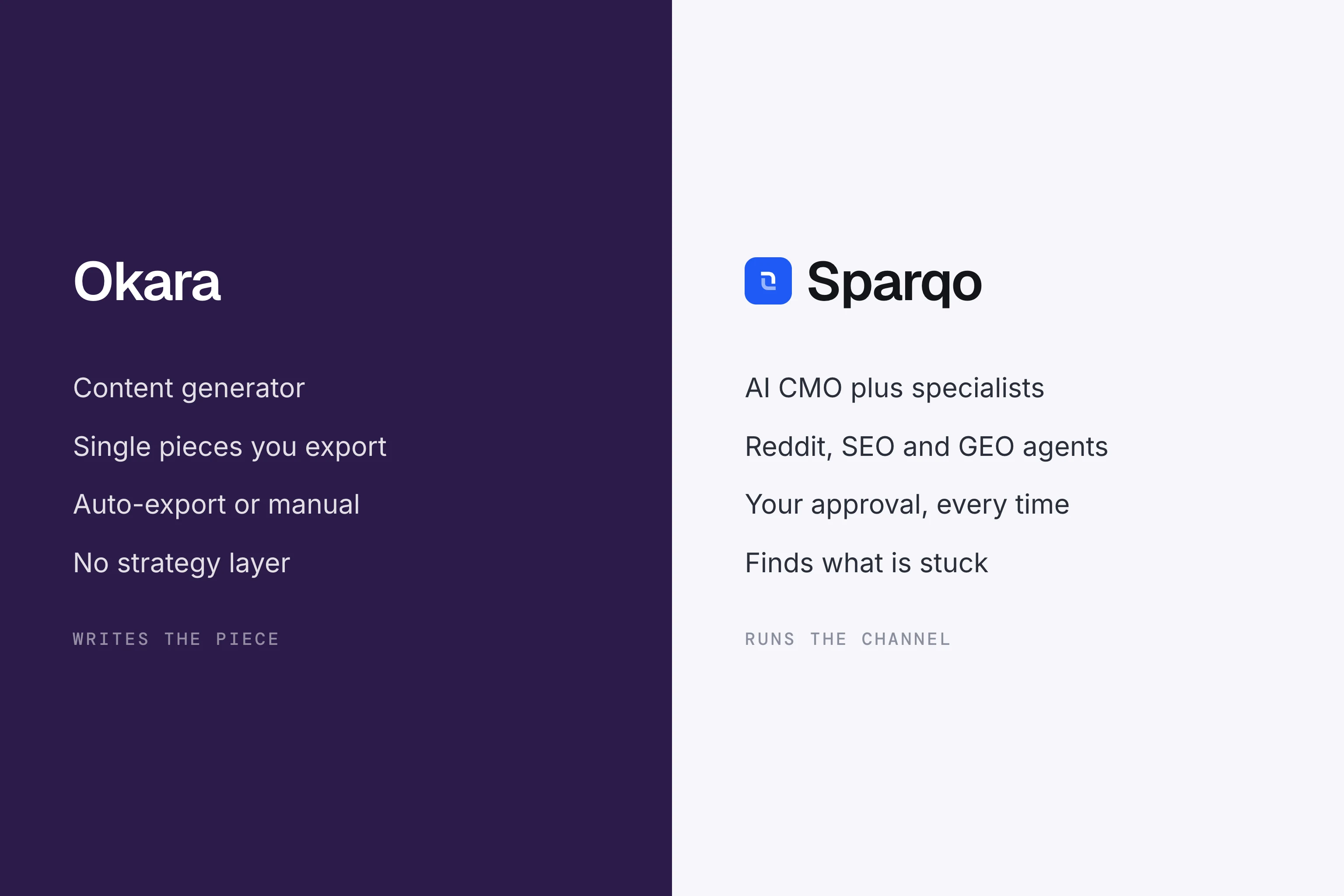
That makes Sparqo different from the other tools on this list. It does not try to be a customer messaging database with email, SMS, and push notifications. Its channels are acquisition channels, especially SEO and Reddit.
Pricing: Sparqo's current plans and limits are listed on the Sparqo pricing page. Confirm the plan's agent access, publishing workflow, connected channels, and usage limits before subscribing, since those details affect the comparison more than a headline monthly price.
Pros
- Plans and drafts recurring marketing work across SEO and Reddit.
- Shares context between channels, so useful Reddit discussions can inform content.
- Keeps a human approval step before publication.
- Designed for founders without a marketing department.
- Can help with daily execution rather than only providing a campaign builder.
Cons
- It does not replace a CRM or lifecycle messaging platform.
- Channel coverage is narrower than HubSpot, Brevo, or Customer.io.
- Human approval is still required, so it does not run without oversight.
- Teams seeking detailed email, SMS, or product notification workflows need another tool.
Who should pick it: Pick Sparqo if the bottleneck is distribution and content execution. It is a good fit for a founder building a B2B SaaS or DevTool who has a product, some customer insight, and no consistent way to publish or participate in relevant conversations.
Sparqo ranks sixth under a traditional omnichannel definition because it does not cover the usual customer messaging channels. It ranks much higher for a founder who defines channels as SEO, Reddit, and other acquisition surfaces. That distinction matters. Buying a customer engagement platform will not solve a publishing and distribution problem.
7. Mailchimp, best for simple email-first marketing
Mailchimp remains a reasonable starting point for a newsletter, basic lead capture, and simple automated emails. It includes landing pages, forms, email campaigns, and integrations that can extend its reach.
Pricing: Mailchimp has a limited free plan, often capped at 500 contacts and a restricted monthly send allowance. Paid plans commonly start around $13 per month for a small audience, with pricing based on contacts and features.
Pros
- Familiar campaign editor.
- Free entry point for a small list.
- Useful templates, forms, and basic automations.
- Easy to hand off to a contractor or part-time marketer.
Cons
- It is primarily email-first.
- Advanced omnichannel journeys often need integrations.
- Pricing depends on audience size, including some archived or inactive contacts.
- Reporting and customer context are less complete than a CRM-centered platform.
Who should pick it: Choose Mailchimp if you need a newsletter and a few simple automations today, and you do not yet need coordinated customer journeys.
Mailchimp is last because the target decision is omnichannel automation, not entry-level email marketing. It can be the right first purchase for a very early company, but most teams will outgrow it when customer behavior needs to control campaigns.
Best Omni-Channel Marketing Tools at a Glance
The table uses public starting-price ranges and common plan structures. Messaging charges, contact limits, seats, onboarding fees, and annual billing can change the total. Treat the figures as buying checkpoints, not quotes.
| Rank | Tool | Best for | Main channels | Starting price or free access | Startup score |
|---|---|---|---|---|---|
| 1 | Brevo | Affordable cross-channel campaigns | Email, SMS, WhatsApp, chat, forms | Free plan, paid email from about $9/month | 80/100 |
| 2 | CRM and marketing together | Email, forms, ads, chat, CRM workflows | Free CRM, paid marketing from about $20/month, higher tiers cost much more | 78/100 | |
| 3 | Complex lifecycle journeys | Email, SMS, integrations, CRM | From about $15/month for small lists | 77/100 | |
| 4 | Product-led SaaS messaging | Email, push, SMS, in-app, webhooks | From about $100/month | 73/100 | |
| 5 | Personalized email and SMS | Email, SMS, forms, integrations | Free tier, paid email from about $20/month | 70/100 | |
| 6 |  Sparqo Sparqo | Daily SEO and Reddit execution | SEO, Reddit, content workflows | Current plans listed on the pricing page | 67/100 |
| 7 | Simple email marketing | Email, forms, landing pages, integrations | Free plan, paid from about $13/month | 64/100 |
The score is not a universal product rating. It reflects a small team's buying decision, where a low monthly cost and useful execution often matter more than enterprise permissions or a long integration directory.
How We Ranked These Marketing Platforms
We ranked these tools on the work a startup must complete each week, not on the number of features shown on a pricing page. The scorecard has six categories, with channel coverage and shared context receiving the highest weights.
| Category | Weight | What a high score means |
|---|---|---|
| Channel coverage | 25% | The platform supports several relevant channels without fragile workarounds |
| Cross-channel context | 20% | One profile, event history, or knowledge base informs the next action |
| Human approval | 15% | A small team can review, edit, and control what gets sent or published |
| Daily execution | 15% | The tool helps plan, produce, schedule, and monitor recurring work |
| Price fit | 15% | The useful plan is affordable before startup revenue is predictable |
| Free access | 10% | A founder can test the core workflow without a large commitment |
This method creates useful tradeoffs. Customer.io scores higher than Mailchimp for product context, but Mailchimp is cheaper to test. Sparqo scores lower on conventional channel coverage, but it gets credit for daily execution and approval controls.
What counts as cross-channel context?
Cross-channel context means the system knows what happened in one place before deciding what to do in another. For example, a visitor who reads a pricing page, starts a trial, and uses a key feature should not receive the same message as a visitor who only downloaded a guide.
For an acquisition-focused startup, the equivalent might be a Reddit question becoming an SEO brief, then a search impression informing a helpful community reply. Few traditional marketing automation platforms handle that loop without manual work.
Why human approval has its own category
Automation without review can create duplicate messages, incorrect claims, and poor community behavior. This matters especially on Reddit, where promotional replies can damage trust or lead to bans.
A startup tool should show the proposed action, explain the trigger, and let a person edit or reject it. Sparqo makes this approval step central. Traditional platforms usually provide permissions and draft states, but they assume a human has already planned the campaign.
Best Free Omni-Channel Marketing Tools: Free Plans, Trial Limits, and Hidden Costs
There is no free omnichannel platform with unlimited contacts, messages, automation, and reporting. Free plans are useful for testing one workflow, but startups usually pay when they add contacts, increase send volume, or need additional channels.
Brevo is a good free starting point when email, forms, and occasional SMS or WhatsApp activity are the priority. HubSpot's free CRM is better when the startup needs contact records, deal stages, and basic sales coordination. Mailchimp works for a simple newsletter. Klaviyo is worth testing when email and SMS personalization matter.
Watch for these costs before choosing a plan:
- Contact-based pricing: A platform may charge for stored contacts, not only active recipients.
- Message credits: SMS and WhatsApp messages are usually billed separately from email.
- Extra seats: A free CRM may become expensive when several people need paid permissions.
- Onboarding fees: Higher HubSpot tiers can include setup costs.
- Event volume: Product-led tools may charge according to profiles, events, or message usage.
- Integrations: A required connector can add a second subscription.
- Human time: A cheap campaign builder still costs hours in planning, writing, QA, and reporting.
A free plan is a good fit when you can answer three questions clearly: which event starts the workflow, which channel sends the message, and what result proves it worked. If the answer is “we will send a few newsletters,” use the simplest email tool. If the answer is “we need a trial user to receive different messages based on product behavior,” test an event-based platform instead.
For a broader view of no-cost options, Sparqo's guide to free AI marketing tools that do not waste time separates useful free tools from products that only offer a short demo.
Sparqo vs. Traditional Marketing Automation Platforms
Traditional marketing automation platforms automate campaigns after a person designs the strategy, while Sparqo is built to help create and execute recurring marketing work. That difference makes each product suitable for a different bottleneck.
A conventional platform starts with a workflow such as:
When a visitor fills out a form, send an email, wait three days, then notify sales.
Sparqo starts closer to the planning problem:
Find where distribution is stuck, suggest a plan, draft the work, and wait for approval before publishing.
The first model is better for lifecycle messaging. The second is better when the founder has no reliable content or community process.
Choose a traditional platform when
A conventional omnichannel tool is the better purchase if:
- Your main data source is product usage or CRM activity.
- Email, SMS, push, and in-app messages must follow one customer journey.
- Sales needs lead scores, routing, and campaign attribution.
- You already have someone who can write campaigns and maintain workflows.
- Compliance, permissions, and audit trails are central requirements.
HubSpot, ActiveCampaign, and Customer.io each fit different versions of this use case. Before buying, map one complete journey from the first event to the desired conversion. A platform's feature list matters less than whether that journey can be built without several disconnected tools.
Choose Sparqo when
Sparqo is a better fit if:
- The product is ready, but few people know it exists.
- SEO research, writing, and distribution keep getting postponed.
- Reddit is relevant to the audience, but the team does not want to spam communities.
- You need one system to connect content ideas, search opportunities, and community conversations.
- You want to approve every draft before it goes public.
Sparqo does not replace a CRM or customer messaging system. A startup may use it alongside Brevo, HubSpot, or Customer.io. The point is to cover the acquisition work those platforms usually leave to the founder.
That distinction also explains why an AI marketing agent should not be judged only as an email automation product. A guide to how AI agents for marketing work describes the planning, delegation, review, and learning loop behind agent-based execution.
What Are Omni-Channel Marketing Tools?
Omnichannel marketing tools connect several marketing channels to shared customer data and coordinated journeys. Common channels include email, SMS, push notifications, in-app messages, web personalization, chat, paid advertising, social media, SEO, and sales outreach.
The spelling varies. “Omni-channel” and “omnichannel” describe the same broad idea.
A basic multichannel setup might send an email, run an ad, and publish a social post from separate tools. An omnichannel setup can use a person's interaction with one channel to change the next action in another channel.
For example, a SaaS startup might:
- Capture a visitor through an SEO article.
- Offer a product-specific guide on the page.
- Send onboarding email after signup.
- Change the sequence when the user activates a key feature.
- Alert sales only after the account meets a qualification rule.
- Suppress promotional messages after a paid conversion.
The channels are connected by data and logic. Without that connection, a startup can accidentally send a trial user a beginner promotion, or ask an existing customer to sign up for the product they already use.
Omnichannel platform examples
A few common examples make the distinction clearer:
- HubSpot: A form submission can create a CRM record, start an email sequence, assign a lead owner, and appear in a sales report.
- Customer.io: A product event such as “completed integration” can change email, push, or in-app messaging.
- Klaviyo: A browse or purchase event can change an email and SMS sequence.
- Brevo: A contact can move through email, SMS, WhatsApp, and form-based automation.
- Sparqo: A community question or search opportunity can inform a draft article or Reddit response, with approval before publication.
These are different types of omnichannel behavior. A platform can be strong for customer retention and weak for new demand generation, or the reverse.
What are the four C's of omnichannel?
The four C's are commonly described as consistency, context, content, and convenience. The wording varies between frameworks, but the practical test is stable.
Consistency means the brand, offer, and customer status do not contradict each other across channels. Context means messages reflect what the person has done. Content means each channel provides a useful reason to engage rather than repeating the same copy everywhere. Convenience means the customer can move between channels without starting over.
For a startup, the four C's can become a simple campaign review:
- Is the claim consistent on the landing page, in email, and in sales follow-up?
- Does the message use the customer's current stage?
- Is the format suitable for the channel?
- Can the customer complete the next step easily?
This check catches many automation problems before they become expensive.
How to Choose an Omni-Channel Marketing Tool for Your Startup
Choose the platform that fixes your current bottleneck, then test one complete journey before expanding into more channels. Do not buy a large platform because it can theoretically support every future campaign.
Start with the outcome. A founder who needs more qualified demos has a different requirement from a product-led startup trying to increase activation. Write the event, message, next step, and measurement in one sentence.
A useful test might be:
When a qualified visitor signs up from an organic landing page, send the right onboarding message, notify the team if the account becomes active, and record whether the signup becomes qualified.
Then check whether the platform can track each part without manual spreadsheets.
Questions to ask before buying
Does it connect to the data you already have? Check your product analytics, CRM, website forms, billing system, and support tools. A platform that cannot receive the events that matter will force you into broad, generic campaigns.
Can a non-specialist operate it? Look at the workflow editor, reporting screens, templates, and error messages. A startup may have the technical ability to install a tool but not the weekly time to maintain it.
What happens when you add a channel? Ask for the total cost of email, SMS, extra contacts, seats, and integrations. A low advertised price can change after one successful campaign grows the list.
Can you review before publishing? This is essential for brand accuracy and community channels. Draft, approval, edit, and rollback controls should be clear.
Does it help with execution or only automation? Most platforms automate a process you have already designed. If the missing work is research, planning, writing, and distribution, add that requirement to the evaluation.
A practical 14-day evaluation
During a trial, connect one data source and build one journey. For example, use an organic landing page, a signup event, and one onboarding email. Do not spend the trial importing every contact or designing ten campaigns.
Track whether the tool can:
- Receive the event reliably.
- Apply the correct segment.
- Delay or suppress messages properly.
- Show the conversion and qualified-signup result.
- Let another person review the workflow.
- Export your data if you leave.
For SEO and Reddit, use a different test. Give the system a narrow audience and a clear product claim. Review its proposed topics, sources, drafts, and community replies. The quality of the approval queue matters more than the number of content formats it claims to support.
A startup should also connect analytics and conversion events before judging an omnichannel tool. At minimum, track organic landing-page visits, demo or signup completion, and qualified signup status. After seven days, record impressions, clicks, signups, and qualified signups. That baseline tells you whether a tool is producing useful movement or only producing more activity.
Founders comparing acquisition channels can also review SEO strategies for SaaS and the guide to Reddit marketing without getting banned. The platform should support the strategy, not decide the strategy for you.

Founder of Sparqo, building an AI CMO that runs SEO, AI visibility and Reddit for indie founders and small teams who do their own marketing.