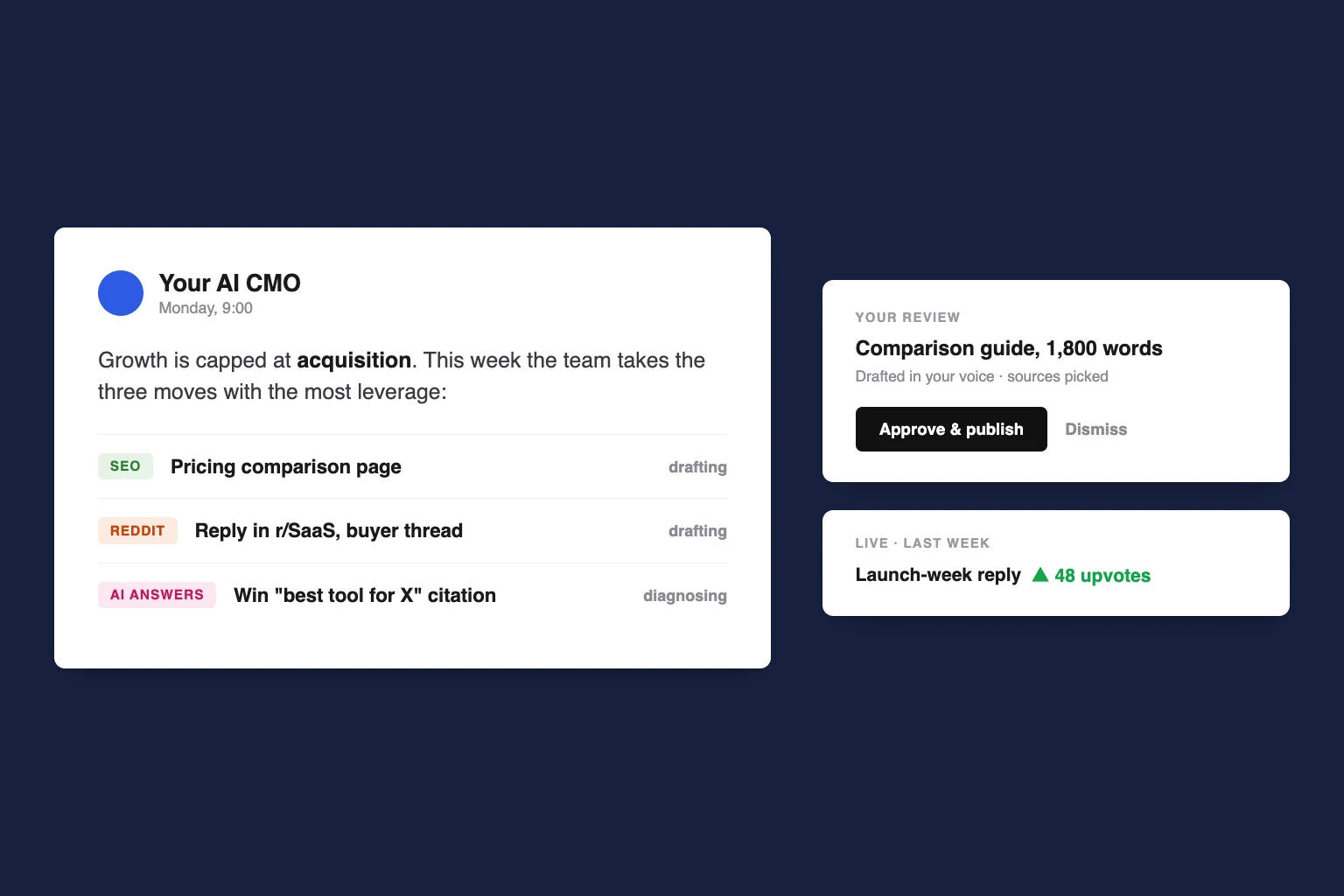
An AI CMO for startups is software that turns a company’s goals into coordinated marketing work across channels, then measures results and improves future recommendations. Unlike a standalone AI writing tool, it can plan campaigns, assign tasks to specialist agents, request approval, publish approved work, and connect performance data back to strategy.
For an early-stage SaaS or DevTools company, that distinction matters. You may already have a website, product analytics, an SEO backlog, and social accounts, but no person responsible for turning them into a consistent growth system.
Key takeaways
- An AI CMO is a coordinated marketing operating system that plans work, delegates tasks to specialist agents, collects approvals, and learns from performance and human feedback.
- The best systems act as a central decision layer, deciding what work should happen next, routing it to the right specialist, and using results to adjust future priorities.
- An AI CMO runs startup marketing by converting a business goal into a sequence of channel-specific tasks, routing those tasks to agents, sending drafts for approval, and using analytics to update the next plan.
- A practical operating loop includes setting a measurable business goal, building a shared context layer, delegating work to specialist agents, and ensuring human approval before publication.
- While an AI CMO can reduce repetitive work and improve coordination, it is not a human CMO replacement and still requires founders to supply product knowledge, customer context, positioning decisions, and quality judgment.
What Is an AI CMO for Startups?
An AI CMO for startups is an AI marketing system designed to perform parts of a chief marketing officers work, including planning, channel coordination, content production, campaign management, and performance review.
The best systems act as a central decision layer. They do not merely generate blog posts or suggest ad copy. They decide what work should happen next, route that work to the right specialist, and use results to adjust future priorities.
A startup AI CMO commonly handles:
- Marketing strategy, such as defining audiences, positioning, and channel priorities.
- SEO planning, including topic research, briefs, internal linking opportunities, and content updates.
- Content production, including articles, landing pages, emails, and social posts.
- Distribution, such as Reddit participation, outreach, social publishing, and email workflows.
- Technical marketing tasks, including site checks, metadata reviews, and conversion issues.
- Analytics, including traffic, rankings, conversions, and channel-level performance.
- Approval workflows, so a founder or marketer reviews work before publication.
The term is still used inconsistently. Some products call one chatbot an AI CMO. Others use it to describe a collection of AI agents directed by a planning layer. Those are very different products.
A useful definition is:
An AI CMO is a coordinated marketing operating system that plans work, delegates tasks to specialist agents, collects approvals, and learns from performance and human feedback.
The category has also appeared in industry research under names such as an AI managed CMO for startups. For buyers, the label matters less than the workflow behind it.
What an AI CMO is not
An AI CMO is not automatically:
- A human CMO replacement.
- A guarantee of qualified leads.
- A content generator with a more impressive name.
- A fully autonomous publisher that should be trusted without review.
- A collection of unrelated AI tools connected by manual exports.
A startup still needs to supply product knowledge, customer context, positioning decisions, and quality judgment. The software can reduce repetitive work and improve coordination. It cannot decide what your company should stand for without useful input.
How Does an AI CMO Run Startup Marketing?
An AI CMO runs startup marketing by converting a business goal into a sequence of channel-specific tasks, routing those tasks to agents, sending drafts for approval, and using analytics to update the next plan.
A practical operating loop looks like this:
- Set a business goal.
- Review the current evidence.
- Choose a marketing priority.
- Create channel tasks.
- Generate drafts and recommendations.
- Request human approval.
- Publish or assign the approved work.
- Measure outcomes and record lessons.
1. Start with a measurable goal
“Get more visibility” is too vague for an AI system. A better instruction would be:
- Increase qualified organic visits to the developer documentation pages.
- Earn five relevant mentions in communities used by technical founders.
- Turn existing product knowledge into 10 search-focused articles.
- Improve demo conversion from a specific product comparison page.
The goal determines which agents should work and what evidence should count as progress.
2. Build a shared context layer
The system needs information about:
- The product and its use cases.
- Ideal customers and buying triggers.
- Competitors and alternatives.
- Customer language from sales calls or support tickets.
- Existing content and its performance.
- Brand rules and prohibited claims.
- Conversion events in analytics.
Without this context, the AI CMO may produce technically correct work that sounds generic or targets the wrong buyer.
For example, a DevTools company selling to engineering leaders should not accept a content plan built around broad “business growth” phrases if its strongest evidence comes from API documentation, migration questions, and integration searches.
3. Delegate work to specialists
A coordinated system might assign tasks to separate agents:
- An SEO agent identifies search opportunities and creates briefs.
- An article writer drafts a page around the selected intent.
- A Reddit or community agent finds relevant discussions and suggests useful responses.
- A technical SEO agent reviews crawlability, metadata, links, and page structure.
- An outreach agent identifies realistic partnership or backlink opportunities.
- An analytics agent tracks movement and reports what changed.
- A content agent adapts approved ideas for social channels.
The AI CMO should determine how these tasks relate. A Reddit question about deployment problems could inform a future SEO article. A page that attracts visits but no signups may trigger a conversion review instead of another article.
That shared learning is one of the clearest differences between an AI CMO and several disconnected AI marketing tools.
4. Put approval before publication
For early-stage companies, approval controls are essential. A useful system should let you review:
- The proposed task and its business reason.
- The source material used.
- The draft or recommendation.
- The target audience and channel.
- Any claims that need verification.
- The expected measurement method.
Approval should also produce feedback the system can reuse. If you repeatedly remove exaggerated claims, reject certain tones, or change how technical examples are explained, those edits should influence later drafts.
5. Close the analytics loop
Marketing automation without measurement creates activity, not learning.
At minimum, connect:
- Search impressions and clicks.
- Organic landing pages.
- Signups, demos, or trial starts.
- Referral and community traffic.
- Content engagement.
- Assisted conversions where available.
- Technical SEO errors.
- Approval and rejection patterns.
A simple weekly review can ask:
- Which pages gained impressions?
- Which topics attracted the right visitors?
- Which channels produced visits without conversions?
- Which approved drafts needed heavy editing?
- Which tasks should stop?
- What should be tested next?
If your company has 15 published articles and dozens of planned briefs, analytics should decide what to update, combine, or deprioritize before the system creates more content.
AI CMO vs AI Marketing Tools vs Human CMO
An AI CMO coordinates marketing decisions and execution, while individual AI tools handle narrower jobs and a human CMO owns judgment, accountability, and high-level direction.
| Factor | AI marketing tool | AI CMO | Human CMO |
|---|---|---|---|
| Main role | Complete one task | Coordinate multiple marketing tasks | Set direction and own outcomes |
| Typical output | Copy, keywords, ads, or reports | Prioritized plan plus channel execution | Strategy, hiring, positioning, and leadership |
| Channel coverage | Usually narrow | Several connected channels | As broad as the team can support |
| Human approval | Varies | Should be built into the workflow | Human-led by definition |
| Learning from edits | Often limited | Should store preferences and corrections | Learns through experience and judgment |
| Analytics connection | May require setup | Central to prioritization | Interprets business context and tradeoffs |
| Cost pattern | Low to moderate subscriptions | Platform cost plus review time | Salary, equity, or consulting fees |
| Best fit | A team with a clear operator | A small team needing daily execution | A company needing leadership and organizational change |
AI marketing tools
Single-purpose tools can be excellent when you know exactly what needs to happen. An SEO platform can help with keyword research. A writing tool can speed up a first draft. A social scheduler can organize approved posts.
The problem appears when the founder has to connect everything manually. Research sits in one tool, drafts in another, analytics in a third, and the strategy exists in a document nobody updates.
AI CMO platforms
An AI CMO earns its name when it handles dependencies between tasks.
For example:
- Analytics identifies a page with growing impressions but low click-through rate.
- The strategy layer recommends a title and snippet review.
- The content agent proposes revised messaging.
- A technical agent checks the page structure.
- The founder approves the changes.
- Analytics measures the result.
That sequence is more useful than asking an AI tool to “write 10 SEO articles.”
Human CMOs
A human CMO remains the better choice when the company needs:
- A major repositioning.
- Pricing or packaging decisions.
- Investor or board communication.
- A marketing team structure.
- Sales and marketing alignment.
- Brand crisis management.
- Deep customer research.
- Executive-level accountability.
An AI CMO can support a human leader, but it should not be given responsibility for decisions that require relationships, taste, or organizational authority.
For a more traditional alternative, compare the role and cost of a fractional CMO. That option gives you a human advisor, while an AI CMO generally gives you more frequent execution at a lower direct cost.
What Is the Best AI Agent for Startups?
The best AI agent for startups is the one that completes a measurable workflow with limited supervision, uses company context correctly, and improves after human feedback. There is no universally best agent across SEO, sales, support, research, and product operations.
For marketing, evaluate the system rather than the chatbot interface.
A good test is to give each candidate the same brief:
Increase qualified signups from technical founders over the next 30 days using existing product knowledge and current website content.
Then inspect whether it can:
- Define a sensible audience.
- Identify the highest-value channel.
- Explain why each task was selected.
- Reuse existing content instead of creating duplicates.
- Produce drafts grounded in the product.
- Ask for approval before publishing.
- Track the result against signups, not only traffic.
- Change its recommendations after your edits.
How to compare the best AI CMO for startups
Use a test project that takes one week. Ask the platform to:
- Audit five existing pages.
- Create two new briefs.
- Suggest three community discussions worth contributing to.
- Identify one technical issue.
- Build a measurement plan.
- Show the approval history.
Score the result from 0 to 2 in each category:
| Evaluation area | 0 points | 1 point | 2 points |
|---|---|---|---|
| Orchestration | Separate outputs only | Basic task list | Dependencies and priorities are clear |
| Context | Generic recommendations | Some product references | Strong use of product and customer evidence |
| Approval | Publishes by default | Manual review is possible | Review is required and feedback is retained |
| Channel coverage | One channel | Several disconnected channels | Several channels share insights |
| Measurement | Activity metrics | Traffic and engagement | Business outcomes guide the next task |
| Editing loop | Edits are discarded | Preferences can be saved | Repeated edits affect future work |
A score of 9 or higher suggests the product may support an operating workflow. A low score does not necessarily make it useless. It may still be a good specialist tool, but calling it an AI CMO would set the wrong expectation.
What about Lindy AI CMO?
Searches for “Lindy AI CMO” usually reflect interest in using a general agent platform to assemble marketing workflows. The key question is whether the setup includes marketing planning, channel specialists, approval controls, and analytics, rather than whether the product can perform one marketing action.
A general-purpose agent may be a good fit if you are comfortable designing triggers, prompts, integrations, and error handling. A dedicated AI CMO may be easier for a founder who wants a predefined marketing workflow.
What is an AI CMO on GitHub?
An “AI CMO GitHub” search often points to open-source agent experiments, prompt libraries, or marketing automation projects. GitHub can be useful for inspecting how an agent works, but repository activity does not prove that a system is reliable for production marketing.
Before adopting an open-source project, check:
- When it was last maintained.
- Whether it has tests and documentation.
- Which data it sends to external services.
- How credentials are stored.
- Whether approval is mandatory.
- How failed tasks are logged.
- Whether analytics events are preserved.
- Who is responsible for updates.
A demo that generates a strategy document is different from a system that safely runs daily marketing operations.
What does an AI CMO icon mean?
An “AI CMO icon” search may be about branding, a dashboard symbol, or a visual asset for an internal workflow. The icon does not tell you what the product can do. When comparing platforms, ignore the interface label and inspect the actual task loop, permissions, integrations, and measurement.
5 Criteria for Choosing an AI CMO
Choose an AI CMO using five criteria: orchestration, approval controls, channel coverage, learning from edits, and measurable outcomes.
1. Orchestration across tasks
Ask whether the system can decide what should happen first.
A useful plan might delay a new article because an existing page already ranks for the topic. It might send a draft to technical review before asking for publication. It might connect a customer question from Reddit to a content brief.
If the product produces a pile of tasks without priorities or dependencies, you still have to act as the marketing manager.
2. Approval and permission controls
Look for separate permissions for:
- Drafting.
- Editing.
- Scheduling.
- Publishing.
- Sending messages.
- Changing website content.
- Accessing analytics.
- Using customer or product data.
The safest default is draft first, review second, publish third. This matters especially for community marketing, where an automated promotional reply can damage trust quickly.
3. Channel coverage that fits your stage
More channels are not automatically better. A technical startup may get more value from SEO, documentation, communities, and founder-led distribution than from launching six social accounts.
Choose coverage based on your buying process. The platform should support the channels you can review and maintain. It should also explain how work in one channel informs another.
You can use a B2B marketing agency comparison to clarify which activities you want software to handle and which require outside human support.
4. Learning from edits
A draft is not useful if the system repeats the same mistakes every week.
Test whether it learns that:
- Your audience prefers technical examples over broad claims.
- Certain terms are inaccurate for your product.
- Your brand uses short paragraphs.
- You do not publish without a source check.
- A particular CTA attracts low-intent leads.
- Community replies should answer the question before mentioning the product.
This is different from saving a static tone preference. The best feedback loops connect edits to content quality, channel rules, and future recommendations.
5. Measurement tied to business outcomes
Do not choose a platform because it reports hundreds of completed tasks. Ask what it considers success.
For SEO, that might include qualified impressions, clicks, signups, and assisted conversions. For community participation, it might include relevant profile visits, referral traffic, or product conversations. For an email campaign, it could include activated users rather than opens alone.
You should be able to see why the system recommends the next task.
How to Set Up an AI CMO in 7 Steps
Set up an AI CMO by starting with one business goal, connecting reliable data, limiting permissions, and reviewing the first work manually.
1. Choose one outcome
Pick one outcome for the first 30 days:
- More qualified organic signups.
- More demo requests from a defined segment.
- Better conversion from existing high-intent pages.
- A repeatable community contribution process.
Do not begin with “automate all marketing.” That makes it impossible to tell what worked.
2. Document the product and audience
Create a short source of truth containing:
- What the product does.
- Who buys it.
- Who should not buy it.
- Common objections.
- Approved customer examples.
- Competitor distinctions.
- Claims that require evidence.
- Words or promises to avoid.
A three-page document is enough for a first test if it is specific.
3. Connect analytics and existing assets
Give the system access to the data it needs, but start with read-only permissions where possible.
Connect:
- Website analytics.
- Search performance data.
- Conversion events.
- Existing articles and landing pages.
- Product documentation.
- CRM or signup data, if relevant.
The system should understand what already exists before recommending new work.
4. Define your approval policy
Write clear rules such as:
- No public reply without approval.
- No new claim without a source or internal confirmation.
- No website change without a preview.
- No outbound message without a named recipient and reason.
- No article brief without a defined search intent.
- No campaign judged only by impressions.
This turns human review into an operating control instead of an informal habit.
5. Select the first channel
Start with one channel where you have enough evidence and can review the output. SEO is often a practical choice if the site already has content and search data. Community marketing can work if the founder understands the communities and approves every contribution.
Avoid starting with a channel where you have no audience, no conversion tracking, and no ability to review the output.
6. Run a small task batch
Ask for a limited batch:
- Two content briefs.
- One update to an existing page.
- Three community response suggestions.
- One analytics report.
- One technical SEO review.
Review every output. Note what was accurate, what was generic, and what required correction.
7. Measure, edit, and expand slowly
After two to four weeks, compare:
- Time spent reviewing work.
- Number of approved outputs.
- Number of rejected outputs.
- Traffic and conversion changes.
- Quality of recommendations.
- Repeated errors.
- Which channels produced useful signals.
Only add another channel when the first workflow is stable. If you are comparing several vendors, document the decision and recurring costs on your Sparqo pricing page, then compare those costs with the time your team will still spend on review.
When an AI CMO Is the Wrong Choice
An AI CMO is the wrong choice when your marketing problem requires senior judgment, direct relationships, original customer research, or a major change in company direction.
Choose a human CMO, consultant, or agency first when:
- Your positioning is still changing every few weeks.
- You have not spoken with enough customers.
- Your product has serious retention problems.
- Sales and marketing disagree about the target buyer.
- You need a launch strategy involving partners and press.
- The company is entering a regulated or high-risk market.
- No one can review the systems output.
- Your analytics does not track a meaningful conversion event.
It is also the wrong choice if you only want a faster writing tool. A specialist tool may cost less and require less setup.
How much does a CMO make at a startup?
A startup CMO can be paid through salary, equity, consulting fees, or a combination. A full-time US CMO at a funded startup may fall roughly in the $150,000 to $300,000 annual salary range, but the actual figure varies sharply by stage, location, funding, company size, and scope.
For a pre-seed company, a fractional CMO or project-based advisor may be more realistic than a full-time executive. An AI CMO has a different cost structure: subscription fees plus the founders time for setup, review, and strategy decisions.
Treat salary ranges as planning estimates, not universal benchmarks. The responsibility matters more than the title.
How much equity should a CMO get in a startup?
There is no standard CMO equity percentage. A rough negotiation range might run from 0.25% to 2%, with larger grants more common for an early executive accepting below-market cash and taking company-level risk.
Evaluate the offer using:
- Company stage and valuation.
- Cash salary discount.
- Full-time or fractional commitment.
- Whether the person is an executive or advisor.
- Scope of responsibility.
- Vesting period and cliff.
- Option exercise terms.
- Expected impact on fundraising and growth.
A part-time advisor should not usually receive the same grant as a full-time founding executive. Ask for the percentage on a fully diluted basis and have a qualified lawyer review the agreement.
Who are the Big 4 AI agents?
There is no universally accepted “Big 4” group of AI agents. The phrase can refer to different vendors, agent frameworks, or categories depending on who uses it.
For startup marketing, classify agents by function instead:
- Planning agent, which selects priorities and assigns work.
- Creation agent, which drafts content and campaign assets.
- Distribution agent, which prepares approved work for channels.
- Analytics agent, which measures performance and recommends changes.
This functional model is more useful than a fixed list of four brands because products change quickly. Evaluate what each agent can do, what permissions it has, and whether it shares context with the others.
An AI CMO should coordinate those functions while keeping a human in control of public-facing decisions.
FAQs
Q: What is an AI CMO for startups?
A: An AI CMO for startups is software that plans marketing, delegates work to specialist agents, supports multiple channels, collects human approval, and uses performance data to improve future tasks.
Q: What is the best AI agent for startups?
A: The best AI agent depends on the workflow. For marketing, choose the system that understands your product, coordinates tasks, requires approval before publication, measures business outcomes, and learns from your edits.
Q: How much does a CMO make at a startup?
A: A full-time US startup CMO may earn roughly $150,000 to $300,000 in salary, but stage, location, funding, and responsibility can move the number substantially. Fractional CMOs and advisors often use different fee and equity structures.
Q: How much equity should a CMO get in a startup?
A: There is no fixed standard. A rough planning range is 0.25% to 2%, with the final amount depending on cash compensation, company stage, time commitment, vesting, and executive responsibility.
Q: Who are the Big 4 AI agents?
A: There is no official Big 4 of AI agents. For startup marketing, it is more practical to assess planning, creation, distribution, and analytics agents, then check whether one system coordinates them safely.

Founder of Sparqo, building an AI CMO that runs SEO, AI visibility and Reddit for indie founders and small teams who do their own marketing.