AI marketing tools are software that uses language models and automation to handle repetitive marketing tasks, everything from drafting social posts to clustering keywords and scheduling content. They run the gamut from single-purpose generators (one blog post at a time) to full platforms that coordinate multiple channels with a human review step.
Most founders hit the same wall: they sign up for a content generator, crank out a flood of mediocre posts, then notice nothing connects to any real strategy. The tools work in isolation. The founder still manages ten tabs, juggles prompts, and manually bridges the gap between what the AI wrote and what their audience needs.
This guide explains what these tools do, where the categories differ, and how to build a stack that does not create more work than it saves.
Key takeaways
- AI marketing tools automate repetitive marketing tasks from drafting social posts to clustering keywords, spanning single-purpose generators to multi-channel platforms.
- These tools functionally categorize into content generation, research/intelligence, orchestration/workflow, distribution/placement, and analytics/optimization, with content generation being a common but often isolated starting point.
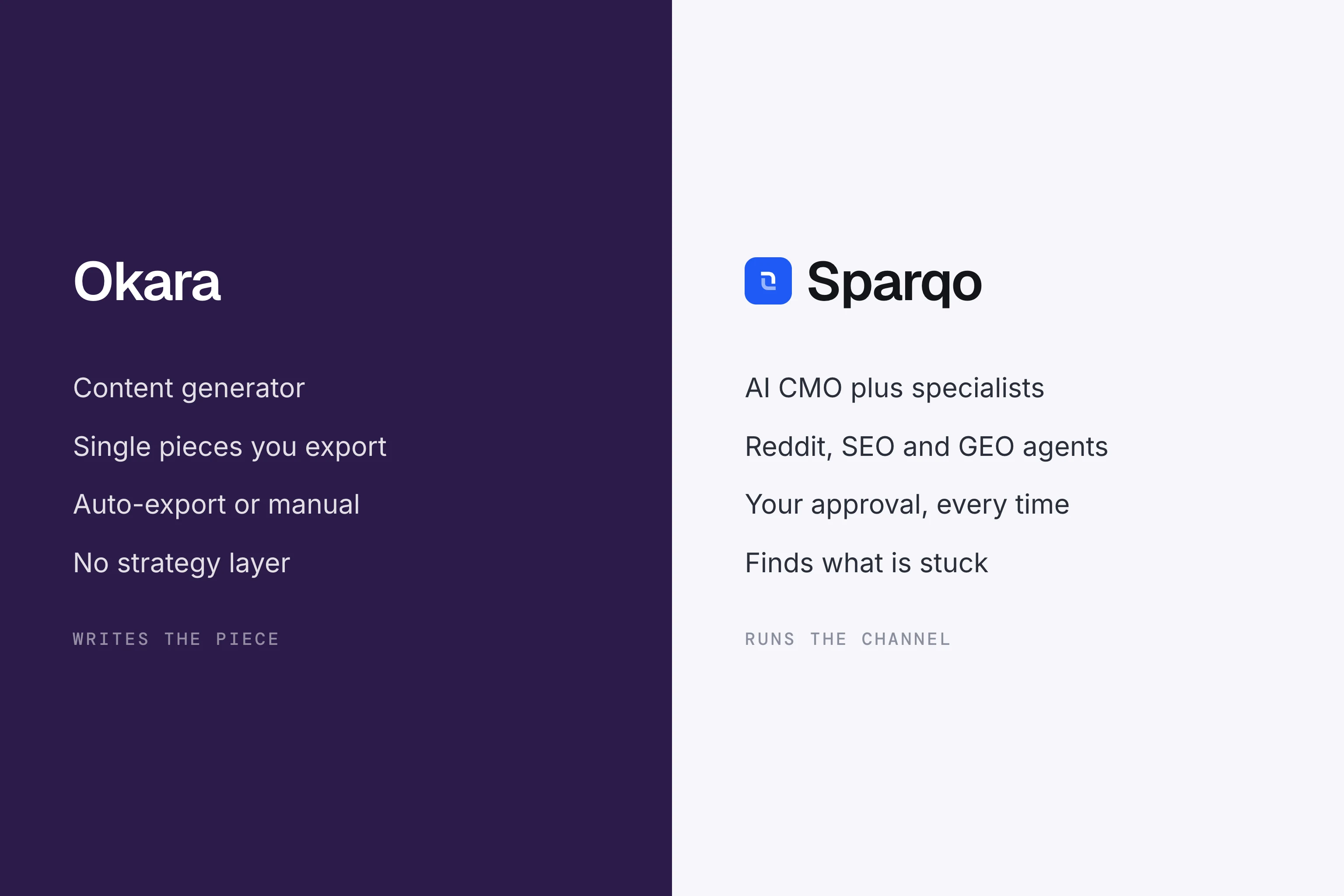
- A key distinction is between a 'content generator' (single channel, speed-focused, optional human involvement) and an 'AI marketing platform' (multi-channel, outcome-focused, required approval gates, learns from feedback).
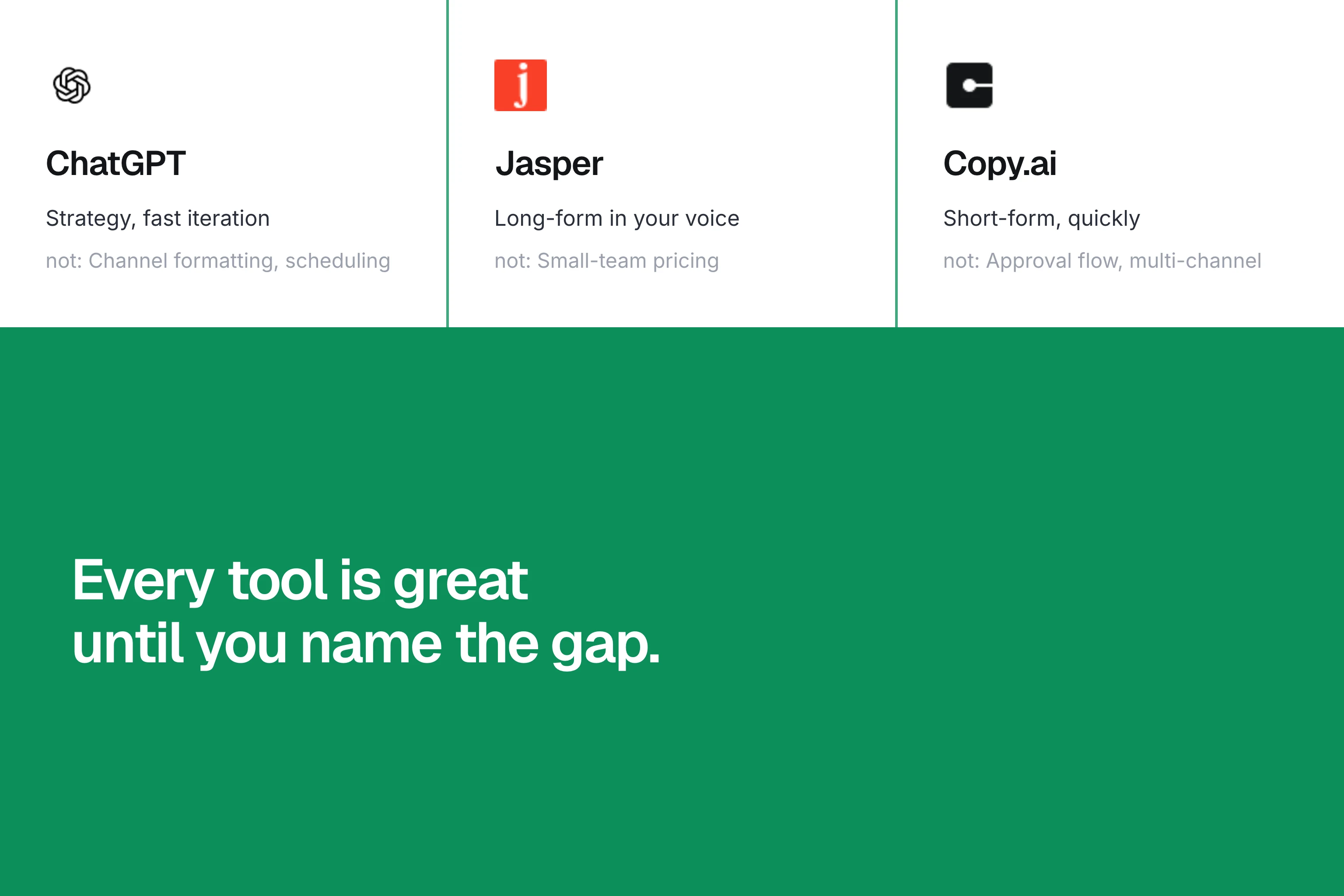
- General-purpose AI models like ChatGPT are not marketing tools and require manual orchestration, while specialized tools like Jasper add templates and voice control but lack cross-channel coordination.
- Prioritize automating keyword research/clustering and first-draft generation for owned channels, as these tasks are time-consuming with low variance in AI-driven quality and offer high payoff.
What AI Marketing Tools Do
AI marketing tools fall into roughly five functional buckets. Understanding this split matters because "AI marketing tool" is a marketing label, not a technical category. A keyword research agent and an auto-posting scheduler share almost no code but get sold in the same breath.
Content generation tools draft copy. Blog posts, LinkedIn updates, ad headlines, email sequences. They take a prompt, run it through a fine-tuned model, and output text. Quality varies wildly. The best ones (Jasper, Copy.ai) let you define brand voice and enforce constraints. The worst ones pump out generic fluff that needs full rewrites.
Research and intelligence tools analyze data. SEO platforms cluster keywords, predict intent, and surface content gaps. Social listening tools track brand mentions and sentiment. Some (like SurferSEO) blend research with generation, scoring drafts against competitor content before you publish.
Orchestration and workflow tools manage the pipeline. They schedule posts, route tasks between team members, and sync calendars across channels. True orchestration includes decision logic: if engagement drops on LinkedIn, shift budget to Reddit. Most tools stop at scheduling.
Distribution and placement tools handle the last mile. They auto-post to social platforms, submit to ad networks, or push content to email lists. This is where bans happen. Platforms cracked down hard on automated posting in 2025 and 2026. Reddit, X, and LinkedIn all tightened rate limits and detection. Tools that post without human review get accounts suspended fast.
Analytics and optimization tools measure what worked and suggest changes. Some close the loop automatically (A/B test headlines, pick the winner). Others just dump data into dashboards you ignore.
Most founders start with content generation because it feels like progress. You see words on the page. But generation without distribution is a filing cabinet. Distribution without orchestration is chaos. The real payoff comes from tools that connect the pieces, not from better prompts in isolation.
AI Marketing Platform Vs Content Generator
This distinction trips up almost every early-stage team. A content generator makes assets. A platform coordinates work across channels, enforces quality gates, and learns from feedback. The gap is architectural, not incremental.
| Factor | Content Generator | AI Marketing Platform |
|---|---|---|
| Scope | Single channel, single task | Multi-channel orchestration |
| Human involvement | Optional, often bypassed | Required approval gates |
| Learning loop | Static or manual prompt tuning | Learns from every approval/edit |
| Failure mode | Spam output, account bans | Slower output, higher quality |
| Best for | High-volume, low-stakes content | Strategic distribution with brand risk |
| Pricing model | Per-seat or usage credits | Flat subscription typical |
Content generators optimize for speed. Platforms optimize for outcomes. If you are posting memes to a brand account with no followers, a generator is fine. If you are building reputation in technical communities where one bad post gets you banned, you need the platform.
The "big 3" AI tools most founders know are ChatGPT, Claude, and Gemini. These are general-purpose models, not marketing tools. They draft well but do not schedule, track, or learn. Using them for marketing means you become the orchestration layer. That works for a week, then you are back to ten tabs and manual copy-paste.
Jasper and Copy.ai sit in the middle. They add marketing-specific templates and brand voice controls on top of base models. SurferSEO adds research and scoring. But none orchestrate across channels. You still export from Jasper, open Surfer, check scores, open Buffer, schedule, open analytics, compare. The tools do not talk.
Sparqo takes the platform approach: specialist agents for Reddit, SEO, GEO, X, and LinkedIn, all coordinated by a CMO agent that identifies your growth constraint and routes work to fix it. Nothing publishes without your approval. The system learns from every edit. This is slower per-post than auto-generation, but it does not get you banned and it improves over time.
Which Marketing Workflows To Automate First
Not everything should be automated. Some tasks need human judgment. Others are pure overhead that drains founder energy. Prioritize by payoff: what takes the most time and has the lowest variance in quality when handled by AI?
First: keyword research and clustering
Manual keyword research is soul-crushing. You start with a seed term, expand through autocomplete, check volumes one by one, group semantically related phrases by hand. AI tools do this in seconds. They predict intent, cluster by topic, and flag gaps where competitors rank but you do not.
The key is using tools that integrate with your content calendar. Research that lives in a spreadsheet dies there. Route clusters directly to draft assignments or your content queue.
Second: first-draft generation for owned channels
Blog posts, newsletter issues, LinkedIn thought leadership. These are low-risk (you control the publish button) and high-volume. AI drafts save 60-70% of writing time if you have a clear brief. Without a brief, you get generic rambling that takes longer to fix than writing from scratch.
Set hard constraints: target keyword, intended audience, key points to cover, tone reference. The AI cannot read your mind. Vague prompts produce vague output.
Third: social distribution with human approval
Drafting posts for Reddit, X, and LinkedIn is automatable. Publishing them without review is reckless. Community norms differ. A post that works on LinkedIn gets you banned on Reddit. Timing matters. Context matters. Automate the drafting, not the button-push.
This is where most tools fail. They optimize for "set it and forget it" and get your account suspended. The right workflow is: AI drafts → human reviews → one-click approve or edit → publish. Any tool that skips the middle step is a liability.
Fourth: analytics synthesis
Dashboards overflow with data. AI tools that summarize trends, flag anomalies, and suggest specific actions (not just "engagement is down 12%") save cognitive load. Look for tools that output decisions, not just reports.
Do not automate yet: crisis response, partnership outreach, pricing strategy, brand positioning. These need human judgment and context AI lacks.
Where AI Tools Break Down
AI marketing tools have failure modes that do not show up in demos. Knowing them prevents bad investments and wasted setup time.
The context gap
AI tools know patterns, not your business. They will suggest you write about "AI marketing trends" because it is a high-volume keyword, even if your product has nothing to do with trends and everything to do with infrastructure. They cannot prioritize by business strategy. You have to feed that in constantly.
The platform arms race
Social platforms and search engines change fast. What worked in 2024 (auto-posting threads to X) got throttled in 2025. What ranked in Google in early 2025 (AI-generated roundup posts) got hammered by algorithm updates later that year. Tools that do not update their tactics become liabilities. Check release notes. If the vendor has not shipped meaningful updates in six months, their advice is stale.
The approval bypass
Every tool promises "human in the loop." Most make it easy to skip. One-click "approve all" buttons. Bulk scheduling that bypasses review. The path of least resistance becomes spam, and spam gets banned. If your workflow allows bulk approval without reading, you will eventually approve something damaging.
The learning loop fiction
Many tools claim to "learn your preferences." What they usually mean is: they store your past prompts. Real learning requires feedback on outcomes (this post performed well, that one flopped) and adjustment to future recommendations. Few tools close this loop. Most just replay what you typed before.
The integration tax
Each new tool adds sync overhead. Export from research tool, import to generator, export to scheduler, check analytics in a fourth tab. The AI does not bridge these gaps. You do. The more tools in your stack, the higher the coordination cost. This is why orchestration matters more than point solutions.
Why Human Approval Still Matters
Mandatory human approval is not a speed bump. It is the feature that keeps your accounts alive and your reputation intact.
Platform enforcement accelerated in 2025 and 2026. Reddit banned thousands of accounts for automated posting. LinkedIn throttled reach for accounts using third-party schedulers that bypassed native controls. X introduced stricter rate limits and CAPTCHA challenges for suspicious automation patterns. The pattern is clear: platforms want humans in the loop, and they punish tools that try to remove them entirely.
Beyond bans, there is brand risk. AI drafts sound plausible but hallucinate facts, misread tone, and miss cultural context. A post that reads fine to you might alienate your core audience. A claim that seems harmless might be legally risky in your jurisdiction. You cannot automate liability away.
The right model is: AI proposes, human disposes. Draft at scale, review with focus, approve with confidence. This is slower than full automation and faster than writing everything yourself. It is the only sustainable path for technical founders building reputation in communities that punish inauthenticity.
Sparqo enforces this by design. The CMO agent routes tasks to specialist channel agents. They draft daily on schedule. Nothing publishes until you click approve. The system learns from your edits, but you stay in control. This is not a compromise between speed and safety. It is the architecture that makes speed possible without catastrophic failure.
How To Choose The Right Stack
Your stack should match your team size, your risk tolerance, and your workflow bottlenecks. Not the workflow you imagine. The one you have.
Step 1: Map your time spend
Track a week. Where do marketing hours go? If you are spending 40% on keyword research and 10% on posting, optimize research first. If you are drafting fast but never publishing because you fear the tone is off, you need approval workflows, not better prompts.
Step 2: Audit your current tools for integration
List every tool you pay for. Note which export to which. If you have three tools that do not talk and you are the API between them, you have a coordination problem, not a capability problem. Prioritize tools that orchestrate or replace the mess.
Step 3: Evaluate by failure mode, not feature list
Every vendor demos the happy path. Ask: what happens when the AI hallucinates? What happens when a platform changes its API? What happens when my account gets flagged? The tools with good answers to these questions are the ones that last.
Step 4: Start with one channel, prove value, expand
Do not buy a full-stack platform on day one. Pick your highest-payoff channel (usually the one where you already have traction) and automate it end to end. Measure time saved and outcome quality. Only then add channels.
Step 5: Plan for the learning loop
Choose tools that improve from your feedback. Not just "save my prompts" but "adjust future recommendations based on what worked." This compounds. A tool that learns becomes more valuable over time. A tool that does not becomes technical debt.
For most indie founders and small dev teams, the right 2026 stack looks like: one orchestration platform handling research, drafting, and scheduled approval across 2-3 core channels, plus native analytics for closed-loop learning. Not ten point solutions. Not a general chatbot doing everything manually. A system that coordinates specialist work and keeps you in the loop.
See our practical guide to marketing tools in 2026 for specific tool comparisons, or read how AI agents for marketing work if you want the technical architecture.

Founder of Sparqo, building an AI CMO that runs SEO, AI visibility and Reddit for indie founders and small teams who do their own marketing.