AI tools can write technical content for devtool audiences without sounding generic, but only with deliberate constraints on context, style, and approval gates. Raw AI output defaults to vague explanations, hedged claims, and surface-level code examples that experienced developers immediately dismiss. The fix is a workflow that feeds the AI specific technical context, enforces style constraints that match your audience's sophistication, and requires human review before publication.
Generic technical content costs you credibility. Developers have seen thousands of blog posts explaining "what is Kafka" with the same three bullet points. They want implementation details, failure modes they will actually hit, and opinions formed from real usage. AI without guardrails gives none of this.
Key takeaways
- AI outputs for technical content default to vague explanations, hedged claims, and surface-level code examples, which experienced developers recognize as generic.
- To produce quality technical content for devtool audiences using AI, a workflow must integrate specific technical context, audience-matched style guidelines, and human review gates.
- Effective AI-generated technical writing requires structural constraints that override the AI's default 'median content' behavior, such as detailed context, specific audience signals, and concrete output constraints.
- AI is a draft accelerator, not a replacement for technical judgment; it excels at coherence but struggles with correctness and concreteness, necessitating human verification steps.
- AI-generated technical content often violates the '3 Cs' (Clarity, Conciseness, Completeness) and struggles with 'Correct' and 'Concrete' aspects of the '7 Cs' framework for quality technical communication.
What Makes AI Technical Writing Sound Generic
AI defaults to median content because its training optimizes for plausibility over specificity. Ask it to explain a database migration and you get: "First, back up your data. Then run the migration. Finally, verify results." Technically true. Completely useless.
Three patterns dominate bad AI technical writing:
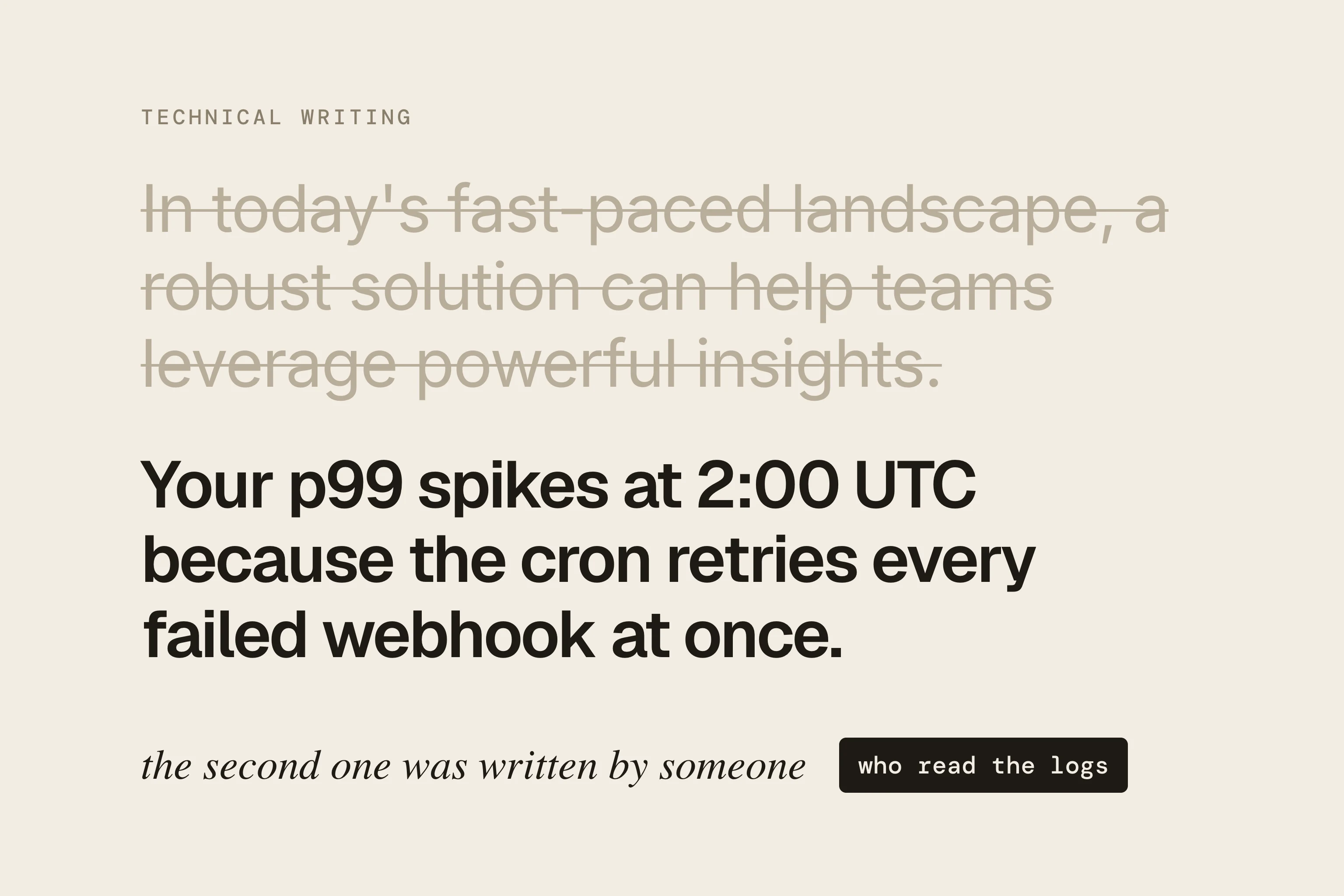
Abstraction without anchoring. Phrases like "scalable solution" or "robust architecture" appear without concrete constraints, throughput numbers, or tradeoff discussions. A senior engineer reading this thinks: "scalable to what? 1K requests or 1M? what was sacrificed?"
Hedging that undermines authority. "You might consider..." "It could be helpful to..." Developers trust writers who state what they do and why, then own the consequences. AI hedges because it has no consequences.
Surface-level code examples. Twenty-line snippets that compile but solve no real problem. Missing: error handling, environment assumptions, performance characteristics under load.
The root cause is prompt context. Most users ask AI to "write a blog post about X" without feeding it audience sophistication level, specific pain points, examples from their actual codebase, or style references they want to emulate. Why Generic AI Content Will Never Build You An Audience covers this trap in detail: AI left unsupervised becomes a writing coach that never pushes back.
Can AI Write Technical Content For DevTool Audiences
Yes, with structural constraints that override its default behavior. The question is not whether AI can generate words about technical topics. It is whether those words pass the sniff test of developers who have built real systems.
At Sparqo, we run AI agents that draft technical content daily for B2B devtool companies. The difference between garbage and usable output is the input architecture:
| Component | What Most People Do | What Produces Specific Output |
|---|---|---|
| Context | "Write about Postgres optimization" | Full query plan, slow query logs, hardware constraints, ORM version |
| Audience signal | "for developers" | "senior backend engineers who have already tuned indexes and need query planner hacks" |
| Style anchor | None | Specific articles from target publication with notes on what to emulate |
| Output constraints | Word count | Specific sections: failure modes first, then workaround, then benchmark numbers |
| Review gate | Publish after glance | Technical accuracy checklist before approval |
Without this structure, AI writes for an imaginary junior developer who needs basic concepts explained slowly. With it, AI can draft content that senior engineers find worth their time.
The key recognition: AI is a draft accelerator, not a replacement for technical judgment. GPT-3 for Code Generation and Explanation: Opportunities and Challenges documents how large language models handle code explanation well for simple cases but struggle with context-dependent reasoning, edge cases, and performance implications. Your workflow must route around these gaps.
The 3 Cs And 7 Cs Of Technical Writing
Technical communication has established quality frameworks. AI output can be evaluated against them.
The 3 Cs of Technical Writing
Clarity. One idea per sentence. Precise terms over fancy vocabulary. "The query planner chose a sequential scan" not "The database made a suboptimal decision regarding data retrieval strategy."
Conciseness. Remove words that add no information. "In order to" → "To." "It is important to note that" → nothing. Developers scan; verbosity signals you don't respect their time.
Completeness. Cover prerequisites, steps, expected outcomes, and common failures. Incomplete documentation wastes more time than it saves.
AI violates all three by default. It loves compound sentences, filler phrases, and optimistic paths that ignore edge cases.
The 7 Cs of Technical Writing
A more comprehensive framework used in professional technical communication:
- Clear, obvious meaning, no ambiguity
- Correct, technically accurate, no errors
- Complete, all necessary information included
- Concrete, specific examples, real data
- Coherent, logical flow, connected ideas
- Courteous, respectful of reader's time and knowledge
- Considerate, appropriate for audience level
AI hits "coherent" easily. It fails hardest on "correct" and "concrete" because it cannot verify facts against reality, only against training data patterns. AI-Assisted Scientific Writing: A Critical Perspective notes this limitation: models generate plausible-sounding but potentially fabricated citations, numbers, and technical claims.
Your workflow must add verification steps that AI cannot perform itself.
Best AI For Technical Writers: What To Compare
No single tool solves technical writing. Compare across dimensions that matter for your workflow:
| Tool Type | Representative Options | Strength | Weakness for DevTools |
|---|---|---|---|
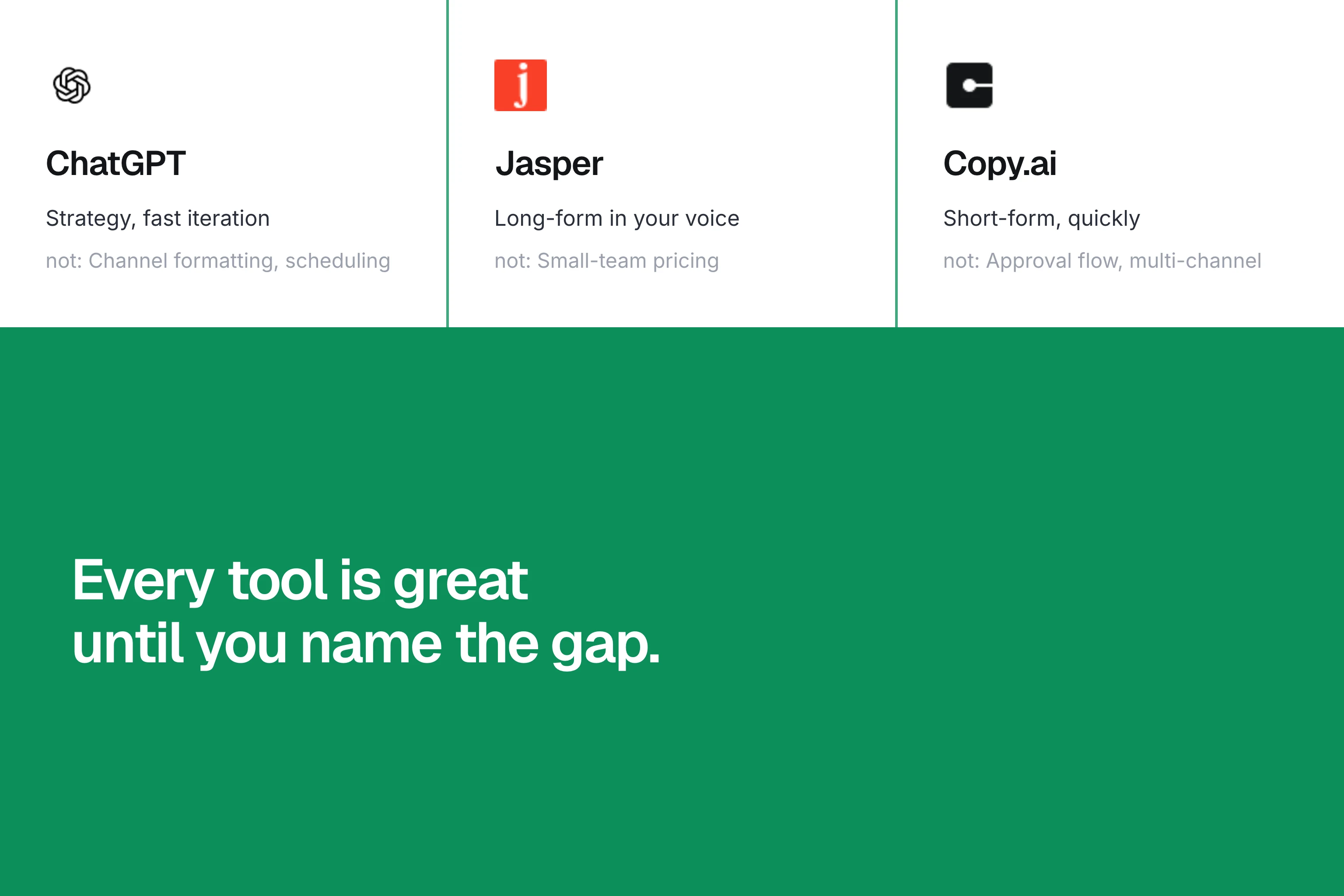
| General LLMs | Broad knowledge, fast iteration | No native technical validation, generic defaults | |
| Code-specialized models | Code generation, syntax awareness | Weak on prose architecture, explanation flow | |
| Documentation platforms with AI | Integration with docs infrastructure | Template-heavy output, limited style control | |
| AI-native documentation tools | Archie, Kudra (emerging) | Structured doc generation | Early, unproven for complex technical domains |
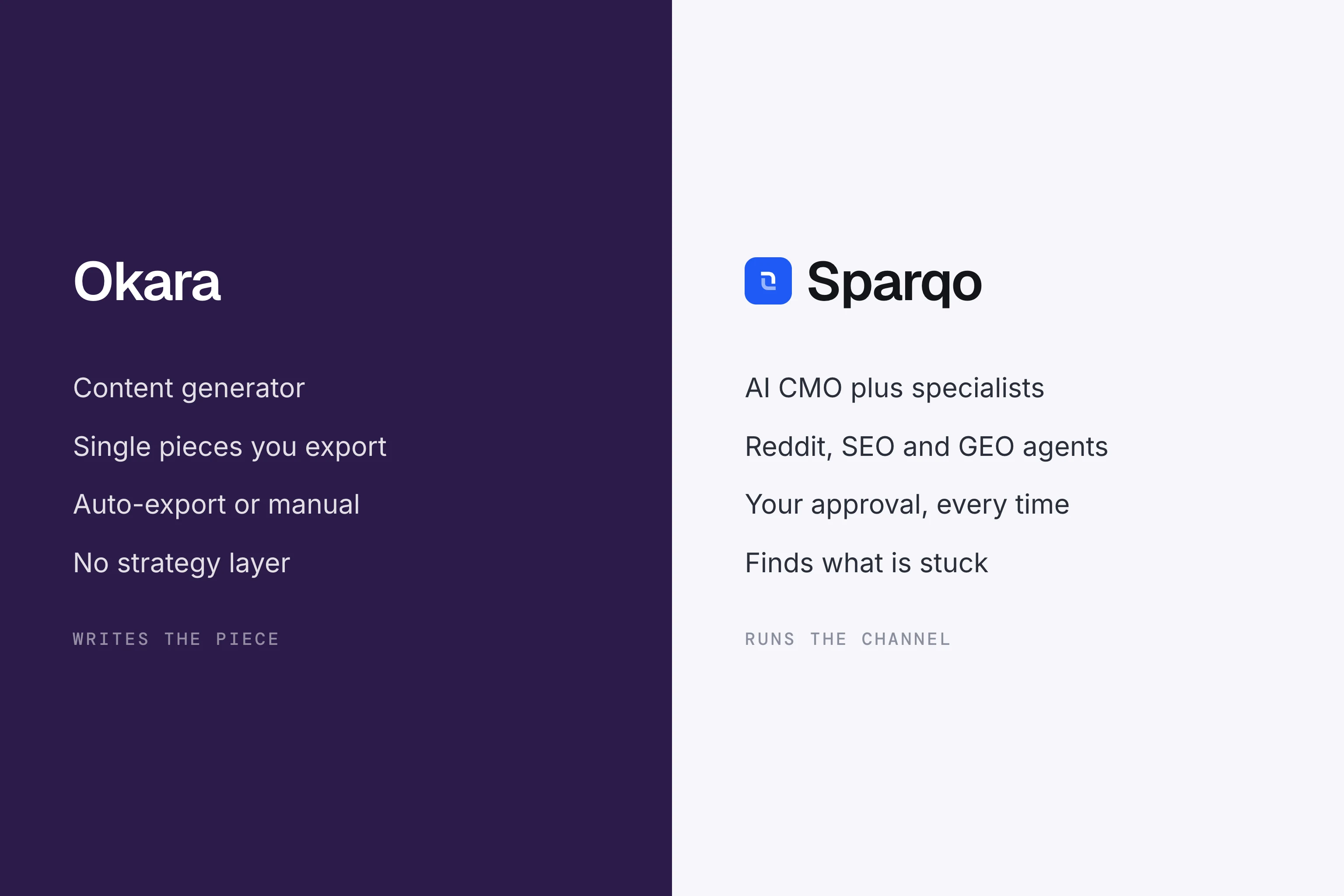
| Agent orchestration systems |  Sparqo, custom pipelines Sparqo, custom pipelines | Multi-channel with approval gates, learning from edits | Setup overhead, requires process commitment |
For devtool technical content, the decision is rarely "which model" and usually "which workflow around the model." A mediocre model with excellent context preparation and review beats a frontier model with bare prompts.
Consider these evaluation criteria:
Context window size. Technical documentation often requires feeding large codebases, API schemas, or error logs. Smaller windows force destructive summarization that loses nuance.
Instruction following precision. Some models drift from constraints mid-generation. Test with specific requirements: "never mention X," "always include Y metric." Grade on compliance rate.
Output consistency. Same prompt, multiple runs: how much variation? Documentation needs predictability.
Integration depth. Can the tool ingest your actual code, support tickets, or Slack threads for context? Or does it only see what you manually paste?
How To Get Specific Output From AI
Specificity is the antidote to generic AI writing. This workflow produces technical content that developers trust:
Step 1: Build context documents
Create files the AI references every time:
- Persona.md: Seniority, technologies they already know, specific frustrations with current solutions
- Style.md: Voice characteristics (dry humor, direct warnings, no hype), sentence length targets, taboo phrases
- Examples.md: Past articles with annotations: "lead with failure mode," "include benchmark," "skip basic setup"
Sparqo's agent system treats these as persistent memory, applying them across every draft rather than hoping each prompt reinvents the wheel.
Step 2: Constrain the generation space
Use structured prompts that remove degrees of freedom:
| Weak Prompt | Constrained Prompt |
|---|---|
| "Write about connection pooling in Node.js" | "Explain connection pool exhaustion in Node.js pg-pool. Start with the specific error 'sorry, too many clients already'. Cover: default pool size (10), why that fails under load, the exact env var to adjust, and a concrete symptom from our logs where latency spiked to 8s. Tone: engineer explaining to engineer who inherited this mess." |
The constrained version removes ambiguity about scope, depth, and voice.
Step 3: Require failure mode coverage
Add to every prompt: "Include three specific failure modes and how to diagnose them." AI defaults to happy paths. Force the uncomfortable territory where real engineering happens.
Step 4: Implement approval gates with technical review
No AI-generated technical content publishes without human review. At minimum:
- Accuracy check: Verify every command, version number, and claim about behavior
- Specificity audit: Highlight vague phrases, demand replacement with concrete details
- Voice match: Compare against style guide, flag deviations
At Sparqo, our CMO agent routes drafts through approval workflows before any channel publication. This prevents the spam-like publishing that gets accounts banned and brands damaged.
Step 5: Feed edits back as training signal
When you correct AI output, capture why. "Changed 'might improve performance' to 'reduced p99 latency from 450ms to 80ms' because specifics build credibility." Systems that learn from these corrections, like Sparqo's feedback loop, improve faster than those that don't.
Where AI Still Fails Hard
Know the boundaries. AI cannot reliably:
- Restructures an explanation you already got right
- Drafts the connective prose between examples
- Holds a style guide across a long document
- Turns your notes into a first pass in minutes
- Verify a version, an endpoint or a flag against reality
- Judge when a reader is bored
- Invent the failure modes that only show up in production
- Stay consistent across a spec without a human pass
Verify technical accuracy against current reality. It does not know your current dependency versions, infrastructure state, or whether that API endpoint still exists. It will confidently describe deprecated features.
Judge complexity appropriateness. It cannot sense when a reader's eyes are glazing. It may over-explain simple concepts or skip critical background the reader actually needs.
Invent realistic failure scenarios. Its "common errors" are often generic or hallucinated. Real failure modes come from production incident logs, not training data patterns.
Maintain consistency across long documents. Technical specifications need internal coherence. AI drifts: renames concepts, changes tense, forgets constraints established in section 1 by section 5.
Generate truly novel architectural insights. It remixes existing patterns. Breakthrough technical writing, the kind that gets cited and shared, requires human judgment about what matters next.
These gaps mean AI is a drafting tool, not a publication-ready generator. The fractional CMO model we built at Sparqo acknowledges this: AI handles volume and iteration, humans handle judgment and final approval.
Hila Fish's NDC talk covers the same ground from the docs side: what makes technical writing land, and why engineers stop reading.
Human Review Checklist For Technical Accuracy
Before any AI-drafted technical content goes live:
Factual verification
- Every version number checked against current release
- All commands tested in clean environment
- API endpoints verified live
- Performance claims have source or benchmark
Specificity audit
- No "improves performance" without "reduced X by Y under Z conditions"
- No "scalable" without concrete throughput number
- No "easy to use" or "intuitive" (meaningless to experts)
- All "best practice" claims traced to named source or own experience
Audience match
- Prerequisite knowledge assumed matches actual audience
- No concepts explained that audience already knows
- Depth appropriate to seniority level signaled
Voice consistency
- Tone matches brand style guide
- Sentence length variation appropriate
- No hedging phrases ("might," "could," "consider") where directness expected
Completeness
- Failure modes covered, not just happy path
- Edge cases acknowledged where relevant
- Next steps or deeper resources provided
This checklist is the minimum viable gate. For content that represents your technical brand, invest in a second set of eyes from someone with domain expertise.
Sparqo runs AI agents for Reddit, SEO, GEO, X, and LinkedIn with this exact workflow: daily drafts, mandatory approval, continuous learning from your edits. If you are building a devtool and need distribution without hiring a marketing team, the structure described here is what we automate. See how it works at https://sparqo.ai/pricing or read our guide on AI-powered content that doesn't waste time.

Founder of Sparqo, building an AI CMO that runs SEO, AI visibility and Reddit for indie founders and small teams who do their own marketing.