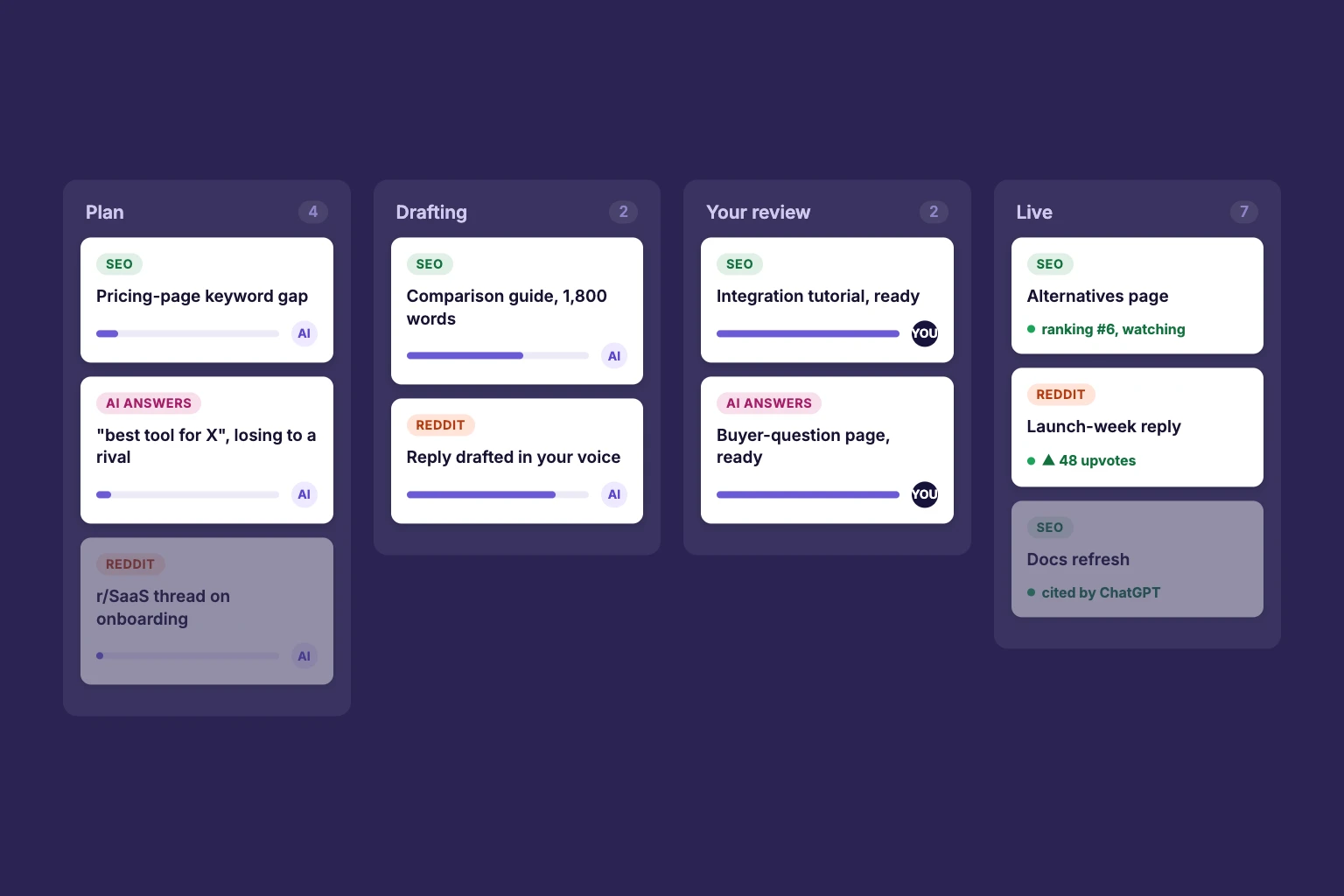
An AI marketing workflow is a repeatable process that uses AI to turn a defined growth constraint into channel-specific marketing drafts, human approvals, scheduled distribution, and measured improvements. The workflow connects strategy, research, content creation, review, publishing, and analytics instead of treating each AI tool as a separate tab.
A useful workflow starts with one business problem. For example, a technical founder might need more qualified visits to a documentation page, not 30 disconnected social posts. The workflow then assigns daily work across SEO, Reddit, LinkedIn, and X, while keeping a person responsible for final approval.
AI creates speed. The workflow creates direction.
Key takeaways
- An AI marketing workflow is a repeatable process that uses AI to turn a defined growth constraint into channel-specific marketing drafts, human approvals, scheduled distribution, and measured improvements.
- A useful workflow starts with one business problem and creates work for multiple channels from shared inputs, always including human approval before publication, and recording what happened.
- An AI marketing workflow is a structured sequence in which AI handles repeatable marketing tasks and people make decisions that require context, judgment, and accountability.
- The workflow connects strategy, research, content creation, review, publishing, and analytics instead of treating each AI tool as a separate tab.
- The process begins by naming a specific growth constraint, defining a measurable conversion event, and building one comprehensive source brief to guide AI content generation across channels.
What Is an AI Marketing Workflow?
An AI marketing workflow is a structured sequence in which AI handles repeatable marketing tasks and people make decisions that require context, judgment, and accountability.
A basic workflow looks like this:
- Identify a growth constraint.
- Define the audience and desired action.
- Gather customer, product, and channel context.
- Generate channel-specific drafts.
- Review claims, tone, targeting, and compliance.
- Publish approved work.
- Measure outcomes.
- Feed the results into the next cycle.
That sequence matters because AI content generation on its own has no operating objective. Give a model the instruction “write five LinkedIn posts” and it will usually produce five posts. It wont know whether the company needs branded search, product signups, developer trust, or better conversion from existing traffic.
An AI marketing workflow gives the model a job with boundaries. It defines:
- The constraint: What is currently slowing growth?
- The audience: Who has the problem and where do they spend time?
- The offer: What should the audience understand, try, or buy?
- The channel: Where should the message appear?
- The evidence: Which customer quotes, product facts, or data support the claim?
- The approval rule: What must a human check before publication?
- The measurement plan: Which event shows progress?
This is why AI marketing automation and AI marketing workflows are related but different. Automation moves work between systems or performs repetitive actions. A workflow explains why those actions happen, in what order, and under whose control.
Atlassian’s overview of AI marketing automation describes common uses such as content assistance, customer segmentation, and campaign optimization. Those are useful capabilities, but the company still needs a decision process around them.
What makes a workflow useful?
A useful workflow has four properties.
It has one primary constraint. If the goal is simultaneously more traffic, more leads, higher retention, and better brand awareness, the AI will produce a pile of unrelated tasks. Pick one constraint for the current cycle.
It creates work for multiple channels from shared inputs. A product update can become a search article, a Reddit discussion, a LinkedIn explanation, and an X post. The angle and format change. The underlying evidence stays consistent.
It includes human approval before publication. AI can miss a community norm, invent a product capability, or phrase a technical claim badly. A review gate catches those failures before they become public.
It records what happened. Store the brief, draft, edits, approval decision, publication date, and result. Without that record, the system cannot distinguish a good idea from a lucky outcome.
How An AI Marketing Workflow Works Step By Step
An AI marketing workflow works best as a daily production loop connected to a weekly strategic review. Daily work creates and improves assets. The weekly review changes priorities when the evidence says the current constraint has moved.
Step 1: Name the growth constraint
Start with a sentence that can be tested.
Weak constraint:
We need more marketing.
Useful constraint:
Qualified developer traffic reaches the pricing page, but few visitors understand how the product fits their existing workflow.
Another useful example:
We have product awareness among indie developers, but no consistent discovery from people searching for AI marketing automation.
The constraint determines the work. If discovery is the problem, the workflow should prioritize search demand, community questions, and answer visibility. If activation is the problem, it should prioritize onboarding content, use-case pages, and customer education.
Write the constraint in this format:
Audience + blocked behavior + suspected reason
Example:
Indie DevTool founders are not starting trials because they cannot see how daily AI drafts fit an approval-based marketing process.
That sentence is specific enough to guide content and broad enough to support several channels.
Step 2: Define the conversion event
Every AI marketing campaign needs a measurable action. It might be:
- A qualified visit to a product page
- A signup
- A booked call
- A documentation page view
- An email reply
- A product activation event
- A branded search
- A relevant community conversation
Use one primary event and a few diagnostic events. For example:
- Primary: trial signup from an organic landing page
- Diagnostic: pricing page visit
- Diagnostic: documentation page visit
- Diagnostic: return visit within seven days
Do not make “engagement” the only measurement. A post can collect likes from people who will never use the product. That may matter for distribution, but it is weak evidence of demand.
Step 3: Build one source brief
The source brief is the shared input for every channel. It should contain facts that the AI can safely reuse.
Include:
- Product name and one-sentence description
- Target audience
- Problem being addressed
- Specific feature or workflow
- Customer language from calls, tickets, or communities
- Proof points
- Claims the company cannot make
- Primary call to action
- Related search terms
- Competitors or alternatives mentioned by customers
- Links to approved product pages
- Publication constraints
Here is a small example for a fictional DevTool:
| Brief field | Example |
|---|---|
| Constraint | Developers find the tool but do not understand setup time |
| Audience | Small platform engineering teams |
| Problem | Configuration feels risky during an active deployment |
| Evidence | Three users completed setup in under one hour |
| Primary action | Read the implementation guide |
| Search angle | Reduce deployment configuration errors |
| Reddit angle | Ask how teams review configuration changes |
| LinkedIn angle | Explain the cost of manual configuration review |
| X angle | Share one practical setup lesson |
| Claim restriction | Do not promise zero deployment failures |
The source brief prevents the common failure where every channel invents its own version of the company. It also gives the human reviewer one place to correct facts.
Step 4: Choose channel jobs
Each channel should have a job. “Post everywhere” is not a strategy.
A practical assignment looks like this:
- SEO: Capture durable search intent with useful pages.
- GEO: Make product explanations clear enough for AI answer systems to understand and cite.
- Reddit: Learn how people describe the problem and contribute to relevant discussions.
- LinkedIn: Explain lessons, decisions, and customer problems in a professional context.
- X: Share short observations, technical notes, and links that can earn repeated attention.
A single topic can serve all five channels, but the output must be native to each environment. Turning one article into five truncated copies is a content repurposing shortcut. It often produces five mediocre assets.
Step 5: Generate drafts with constraints
The AI should receive a different instruction for each channel.
For SEO, specify:
- Search intent
- Primary question
- Page type
- Required evidence
- Internal links
- Terms that need definition
- Reader action
For Reddit, specify:
- Community context
- Whether the post is a question, response, or case study
- What experience the founder can share
- What promotional language is prohibited
- Whether a link is necessary
For LinkedIn, specify:
- One point
- One concrete example
- A useful conclusion
- The audience level
- The desired discussion
For X, specify:
- A single observation
- A clear technical detail
- A link only if it adds value
- No vague motivational language
Prompt length is less important than input quality. A 500-word prompt with no customer evidence still creates generic work. A short prompt containing the exact problem, proof, audience, and constraints can produce a strong first draft.
Step 6: Review before publication
Human review is a control system, not a ceremonial approval button.
Use a review checklist:
- Is the central claim accurate?
- Does the draft address the defined constraint?
- Is the audience obvious?
- Does the channel format fit the community?
- Are examples specific?
- Are technical terms used correctly?
- Are links relevant and working?
- Does the call to action match the reader’s stage?
- Does the draft contain an unsupported statistic?
- Does it sound like a person who has done the work?
- Would the post be useful without the company name?
For Reddit, add two checks:
- Is the contribution useful before the promotion?
- Would the post still belong in the community if the link were removed?
For SEO, add three more:
- Does the page answer the primary query early?
- Does it cover related questions without repeating the keyword?
- Does it provide information gain, such as a template, decision rule, or worked example?
Step 7: Publish and record edits
Save the approved version, not only the first AI draft. The edits contain valuable training data for the next cycle.
Track:
- Original draft
- Human edits
- Approval reason
- Channel
- Topic
- Publication date
- Primary metric
- Secondary metrics
- Follow-up action
If the founder removes inflated claims from every draft, that is a system problem. Add a claim restriction to the source brief. If the founder repeatedly adds technical examples, add a required example field. The workflow should learn through process changes, not through wishful thinking.
Step 8: Review weekly
A weekly review should answer four questions:
- Which channel produced qualified attention?
- Which topic produced the strongest response?
- Which drafts required the most editing?
- Has the growth constraint changed?
A useful review can fit on one page. Do not turn it into a 40-slide marketing report. Small teams need decisions, not decorative analytics.
AI Marketing Workflow Template
Use the following template as the control document for an AI marketing workflow.
Strategy block
Growth constraint:
Target audience:
Blocked behavior:
Suspected reason:
Primary conversion event:
Secondary diagnostic events:
Current evidence:
Main offer:
Review period:
Example:
Growth constraint:
Qualified technical visitors do not understand the product's approval model.

Target audience:
Indie founders and two-person B2B SaaS teams using AI for marketing.

Blocked behavior:
They read about AI marketing automation but do not start a trial.

Suspected reason:
They assume automation means unsupervised auto-posting and spam risk.

Primary conversion event:
Trial signup.

Secondary diagnostic events:
Pricing page visit, product page scroll, return visit within seven days.

Current evidence:
Founder interviews mention fear of low-quality posts and account bans.

Main offer:
A reviewed workflow that produces daily channel drafts.

Review period:
Four weeks.
Content block
Core topic:
Primary search intent:
Customer language:
Product or process facts:
Proof:
Counterargument:
SEO asset:
Reddit contribution:
LinkedIn draft:
X draft:
GEO clarification:
Primary call to action:
Claims to avoid:
The counterargument field deserves attention. It forces the workflow to address skepticism. For the example above, the counterargument might be:
AI drafts can still be generic, so human review only helps if the source brief contains real customer context.
That statement is more credible than pretending approval solves every quality problem.
Approval block
Factually accurate:
Audience is specific:
Channel format is appropriate:
No unsupported claims:
No unnecessary promotion:
Links are relevant:
Call to action fits intent:
Human reviewer:
Approval status:
Required edits:
Measurement block
Published URL:
Publication date:
Impressions or reach:
Qualified visits:
Conversion event:
Conversion rate:
Community replies:
Assisted conversions:
Human edits needed:
Next test:
The template should live somewhere the team will use it. A spreadsheet works for a founder publishing a few assets each week. A project database works when multiple people review drafts. An AI marketing platform becomes useful when it can keep the brief, draft versions, approvals, schedules, and measurement records connected.
This guide to AI marketing workflows for campaigns also emphasizes the connection between planning, execution, and optimization. That connection is the part teams tend to skip when they focus on text generation.
AI Marketing Workflow Examples For Small Teams
The examples below use founder-scale workloads. They assume one person owns approval and has limited time for marketing each day.
Example 1: A DevTool needs qualified search traffic
Constraint: Developers search for the problem but do not find the product.
Weekly asset: One search article targeting a specific implementation problem.
Daily workflow:
- Monday: Analyze search intent and collect customer phrasing from support conversations.
- Tuesday: Draft the article outline and identify missing technical evidence.
- Wednesday: Draft the article, a short LinkedIn explanation, and two X posts.
- Thursday: Review technical accuracy and add internal links.
- Friday: Publish the article and answer related Reddit questions without forcing a product link.
The SEO page should answer the question early, show a concrete workflow, and explain where the product fits. The Reddit contribution should discuss the problem in the language used by practitioners. The social drafts should point to one insight from the article, not repeat the title five times.
Measurement: Track qualified organic sessions, visits to the implementation page, and signups assisted by the article. Do not judge the article only by its first week of traffic. Technical search pages can take time to accumulate impressions.
Example 2: A SaaS product has awareness but weak activation
Constraint: Visitors sign up but do not complete the first meaningful action.
Weekly asset: An activation guide based on the first successful user path.
Daily workflow:
- Monday: Review product analytics and identify the step with the highest drop-off.
- Tuesday: Ask the AI to summarize support questions about that step.
- Wednesday: Draft an activation guide, onboarding email, and LinkedIn explanation.
- Thursday: A product person checks the instructions against the current interface.
- Friday: Publish the guide and update the onboarding sequence.
The AI should not invent onboarding advice from general patterns. Give it the actual event names, interface labels, failure messages, and successful path. If the button is called “Create workspace,” the content should not call it “Start project.”
Measurement: Track completion of the target activation event, time to activation, support requests for that step, and conversion from the guide to the product. A higher pageview count with no activation improvement is a failed test.
Example 3: An indie founder needs distribution without daily posting
Constraint: The founder has useful product lessons but spends no consistent time sharing them.
Weekly asset: One real build or customer lesson.
Daily workflow:
- Monday: Record a 10-minute voice note about a product decision.
- Tuesday: AI extracts the problem, decision, tradeoff, and result.
- Wednesday: Draft a LinkedIn post, an X thread, and a Reddit response from the same evidence.
- Thursday: Founder removes generic phrasing and verifies the result.
- Friday: Publish the approved drafts and record replies that reveal new customer language.
The source material should contain a real decision, such as:
We removed a configuration option because new users treated it as mandatory. Activation improved after the default became automatic.
That produces useful content because it contains context and a consequence. “We are improving the user experience” contains neither.
Measurement: Track relevant replies, profile visits from the target audience, direct mentions of the problem, and qualified visits. Follower growth can be recorded, but it should not outrank conversations with potential users.
Example 4: A small team wants AI for performance marketing
AI for performance marketing can assist with ad variations, audience analysis, landing page ideas, and budget diagnostics. It should not be allowed to create a feedback loop where low-quality ads generate cheap clicks, the clicks become the optimization signal, and the system keeps buying more of them.
A safer workflow is:
- Define the conversion event and acceptable acquisition cost.
- Give the AI approved customer language and product claims.
- Generate multiple ad angles tied to different problems.
- Send each angle to a matching landing page.
- Approve copy and targeting manually.
- Test one variable at a time where practical.
- Review conversions, lead quality, and sales feedback.
- Pause ads that attract the wrong audience, even if click-through rate looks good.
For a technical SaaS, an ad promising “launch in minutes” may attract hobbyists who never need the product. An ad describing a specific deployment bottleneck may generate fewer clicks but better conversations. The workflow needs a quality signal beyond traffic.
AI Marketing Automation Vs AI Marketing Agents
AI marketing automation follows predefined rules to execute repeatable tasks. AI marketing agents can interpret a goal, choose tasks, use connected information, and produce work across several steps, usually within defined boundaries.
The difference is easiest to see in the operating model:
| Factor | AI marketing automation | AI marketing agents |
|---|---|---|
| Primary behavior | Runs predefined triggers and actions | Plans and performs a sequence of related tasks |
| Typical input | Event, schedule, or rule | Goal, constraint, context, and tools |
| Example | Send an email after signup | Find the activation bottleneck and draft an email sequence |
| Flexibility | Predictable but limited | More adaptable, with more review requirements |
| Main risk | Wrong rule runs repeatedly | Agent makes a poor decision or unsupported assumption |
| Best control | Workflow logic and permissions | Approval gates, tool limits, and audit logs |
| Good use case | Routing leads or scheduling emails | Coordinating research, drafting, and channel adaptations |
Automation is often better for deterministic work. If a user submits a form, add the contact to a list. If a trial expires, send a reminder. These actions need reliability and clear conditions.
Agents are more useful when the work requires interpretation. A CMO-style agent could review analytics, identify that organic visits are healthy but conversion from comparison pages is weak, and route work toward a new comparison brief and supporting distribution. That output still needs review. The agent is making a recommendation based on evidence, not receiving a simple trigger.
The two systems can operate together. Automation handles scheduling and data movement. Agents handle research, prioritization, drafting, and adaptation. Human reviewers remain responsible for public claims and high-impact decisions.
This explanation of AI-driven content marketing workflows covers a similar division between planning, creation, review, and distribution. The practical lesson is simple: automate handoffs, not judgment.
How To Choose An AI Marketing Platform
Choose an AI marketing platform based on the workflow it can support, not the number of text formats it can generate.
Ask these questions before paying for a tool.
Does it connect the growth goal to the output?
A platform should let you state the problem first. If it begins with “generate content,” it may optimize for volume. Look for a system that stores the audience, constraint, offer, channel role, and conversion event alongside the draft.
Can it support multiple channels?
The platform should create distinct work for the channels your audience uses. A single article spinner is not an omni-channel workflow.
Check whether it supports:
- Search content
- Community responses
- Professional social posts
- Short-form updates
- Briefs and campaign planning
- Approval status
- Publication history
- Analytics feedback
Channel count alone proves nothing. The important question is whether the outputs share context without becoming duplicate copies.
Is approval mandatory and visible?
Human review should be part of the system state. You should be able to see:
- Which drafts are awaiting review
- Who approved them
- What changed
- What was rejected
- Whether a rejected idea can be revised
- Which channels are allowed to publish
Auto-posting can save minutes and create weeks of cleanup. For communities with strict anti-spam rules, approval is a basic safety measure.
Does the platform use your edits?
The best input is often the correction a founder makes repeatedly. Ask whether the system stores preferences about:
- Tone
- Claims
- Formatting
- Audience level
- Words to avoid
- Preferred examples
- Channel-specific behavior
A system that regenerates the same bad draft after every correction is a vending machine with a login screen.
How does pricing work?
Compare the cost model carefully. Some tools charge by seat, generation, channel, contact, or usage credits. Those models can become difficult to predict when a workflow expands.
Review the Sparqo pricing page if you want one example of how an AI CMO product presents its subscription model. The broader buying rule remains the same: estimate the cost of your expected workflow, not the cheapest entry tier.
You can also compare a platform with an agency or fractional operator. A B2B marketing agency may provide strategy and execution through people. A fractional CMO may set priorities and manage the system. AI software handles recurring production, but it does not remove the need for positioning or judgment.
How To Measure AI Marketing Campaigns
Measure AI marketing campaigns by connecting content activity to qualified behavior, not by counting drafts.
Use a measurement chain:
Input → output → distribution → qualified behavior → business result
For example:
- Input: Customer interviews about approval-based AI marketing
- Output: Search article, Reddit response, LinkedIn post, and X post
- Distribution: Organic search and approved community participation
- Qualified behavior: Visit to the workflow template page
- Business result: Trial signup from a target company
Metrics for each stage
| Stage | Useful metrics | What it tells you |
|---|---|---|
| Research | Questions collected, evidence quality | Whether the topic reflects a real problem |
| Production | Drafts approved, edit time, rejection rate | Whether the workflow produces usable work |
| Distribution | Impressions, reach, search impressions | Whether the content is being found |
| Qualification | Target-company visits, engaged sessions, replies | Whether the audience matches |
| Conversion | Signups, demos, activation events | Whether the content supports demand |
| Learning | Repeated edits, winning topics, failed angles | What to change next |
Edit time is an underrated workflow metric. If a draft takes 25 minutes to repair, the AI has not saved the founder much time. If the same content takes five minutes to verify, the brief and system are improving.
Rejection rate needs context. A high rejection rate can mean poor drafts, unclear strategy, or a strict reviewer. Record the reason for rejection instead of treating it as a single quality score.
Assisted conversions help when the buyer reads several assets before signing up. A Reddit discussion may create initial awareness, while an SEO article produces the final visit. Last-touch attribution would credit only the article. That is useful but incomplete.
A simple four-week review
At the end of four weeks, compare:
- Topics published
- Channels used
- Approved versus rejected drafts
- Average human edit time
- Qualified visits by topic
- Conversion events by topic
- Sales or support language generated
- Next constraint
Do not change every variable after every post. Keep the audience and conversion event stable while testing the topic, channel angle, format, or call to action. Otherwise the results will be impossible to interpret.
A small team can manage this in a spreadsheet. Larger workflows need event tracking, campaign naming, and a content database. The technology should match the volume. You dont need an enterprise analytics stack to learn whether one article generated three qualified conversations.
FAQ
What is an AI marketing workflow?
An AI marketing workflow is a repeatable process that connects a marketing goal to AI-assisted research, drafting, review, distribution, and measurement. It gives AI a defined constraint and channel role, while a person approves public output.
What should an AI marketing workflow template include?
A useful template includes the growth constraint, audience, blocked behavior, conversion event, source evidence, channel assignments, claims to avoid, approval checklist, publication record, and performance metrics. Without these fields, the template becomes a prompt with extra paperwork.
What are good AI marketing workflow examples?
Good examples include turning one customer problem into an SEO article and community response, creating onboarding content from product analytics, and converting a founder voice note into channel-specific drafts. Each example starts with a measurable constraint and ends with a review of qualified behavior.
Is AI marketing automation the same as using AI marketing agents?
No. AI marketing automation follows predefined rules, while AI marketing agents can interpret a goal and coordinate several tasks. Automation works well for triggers and handoffs. Agents are better suited to research, prioritization, and drafting, but they require stronger approval controls.
How do you measure AI marketing campaigns?
Measure the full path from source brief to business result. Track production quality, distribution, qualified behavior, conversions, edit time, and what the workflow learned. Draft count and social engagement alone cannot show whether the campaign helped the business.
FAQ
What is an AI marketing workflow?
An AI marketing workflow connects a marketing goal to AI-assisted research, drafting, human review, distribution, and measurement. It gives AI a defined constraint and channel role instead of asking it to produce disconnected content.
What should an AI marketing workflow template include?
Include the growth constraint, target audience, conversion event, source evidence, channel assignments, claims to avoid, approval checklist, publication record, and performance metrics.
What are good AI marketing workflow examples?
Useful examples include turning one customer problem into an SEO article and Reddit response, creating onboarding content from product analytics, and adapting a founder lesson into channel-specific drafts.
Is AI marketing automation the same as AI marketing agents?
No. Automation follows predefined rules, while AI marketing agents interpret goals and coordinate several tasks. Both can work together, with automation handling predictable actions and agents handling research or drafting.
How do you measure AI marketing campaigns?
Track the path from source brief to business result, including qualified visits, conversions, edit time, approval rates, and the topics or messages that produced useful customer behavior.

Founder of Sparqo, building an AI CMO that runs SEO, AI visibility and Reddit for indie founders and small teams who do their own marketing.