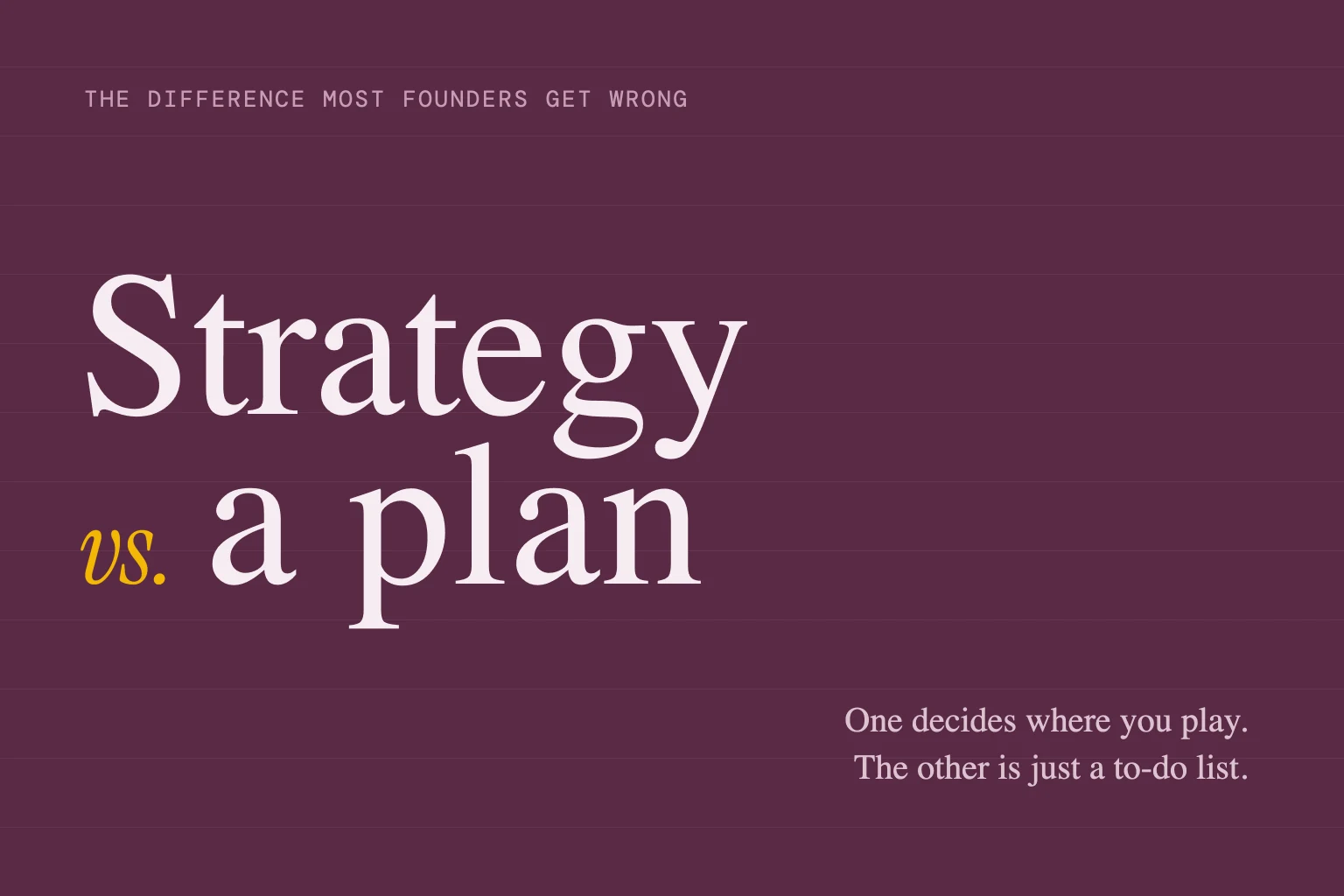
Marketing strategy defines where you are going and why. Marketing plans document how you will get there, with specific actions, timelines, and budgets. The strategy answers what market position you are trying to win; the plan lists the tweets, campaigns, and spend required to reach it.
This distinction trips up founders constantly. You see teams with elaborate 90-day content calendars (plans) who cannot explain why they are on LinkedIn instead of Reddit (strategy). Or founders who articulate brilliant positioning but have no idea what to publish next Tuesday. Both fail. Here is how to get it right.
Key takeaways
- Marketing strategy defines "where you are going and why," addressing market position, while marketing plans document "how you will get there" with specific actions, timelines, and budgets.
- Marketing strategy is directional, encompassing target customer, competitive positioning, channel selection, and core messaging, whereas a marketing plan is operational, breaking the strategy into executable components with deadlines, owners, and success metrics.
- Strategy absolutely comes first, as creating a plan without a strategy is like drafting code without knowing the product requirements, ensuring execution decisions cascade from strategic choices.
- A marketing strategy has a 1-3 year time horizon, is stable, and focuses on market share and brand awareness, while a marketing plan has a 30-90 day horizon, is fluid, and measures conversion rates and ROI per channel.
- Conflating strategy and plan leads to either paralysis, where founders try to perfect strategy before execution, or chaos, where founders skip strategy and chase every tactical opportunity.
What Is The Difference Between Marketing Strategy And Marketing Plan?
Marketing strategy is directional. It includes your target customer definition, competitive positioning, channel selection, and core messaging. It lives at the level of "we sell developer tools to indie founders through community trust, not paid ads."
Marketing plan is operational. It breaks the strategy into executable components: the 47 Reddit posts this quarter, the SEO sprint schedule, the $3,000 Hacker News promoted spend, the hire timeline. It includes deadlines, owners, and success metrics.
Think of it this way: strategy is the map showing your destination and the terrain. The plan is the turn-by-turn directions with gas stops calculated.
Your strategy should rarely change. Markets shift slowly. Your plan should flex constantly, responding to what actually worked last week.
A realistic strategy for a B2B SaaS founder in 2026 might read: "Become the default AI marketing tool mentioned in indie founder podcasts by building authority through transparent build-in-public content on X and targeted founder communities, avoiding direct competition with enterprise platforms on features."
The corresponding plan would specify: "Post 3 technical breakdowns weekly on X, guest on 2 podcasts monthly, run a $500/month sponsorship in The Slice, track unaided brand recall in quarterly founder surveys."
Without the strategy, the plan becomes busywork. Without the plan, the strategy stays theoretical.
What Comes First: Marketing Strategy Or Marketing Plan?
Strategy absolutely comes first. Creating a plan without a strategy is like drafting code without knowing the product requirements. You will produce something, but it will not solve the right problem.
The sequence matters because execution decisions cascade from strategic choices:
| Decision | Strategy Level | Plan Level |
|---|---|---|
| Target audience | Indie devs, not enterprise | Specific subreddits and newsletters they read |
| Core message | AI that respects your approval workflow | Exact headline formulas and proof points |
| Primary channel | Community trust over paid scale | Daily posting schedule per platform |
| Success metric | Unaided brand recall in target segment | Impressions, mentions, trial signups |
Many founders reverse this. They start with tactics because tactics feel productive. You can "do SEO" or "post on LinkedIn" immediately. But without the strategic container, those tactics scatter. You optimize for impressions when you need trust. You chase viral posts when you need consistent pipeline.
The correct workflow: spend 2-4 weeks on strategy (customer interviews, competitive analysis, positioning work), then move to planning. Your first plan should be a 30-60 day experiment designed to validate strategic assumptions, not a year-long commitment.
At Sparqo, we see this pattern repeatedly. Founders arrive with scattered marketing efforts and unclear results. The fix is rarely more activity. It is almost always clarifying the strategy first, then rebuilding the plan around it. Our AI CMO agents can execute either, but they perform markedly better when the strategic direction is explicit.
Marketing Strategy Vs Marketing Plan: Side-By-Comparison
| Element | Marketing Strategy | Marketing Plan |
|---|---|---|
| Time horizon | 1-3 years, reviewed annually | 30-90 days, reviewed weekly |
| Level of detail | Positioning statements, customer segments, channel principles | Post counts, deadlines, budgets, owner assignments |
| Success metrics | Market share, brand awareness, category ownership | Conversion rates, content velocity, CAC, ROI per channel |
| Flexibility | Stable, changes only with market shifts | Fluid, adjusts based on performance data |
| Primary output | Briefs and principles | Calendars, briefs, asset lists, spend projections |
| Who owns it | Founder/CEO with CMO input | Marketing lead or operations |
| Example artifact | "We win through developer credibility, not feature lists" | "Publish 12 technical comparisons, sponsor 3 newsletters, spend $8K" |
The table reveals a common failure mode: treating the plan as permanent and the strategy as optional. Founders will obsess over their Q2 content calendar while their competitive positioning drifts. Or they will revise their "strategy" quarterly because some tactic failed, confusing temporary execution problems with directional errors.
A strategy is wrong if the fundamental market assumption fails: your target customer does not exist, your differentiation is not real, your channel thesis is broken. A plan is wrong if the specific execution underperforms: the copy misfires, the timing is off, the spend was inefficient. Learn to diagnose which failure mode you are seeing.
Is Marketing Strategy The Same As A Marketing Plan?
No. They are distinct layers of the same system. Conflating them produces either paralysis or chaos.
Paralysis happens when founders try to "finalize" their strategy before doing anything. They want perfect positioning before their first post. This is a trap. Strategy develops through market contact. You need lightweight execution to inform strategic refinement.
Chaos happens when founders skip strategy entirely and chase every tactical opportunity. They are on TikTok because competitor A is there, then pivot to SEO because competitor B ranks, then try podcast ads because a founder friend recommended it. No accumulated advantage. No compound learning.
The healthy relationship: strategy constrains the plan, the plan tests the strategy. Your strategic choice to focus on community-driven growth means saying no to paid acquisition experiments this quarter. Your plan to post daily on Reddit generates data about which message angles resonate, which feeds back into strategic messaging refinement.
This is why Sparqo structures its AI agent system around both layers. The CMO agent maintains strategic context across channels. Specialist agents execute plans. The human approval loop sits at the boundary, letting founders validate tactical choices against strategic intent before anything publishes.
Marketing Strategy Example Vs Marketing Plan Example
Strategy Example: Developer-Focused API Monitoring Tool
Strategic positioning: "We are the monitoring tool built by developers who were exhausted by Datadog's pricing surprises. Our wedge is transparent, predictable pricing and a 30-second setup that actually works. We win when developers mention us in Slack threads about 'what do you use for monitoring?'"
Strategic choices:
- Target: Backend engineers at post-revenue startups (10-200 employees)
- Avoid: Selling to CFOs or procurement directly
- Channel: Technical content, GitHub presence, founder-engineer credibility
- Message: "Finally, monitoring without the pricing anxiety"
- Anti-message: We do not compete on feature depth against enterprise platforms
Plan Example: 90-Day Execution
| Week | Activity | Owner | Budget | Success Metric |
|---|---|---|---|---|
| 1-2 | Publish "We analyzed 100 Datadog bills" analysis | Content agent | $0 | 500 HN upvotes |
| 3-4 | Launch GitHub Action for auto-setup | DevRel | $0 | 200 stars |
| 5-6 | Sponsor 2 backend engineering newsletters | Growth | $1,200 | 50 trial signups |
| 7-8 | Founder AMA in r/devops | Founder | $0 | 10 organic mentions tracked |
| 9-12 | Double down on highest-converting channel from above | All | TBD | CAC under $150 |
Notice how every plan item connects to the strategy. The HN post builds developer credibility (strategic). The GitHub Action delivers on "30-second setup" (strategic). The newsletter sponsorship reaches the target segment where they already congregate (strategic). The AMA builds founder-engineer trust (strategic).
A bad plan would ignore these connections: "Run Instagram ads because our contractor suggested it" or "Write 50 blog posts about AI trends" with no strategic thread.
For founders building this themselves, the pattern is clear. Define your strategy in a single page. Then build plans that test specific strategic assumptions with measurable, time-bound experiments. See our guide on the seo playbook for founders for how this plays out in organic search specifically.
When You Need A Strategy, A Plan, Or Both
Strategy Only (Rare)
Early idea validation, before product-market fit. You need strategic clarity about what problem you solve and for whom, but detailed planning is premature. Your "plan" is conversations, not campaigns.
Plan Only (Dangerous)
Execution of someone else's strategy, like a marketing hire runningplaybooks from a previous company. This works briefly, then drifts as market context changes. Avoid.
Strategy Then Plan (Standard)
Post-PMF, pre-scale. You know your customer, you have initial traction, you need systematic growth. Lock strategy for 12 months. Build quarterly plans. Review strategy only when plan results contradict core assumptions.
Both In Tension (Advanced)
High-velocity markets where strategy evolves through execution. You maintain directional clarity ("we serve indie developers") while rapidly testing tactical variants ("Twitter vs. Reddit vs. Discord"). This requires disciplined measurement and honest kill criteria for experiments.
Most founders overestimate their need for strategic flexibility. Markets move slower than Twitter suggests. A 12-month strategy with quarterly plan adjustments serves 90% of B2B SaaS companies under $10M ARR.
The exception: genuine platform shifts. When a new distribution channel emerges (2023-2024's AI tool directories, 2025's GEO optimization for LLM citations), strategy may need faster revision. But this is channel strategy, not core positioning. Your "who we serve" and "why they care" should remain stable even as "where we reach them" shifts.
Common Mistakes Founders Make When Confusing The Two
Mistake 1: Annual Strategic Planning Marathons
Founders spend weeks in "strategy" sessions that produce vague platitudes. "We will be the leading platform in our space." No customer segmentation, no competitive differentiation, no channel thesis. Then they call the resulting slide deck a "strategy" and wonder why execution is unfocused.
Fix: Strategy fits on one page. If it requires a presentation, it is unclear.
Mistake 2: Tactic-Driven "Strategy" Documents
"We will do content marketing, SEO, paid social, and partnerships" is not a strategy. It is a list of channels, which is a plan component. Strategy explains why those channels and not others.
Fix: Every strategic element must include a "because" clause tied to customer behavior. "We will focus on SEO because our buyers research solutions via Google for 2-4 weeks before purchasing, and we can own the comparison keywords competitors ignore."
Mistake 3: Plans Without Metrics
Founders build elaborate content calendars with no definition of success. Post count becomes the metric. This measures activity, not progress.
Fix: Every plan item needs a metric tied to strategic movement. "Publish 10 posts" is weak. "Generate 50 qualified trials from organic search with CAC under $200" is strong. The latter requires strategic alignment on trial qualification and acceptable acquisition cost.
Mistake 4: Constant Strategic Pivoting
Changing positioning quarterly based on the last customer conversation or competitor move. This prevents accumulation of reputation and expertise.
Fix: Set kill criteria for strategy revision in advance. "We revise positioning if: (a) 3+ consecutive quarters miss pipeline targets with confirmed execution quality, (b) a new entrant captures >20% of our target segment with a differentiated offering, (c) our primary channel sees >50% CAC inflation with no mitigating tactics."
Mistake 5: Outsourcing Strategy To Agencies
Marketing agencies excel at plan execution, channel expertise, and creative production. They rarely understand your customer, competitive position, or product nuance well enough to set strategy. Yet many founders delegate both layers, receiving templated "strategies" that match the agency's capabilities, not their market reality.
Fix: Own strategy internally. Use agencies or tools for plan execution. If you lack marketing leadership, consider a fractional CMO or an AI CMO system that maintains strategic continuity across execution cycles.
The distinction between marketing strategy and marketing plan is not academic jargon. It is the difference between building sustainable competitive advantage and running expensive tactical experiments that never compound. Strategy first, always. Plans second, iteratively. Both together, continuously validated against market reality.
FAQ
What is the main difference between a marketing strategy and a marketing plan?
Marketing strategy defines your target market, competitive positioning, and core message (the "what" and "why"). Marketing plans detail specific actions, timelines, budgets, and owners (the "how" and "when"). Strategy is directional and stable; plans are operational and flexible.
What comes first, marketing strategy or marketing plan?
Strategy comes first. You cannot build an effective plan without knowing your target customer, differentiation, and channel thesis. Attempting to plan before strategizing produces scattered tactics that do not accumulate into competitive advantage.
Is marketing strategy a marketing plan?
No. They are distinct but complementary. Strategy provides the constraints and direction; plans provide executable steps within those constraints. Conflating them leads to either strategic paralysis (endless planning without action) or tactical chaos (action without direction).
Is there a difference between a strategy and a plan?
Yes, in any business context. Strategy addresses which battles to fight and why they matter. Plans address resource allocation and sequencing for those specific battles. This distinction holds for product strategy vs. roadmap, business strategy vs. operating plan, and marketing strategy vs. marketing plan.
Can I have a good marketing plan without a marketing strategy?
Technically yes, temporarily. You can execute templated tactics that generate some results. But without strategic direction, these efforts rarely compound into sustainable advantage. You will optimize locally while competitors build stronger market positions.
How often should I update my marketing strategy vs. my marketing plan?
Review strategy annually, revise only when fundamental market assumptions fail. Review plans weekly or biweekly, adjusting based on performance data. Plans change frequently; strategies change rarely and with deliberate analysis.

Founder of Sparqo, building an AI CMO that runs SEO, AI visibility and Reddit for indie founders and small teams who do their own marketing.