An AI marketing platform uses artificial intelligence to plan, create, measure, and sometimes distribute marketing work across channels. The best platform for a small B2B SaaS team connects those tasks, keeps a human in approval, and ties each activity to measurable outcomes such as qualified visits, signups, onboarding completion, and revenue.
AI marketing platforms range from single-purpose writing tools to broader systems that coordinate SEO, email, paid campaigns, social content, analytics, and customer research. That difference matters. A tool that writes a blog post can save an hour. A platform that identifies a growth problem, creates a plan, produces the work, and measures what happened can change how a small team operates.
The right choice depends on your bottleneck, available review time, channels, and ability to measure results.
Key takeaways
- AI marketing platforms broadly encompass AI content tools, AI analytics tools, marketing automation platforms, AI agent systems, and AI marketing suites.
- A useful AI marketing platform for small B2B SaaS teams should support diagnosis, planning, production, and learning stages, going beyond just content generation.
- The best AI marketing platform enables moving one important metric from research to approved execution and measurement within a single repeatable workflow.
- Small teams benefit from platforms combining planning, channel execution, context sharing, human approval, measurement, and learning capabilities.
- The most effective platform depends on your specific bottleneck, available review time, channels, and ability to measure results, not just feature counts.
What Is An AI Marketing Platform?
An AI marketing platform is software that applies machine learning or generative AI to marketing planning, content production, campaign execution, customer analysis, or performance measurement.
The term covers several product types:
- AI content tools generate blog posts, ads, emails, social posts, or sales copy.
- AI analytics tools identify patterns in traffic, conversion, customer behavior, or campaign performance.
- Marketing automation platforms trigger messages and actions based on customer activity.
- AI agent systems can plan tasks, complete multi-step work, and return drafts or recommendations for approval.
- AI marketing suites combine several of these functions in one product.
A typical AI marketing platform can help with keyword research, audience segmentation, ad variations, email personalization, content briefs, campaign reporting, and lead scoring. Some platforms also publish work automatically. That convenience creates a risk: poor prompts, weak source material, or incorrect targeting can turn into public mistakes at scale.
For that reason, a useful platform needs more than text generation. It should preserve brand context, show why it made a recommendation, let a person review important outputs, and connect work to business metrics.
Salesforce describes AI marketing as the use of AI to support tasks such as customer understanding, personalization, automation, and campaign optimization. In practice, small teams should judge these capabilities by the amount of useful work completed, not by the number of AI features listed on a pricing page.
What an AI marketing platform does
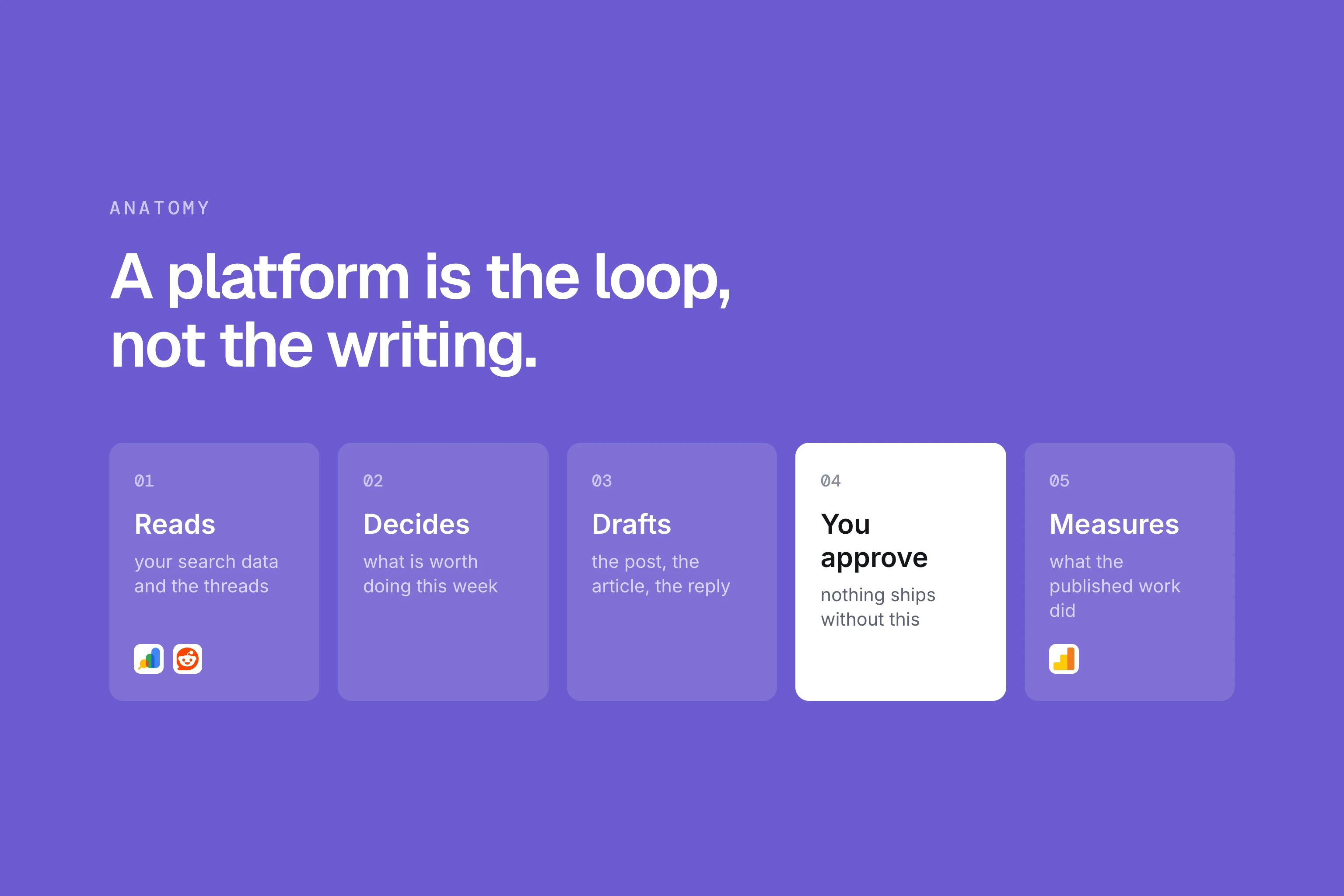
An AI marketing platform may support four connected stages:
- Diagnosis: Find gaps in traffic, conversion, positioning, content, or distribution.
- Planning: Turn those gaps into campaigns, experiments, content briefs, or tasks.
- Production: Create drafts, variants, research, reports, or audience segments.
- Learning: Compare results with the original goal and improve future recommendations.
A writing assistant normally starts at production. A broader platform should help with diagnosis and planning before it generates anything.
That distinction is especially important for early-stage B2B SaaS companies. If your problem is that the product is hard to understand, producing 30 more articles will not fix it. If people visit your site but fail to activate, more traffic may make the underlying problem harder to see.
What Is The Best AI Marketing Platform?
The best AI marketing platform is the one that completes your highest-value marketing workflow with the least manual coordination while preserving review and measurement.
There is no universal winner. A CRM-centered company may prefer an AI system inside its customer database. A content-led SaaS company may need stronger SEO research and publishing workflows. A founder selling to technical communities may value Reddit or developer-facing distribution more than automated email sequences.
Use this decision rule:
Choose the platform that can move one important metric from research to approved execution and measurement inside one repeatable workflow.
For example, suppose an API monitoring product receives organic visits but very few signups. The useful workflow is not “generate more content.” It is:
- identify pages attracting the wrong search intent;
- revise the strongest page for the right audience;
- add a clear product path;
- measure visits, signup rate, onboarding completion, and first meaningful product action;
- use the results to choose the next revision.
A platform that can support this chain is more valuable than one that creates attractive copy in isolation.
A practical answer for small B2B SaaS teams
Small teams often benefit from a platform that combines:
- Planning: a clear priority list rather than an endless content calendar.
- Channel execution: support for the channels where customers already seek answers.
- Context sharing: product details, audience knowledge, approved language, and past results available to each workflow.
- Human approval: no important public output goes live without review.
- Measurement: campaign and content activity connected to conversion events.
- Learning: approved edits and performance data inform future work.
A platform can be excellent at one of these and weak at another. Ask for a working demonstration using your own product, audience, and conversion event. Generic demo content hides the parts that require manual work.
AI Marketing Platforms Compared By Use Case
The best AI marketing platform varies by the job you want completed. Compare platforms by use case before comparing feature counts.
| Use case | Best-fit platform type | What it should do | Main tradeoff |
|---|---|---|---|
| Blog and SEO production | AI SEO or content platform | Research topics, map intent, create briefs, draft pages, and report on organic performance | More drafts can create editorial review work |
| Email lifecycle marketing | CRM or marketing automation platform | Segment contacts, trigger messages, personalize copy, and report on conversions | Requires clean customer data and careful consent management |
| Paid advertising | AI advertising platform | Generate variants, adjust targeting or bids, and compare creative performance | Automation can spend budget quickly when tracking is weak |
| Social and community distribution | Social or community marketing platform | Adapt messages to channel norms, schedule content, and monitor responses | Public automation can damage trust or trigger moderation |
| Marketing analytics | AI analytics platform | Combine traffic, funnel, and campaign data to identify changes and opportunities | Recommendations are only as reliable as the underlying events |
| Full marketing execution | AI agent or integrated marketing platform | Diagnose priorities, delegate work, return drafts, and connect results across channels | Requires clear approval rules and an initial setup of context |
A founder who needs ten product-led SEO pages may choose a different system from a company that needs an abandoned-trial email sequence. Start with the bottleneck.
AI marketing platform list by operating model
You can also classify the market by how much work the buyer still performs.
Assistant platforms wait for a prompt and return an output. They are flexible and often inexpensive, but you must provide the strategy, context, review, and distribution.
Workflow platforms automate a defined sequence. They are useful for recurring tasks such as lead routing, email journeys, reporting, or content briefs. Their limitation is that they may not know which workflow deserves attention first.
Agent platforms can break a goal into tasks and complete several steps. They can reduce coordination work, but they need boundaries, approval checkpoints, and reliable source information.
Suite platforms combine CRM, analytics, advertising, email, content, and automation. They can reduce the number of tools you operate, although setup and administration may be heavier.
The operating model is often more important than the AI model underneath it. If the platform still requires you to research every topic, write every brief, move drafts between applications, and build reports manually, it may be an AI tool collection rather than an AI marketing platform.
AI Marketing Platform Examples
AI marketing platform examples include CRM suites, content platforms, analytics products, advertising systems, and agent-based marketing software. They differ in the work they automate and the amount of human direction they require.
Examples include:
- CRM-centered platforms, which use customer records and campaign history to support segmentation, email, lead management, and reporting.
- Content and SEO platforms, which help research search demand, create briefs, draft pages, and monitor rankings or organic traffic.
- Advertising platforms, which generate creative variations and optimize campaign delivery based on response data.
- Analytics platforms, which identify funnel changes and connect marketing activity with user behavior.
- AI agent systems, which coordinate research, planning, creation, and distribution across selected channels.
When evaluating named products, inspect the workflow rather than accepting the category label. A product may advertise AI campaign management but only generate copy. Another may automate reporting while leaving campaign decisions to the marketer.
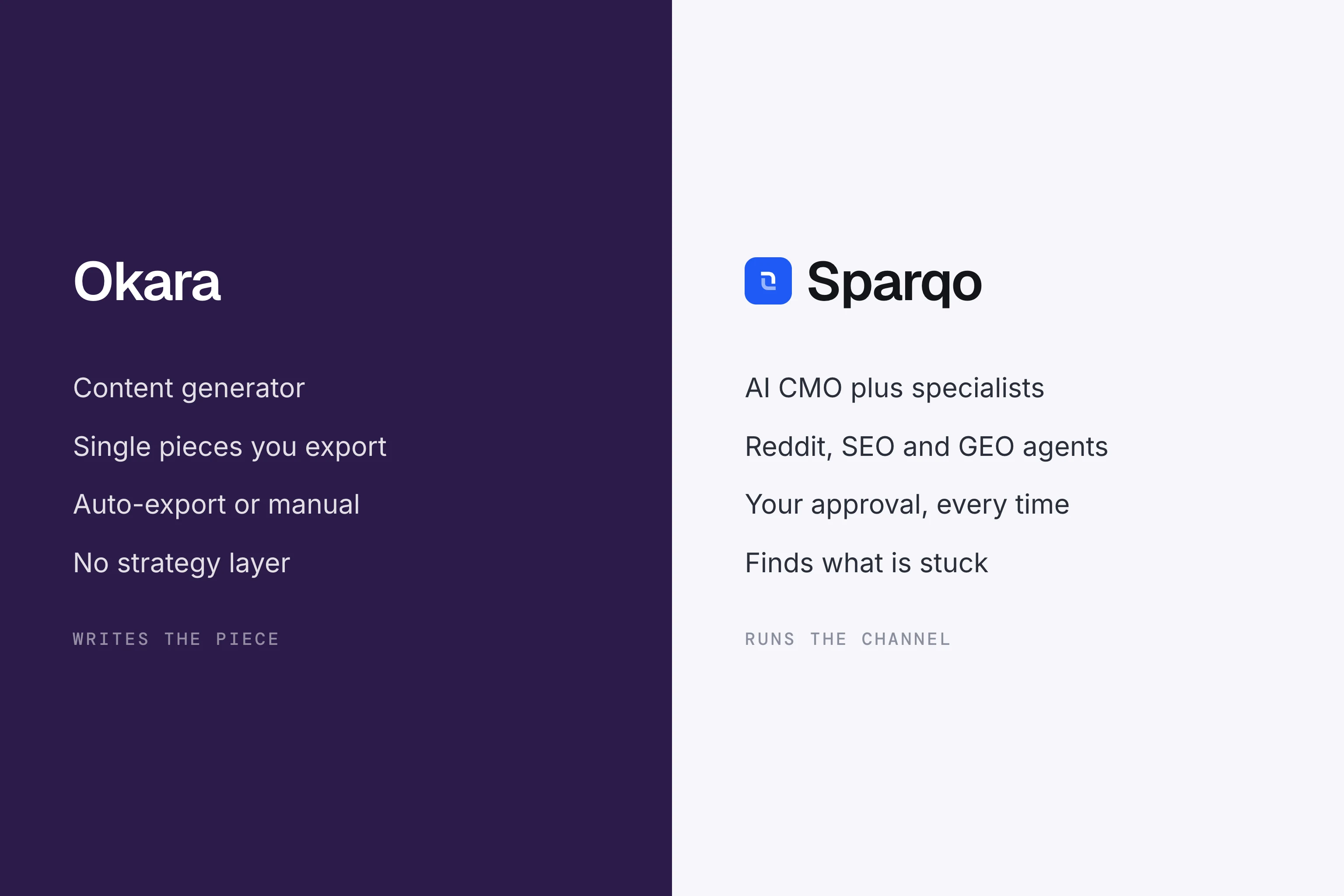
Sparqo is one example of an AI CMO approach. Its specialist agents work across SEO and Reddit growth, while a person reviews and approves work before publication. That model is designed for teams that need daily marketing execution and want context shared across channels. The broader lesson applies to any agent system: the product's approval and learning loop deserves as much attention as its generation capability.
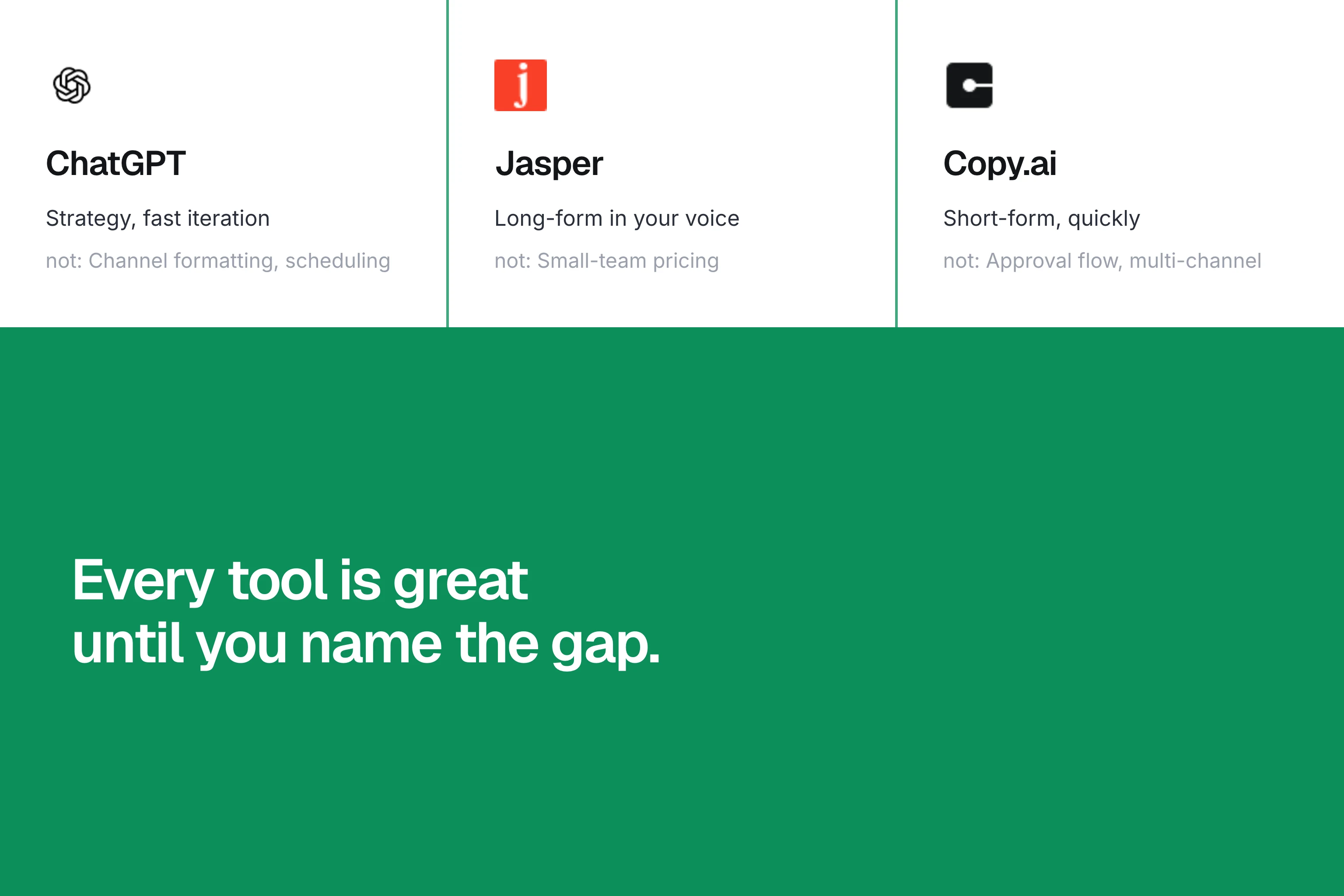
For a more detailed explanation of how coordinated agents work, see how AI agents for marketing work. For teams comparing content-focused products, Sparqo, Jasper, and Copy.ai for ongoing content focuses on the difference between generating assets and running a continuing process.
What are the five most popular AI platforms?
There is no single authoritative ranking of the five most popular AI platforms because popularity changes by audience and use case. The commonly recognized general-purpose platforms include:
ChatGPT, used for general writing, analysis, research support, and ideation.
Google Gemini, used for general-purpose assistance and work connected to Google's ecosystem.
Claude, often used for writing, document analysis, and coding support.
Microsoft Copilot, used for assistance within Microsoft's software and services.
Salesforce Einstein, used for AI features within customer relationship and marketing workflows.
These are broad AI platforms or ecosystems, not equivalent AI marketing platforms. A general-purpose model can help you write an email. A marketing platform should also help decide who receives it, trigger it at the right time, track the result, and update the next action.
AI Marketing Platforms vs Free AI Marketing Tools
Free AI marketing tools are useful for testing ideas, creating first drafts, and learning where automation could save time. An AI marketing platform earns its cost by coordinating recurring work, maintaining context, controlling approvals, and measuring outcomes.
| Factor | Free AI marketing tools | Paid AI marketing platform |
|---|---|---|
| Primary value | Generate or analyze one output | Run a connected marketing workflow |
| Context | Usually supplied in each session | Stored across projects or workflows |
| Planning | Often manual | May prioritize tasks or campaigns |
| Distribution | Usually handled by the user | May be built into the workflow |
| Measurement | Separate analytics setup | More likely to connect activity and outcomes |
| Review | Depends on the user | Can include approval gates and permissions |
| Best fit | Occasional work and experimentation | Recurring execution with clear goals |
Free does not mean useless. A founder can use a free tool to test positioning variants, draft customer interview questions, or create a first email sequence. The problem begins when a team mistakes generated output for a complete marketing system.
A free tool is often the right choice when the work is infrequent, the risk is low, and you have time to perform the surrounding research and measurement yourself. A paid platform becomes more defensible when several people or channels need the same context, when work repeats every week, or when missed follow-up has a measurable cost.
Do not compare free and paid products only by output volume. Compare the hours spent briefing, editing, transferring, publishing, tagging, and reporting. Those hidden tasks form the operating cost.
How To Choose An AI Marketing Platform
Choose an AI marketing platform with a six-point evaluation framework: workflow coverage, context, control, output quality, measurement, and total operating cost.
1. Workflow coverage
Write down the complete task from trigger to result. For SEO, that might be:
“Find a product-relevant topic, validate search intent, create a brief, draft the page, add internal links, submit it for review, publish it, and report on qualified organic conversions.”
Score each platform on how much of that sequence it supports. Do not award full credit because it handles one step well.
2. Context
The system should be able to use your product facts, customer language, positioning, exclusions, preferred examples, and previous approvals. Ask whether context is reused across workflows or pasted into every prompt.
Many AI tool stacks become expensive at this point. Each application has a partial view of the company, so the founder repeatedly corrects the same misunderstandings.
3. Control
Look for approval stages, editable drafts, permissions, audit history, and channel-specific safeguards. Public replies and customer-facing campaigns deserve more control than private brainstorming.
For Reddit marketing, for example, a human should review whether a response contributes to the discussion and follows community rules. Automation that treats every thread as a promotion opportunity can create reputational risk.
4. Output quality
Test the platform with difficult inputs, not a polished fictional brief. Give it a technical topic, a narrow audience, a product limitation, and a claim it must not make. Then inspect the result for factual accuracy, useful specificity, tone, and repetition.
Ask how the system handles uncertainty. A trustworthy workflow should leave gaps visible instead of inventing customer evidence or product capabilities.
5. Measurement
A platform should make it possible to connect an activity to a landing page visit, signup, onboarding milestone, and meaningful product action. If it only reports impressions or generated assets, you cannot tell whether the work is helping.
A practical analytics setup should record both the source and the marketing action. PostHog can be used to define these events, but the same specification can work in another analytics system.
6. Total operating cost
Include subscription cost, setup time, review time, correction time, publishing work, and the cost of errors. A cheap generator that creates unusable drafts may cost more than a focused platform that produces fewer, better-controlled outputs.
Run a two-week test with one measurable workflow. Record how long the team spends before and after adoption. Keep the platform if it reduces coordination without reducing quality or trust.
For a broader comparison of service-based and software-based options, B2B marketing agencies and their 2026 alternatives provides useful context. An AI platform does not remove the need for judgment. It changes where that judgment is spent.
How To Measure AI Marketing Results
Measure AI marketing by business outcomes and workflow quality, not by the number of words, posts, or images produced.
A small B2B SaaS team can start with four levels:
| Measurement level | Example metric | What it tells you |
|---|---|---|
| Distribution | Organic sessions, referral visits, Reddit referral clicks | Did the work reach people? |
| Engagement | Engaged sessions, key page views, return visits | Did visitors find the topic useful? |
| Conversion | Signup rate, demo requests, trial starts | Did the visit create demand? |
| Activation | Onboarding completion, first project, first approved draft | Did the user reach meaningful value? |
Revenue should remain the long-term outcome, but it may take time to connect a new article or community reply to a sale. Intermediate events help you find where the funnel breaks.
A PostHog measurement specification
Use consistent event names and properties. For organic and referral traffic, record:
landing_page_viewsignup_completedonboarding_completedmarketing_draft_approved
Attach properties such as utm_source, utm_medium, utm_campaign, utm_content, landing_page, referrer_domain, content_type, and content_id.
A simple UTM convention might look like this:
| Field | Convention | Example |
|---|---|---|
utm_source | Platform or site sending traffic | reddit |
utm_medium | Channel type | referral |
utm_campaign | Initiative name | api-monitoring-launch |
utm_content | Specific post or link location | comment-01 |
landing_page | First page in the session | /blog/api-monitoring-guide |
Keep the values lowercase and use hyphens instead of spaces. Decide whether organic search will be identified through referrer data or a dedicated campaign convention. Do not mix conventions between teams, because inconsistent tags make channel comparisons unreliable.
For each event, capture the anonymous user or session identifier where permitted, the first-touch source, the latest-touch source, and the relevant page or campaign ID. When a signup occurs, preserve the acquisition properties so later activation analysis does not lose the original source.
The key funnel questions are:
- Which landing pages attract qualified visitors?
- Which sources produce signups?
- Which sources produce completed onboarding?
- Which content or referral activity precedes the first approved marketing draft?
- How long does each step take?
A page with fewer visits but a higher onboarding completion rate may deserve more attention than a high-traffic page with no product engagement. That is the kind of decision a marketing platform should help you make.
How To Build An AI Marketing Workflow
Build an AI marketing workflow around one business goal, one owner, defined approval points, and a small set of events. Add channels only after the first workflow produces reliable evidence.
A workable sequence for a small B2B SaaS team is:
- Define the outcome. Choose one target such as increasing qualified organic signups from a product category.
- Describe the audience. Include the job, pain, technical environment, current workaround, and buying trigger.
- Give the system source material. Add product documentation, customer language, approved claims, competitor distinctions, and topics to avoid.
- Ask for diagnosis before production. Have the system identify the highest-intent pages, missing topics, conversion gaps, or distribution opportunities.
- Approve the plan. Select one or two actions. A narrow plan is easier to review than a large queue of weak ideas.
- Generate channel-specific drafts. An SEO article, a Reddit response, and an email should share the same product facts but use different formats and community expectations.
- Review for truth and fit. Check claims, technical details, search intent, audience relevance, links, and whether the message contributes value.
- Publish with tracking. Apply the agreed UTM rules and record the content or campaign identifier.
- Inspect results on a fixed schedule. Review traffic quality, signups, onboarding completion, and approved marketing actions.
- Feed decisions back into the next cycle. Keep what worked, revise what missed, and stop tasks that produce activity without useful movement.
A concrete example helps. Imagine a developer tools company selling error monitoring to small engineering teams. Its AI workflow might find that a comparison page gets organic traffic but attracts students and hobbyists. The team revises the page around production incident response, adds a technical proof point, and connects it to a trial landing page. The page then gets tagged and measured through signup and onboarding completion.
The next decision comes from the data. If qualified visits rise but onboarding remains flat, the next task belongs to product education or activation. If onboarding improves but traffic remains small, the team returns to topic selection and distribution.
Cross-channel context matters here too. A recurring question from a technical community can become a search topic. A page that earns qualified organic visits can provide a useful answer in a relevant discussion. The workflow should transfer insight between channels without copying the same message everywhere.
Avoid fully automatic publishing at the beginning. Review teaches the system your standards and protects the company from unsupported claims, repetitive content, and community spam. SEO automation without spam covers the controls that keep automation useful.
How can I make $1,000 a day using AI?
AI cannot guarantee $1,000 a day. The credible path is to use AI to deliver a valuable service or sell a product more efficiently, then validate demand, pricing, acquisition cost, and retention.
For example, a person might use AI to speed up research and production for a narrowly defined marketing service. If the service sells for $1,000, the buyer still pays for a business outcome, not for AI-generated minutes. The work must be accurate, reviewed, differentiated, and supported by evidence.
A safer process is to choose a specific customer problem, sell a small paid version, use AI to reduce repetitive work, and measure delivery time and customer results. Avoid claims that a tool can create passive income or predictable daily revenue without sales, expertise, and market demand.
AI Marketing Platforms and AI Trading Platforms Are Different
AI trading platforms are software products for financial market analysis or automated trading. They are not AI marketing platforms, and trading claims carry financial risk that marketing automation does not.
When someone searches for the “top three AI trading platforms,” they are asking a separate finance question. The answer depends on market, regulation, account type, fees, strategy, and whether the product provides analysis or executes trades. It should be researched from current financial sources rather than mixed into a marketing software comparison.
For this guide, the useful distinction is simple: AI marketing platforms help businesses acquire, convert, and retain customers; AI trading platforms deal with investment decisions and market transactions. Do not select a marketing platform based on a trading platform list, and do not treat either category as a source of guaranteed income.
FAQS
Q: What is the best AI marketing platform?
A: The best AI marketing platform is the one that supports your highest-value workflow from diagnosis through approved execution and measurement. For a small B2B SaaS team, prioritize shared context, human review, channel support, and conversion tracking over the largest feature list.
Q: Can free AI tools replace an AI marketing platform?
A: Free AI tools can handle individual tasks such as brainstorming, drafting, and analysis. They usually leave planning, context management, distribution, approvals, and measurement to you, so they become less suitable as recurring marketing work grows.
Q: What are the five most popular AI platforms?
A: Commonly recognized general-purpose platforms include ChatGPT, Google Gemini, Claude, Microsoft Copilot, and Salesforce Einstein. They are not interchangeable with AI marketing platforms, which connect marketing planning and execution to customer and campaign data.
Q: How can I make $1,000 a day using AI?
A: There is no reliable AI shortcut to $1,000 a day. The realistic route is to use AI to deliver a specific service or product more efficiently, while validating demand, pricing, quality, customer acquisition, and retention.
Q: What are the top three AI trading platforms?
A: AI trading platforms are a separate category from AI marketing platforms. Their suitability depends on the market, regulation, fees, strategy, and execution features, and no platform can guarantee trading profits.

Founder of Sparqo, building an AI CMO that runs SEO, AI visibility and Reddit for indie founders and small teams who do their own marketing.