Early stage SaaS marketing is the process of finding a specific customer, proving your product solves an urgent problem, and building one repeatable path from discovery to activation. The best approach starts with customer conversations, focuses on one primary channel, and measures activated users before spending heavily on traffic.
A useful early-stage plan connects five decisions:
- Who has the problem now?
- Why should they choose this product?
- Where do they already look for help?
- What will the team publish or do every week?
- What behavior shows that marketing attracted a likely customer?
This stage rewards focus. A SaaS company with 200 relevant visitors and five activated users may be learning more than one with 10,000 visitors and no product usage.
Key takeaways
- Early-stage SaaS marketing sequentially addresses problem discovery, early validation, initial traction, and early scale using a five-decision framework.
- Marketing should begin by interviewing 5-10 people resembling the proposed buyer to understand their current problem handling, workaround costs, decision-makers, and perceived risks.
- Choose a primary marketing channel by matching buyer behavior with the founder's ability to create useful material, ensuring the customer is present, the offering is useful, and consistency can be maintained for 6-8 weeks.
- Channels are effective when they align with active search intent (SEO), provide fast feedback from prospects (founder-led outbound), or allow for direct language and objection discovery (Reddit/communities).
- A channel test requires a defined output, such as three high-intent SEO pages, 100 customized outbound messages, or ten useful community responses.
What Is Early-Stage SaaS Marketing?
Early-stage SaaS marketing creates a reliable connection between a specific customer problem and a product that solves it. It includes customer discovery, positioning, channel testing, content, sales conversations, onboarding feedback, and measurement.
The work changes as the company moves from an idea to repeatable growth. A pre-launch product needs evidence that the problem matters. A product with early users needs a clear promise and a way to reach similar people. A product with signs of product-market fit needs repeatable acquisition and activation systems.
A simple stage model looks like this:
| Stage | Main marketing question | Best evidence |
|---|---|---|
| Problem discovery | Who has this problem badly enough to act? | Repeated customer language and urgent use cases |
| Early validation | Does the product promise attract the right people? | Qualified conversations, trials, and first successful outcomes |
| Initial traction | Can the team acquire similar users repeatedly? | A channel producing qualified signups and activations |
| Early scale | Can acquisition grow without harming retention or quality? | Stable conversion, retention, and channel economics |
The first stage is usually the least visible from the outside. Founders may want a blog, newsletter, paid campaign, or social presence immediately. Those activities can wait if the team still cannot explain who the product is for and why that buyer would change their current behavior.
The sequence matters. A SaaS growth framework from T2D3 describes four broad milestones, from reaching an MVP to reaching product-market fit, then pursuing larger growth. Its useful warning is that major milestones arrive in sequence, and shortcuts create problems later.
Start with a narrow customer and problem
“Small businesses that need better productivity” is too broad to guide marketing. “Three-person DevTools teams that lose qualified leads because technical documentation is hard to search” gives you something to investigate.
Interview five to ten people who resemble the proposed buyer. Ask:
- What happened the last time this problem occurred?
- How do you handle it now?
- What does the current workaround cost in time, money, or missed opportunities?
- Who owns the decision to change it?
- What would make a new solution feel risky?
Record exact phrases. A buyer saying, “I spend Friday afternoon turning support answers into documentation” gives you a stronger positioning input than the abstract phrase “documentation automation.”
How To Choose Your First SaaS Marketing Channel
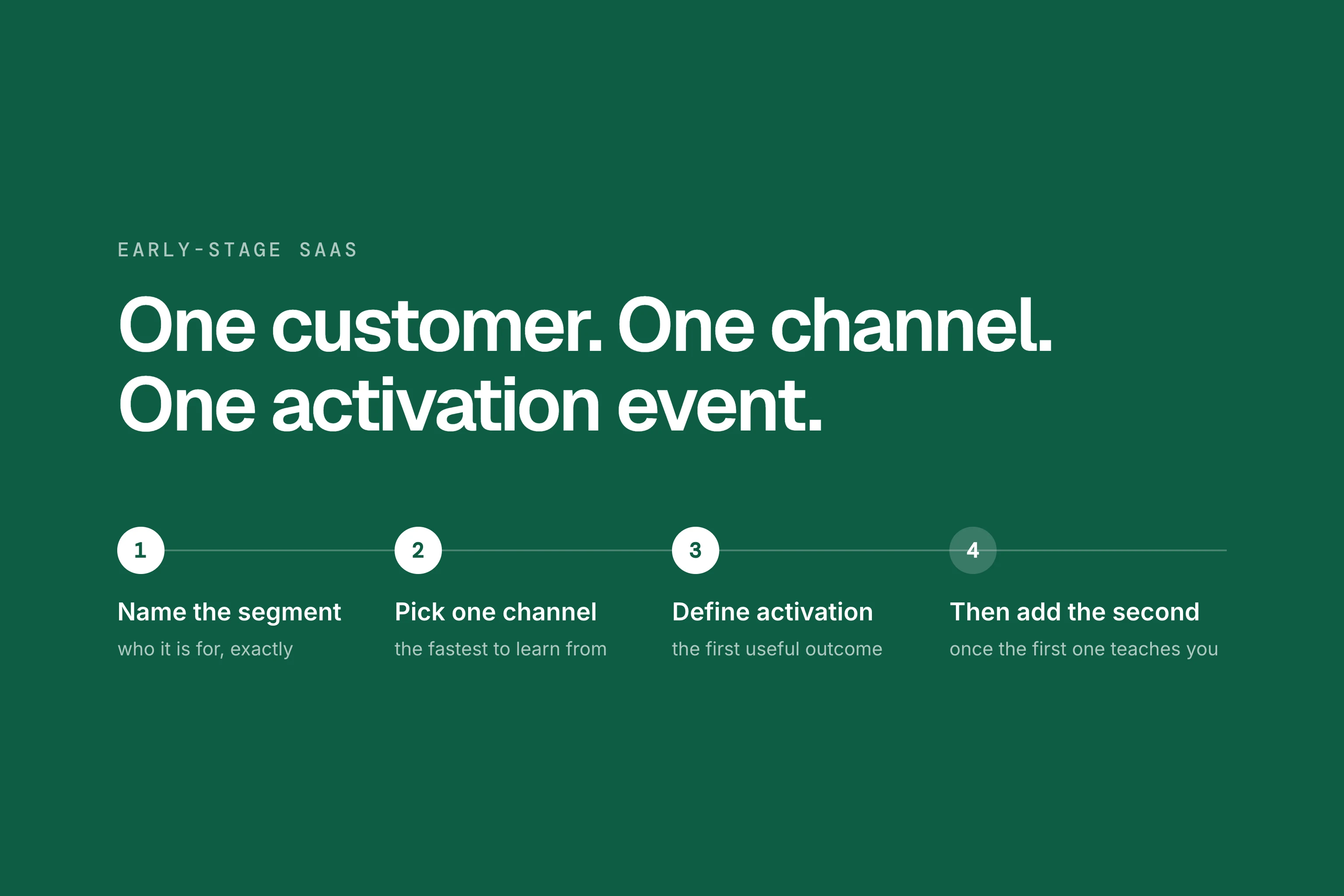
Choose your first SaaS marketing channel by matching the buyer's existing behavior with the founder's ability to produce useful material consistently. Pick one primary channel for focused testing, then use a small supporting channel to capture or distribute the resulting demand.
A channel should pass three tests:
- The customer is already there.
- You can offer a useful reason to pay attention.
- You can sustain the work for at least six to eight weeks.
For example, a developer tool may fit technical communities, search content, documentation partnerships, and founder-led outbound. A finance workflow product aimed at controllers may fit targeted outbound, niche newsletters, accounting communities, and search pages built around specific operational problems.
The answer is rarely “be everywhere.” Research cited by SaaStr's early-stage SaaS marketing tactics says most startups find that only one or two channels really work for them. Treat that as a reason to test carefully, not as permission to guess.
Compare channels by learning speed
| Channel | Useful when | Main advantage | Common early-stage mistake |
|---|---|---|---|
| Founder-led outbound | You can identify a narrow buyer list | Fast feedback from real prospects | Sending generic messages at high volume |
| SEO content | The problem has clear search intent | Compounds over time and answers active questions | Publishing broad articles with no product relevance |
| Reddit and communities | Buyers discuss the problem openly | Direct language and objection discovery | Posting links before contributing useful answers |
| Partnerships | Trusted experts already serve the buyer | Borrowed credibility and targeted reach | Pursuing large partnerships before proving demand |
| Paid ads | Conversion and activation are understood | Fast traffic and controlled testing | Paying to amplify a weak promise |
| Email referrals | Users see value and know similar people | High trust and low distribution cost | Asking for referrals before users succeed |
A channel test needs a defined output. For SEO, that might be three pages targeting high-intent problems. For outbound, it could be 100 carefully researched messages, each tied to a relevant trigger. For a community channel, it could be ten useful responses and a record of repeated questions.
Carefully customized outreach often beats mass sending at this stage. SaaStr recommends crafting 100 strong, personalized emails rather than spamming 1,000 prospects. The point is the feedback quality: a small number of thoughtful conversations can expose positioning errors quickly.
Do not judge a channel by traffic alone. Judge it by the quality of the people it attracts and what they do next.
How To Build An Early-Stage SaaS Marketing Plan
An early-stage SaaS marketing plan should fit on one page and connect a target customer, a positioning statement, one primary channel, weekly activities, and one activation metric. If a plan needs a large spreadsheet to explain its priorities, the strategy is probably too broad.
1. Define the customer segment
Write the segment as a situation, not a demographic label.
Weak:
Startups that want better analytics.
Stronger:
B2B SaaS founders with early trial traffic who cannot tell which acquisition sources produce users that reach a meaningful product action.
The second version suggests what to publish, where to find the audience, and what evidence matters.
2. Write a problem-led position
Use this structure:
For [specific customer] who struggle with [costly problem], [product] helps them [desired outcome] by [distinct mechanism].
Example:
For small B2B SaaS teams that publish inconsistently because no one owns marketing, the product helps them maintain a daily distribution routine by turning approved strategy into channel-specific drafts.
Keep the claim narrow enough to prove. “Grow your business with AI” gives a buyer no reason to believe the product is relevant. “Turn approved product knowledge into search articles and community responses” is easier to understand and test.
3. Choose a meaningful activation event
A signup is a weak signal if the user does not reach value. Choose an action that shows the product has entered the user's workflow.
Examples include:
- Creating and sharing a first report
- Connecting a data source and viewing a useful insight
- Inviting a teammate to a live workspace
- Publishing a first integration or workflow
- Completing a first analysis
- Approving a first marketing draft
The right event depends on the product. Ask, “What has a successful user done within the first few days that a curious visitor usually has not?”
4. Turn the plan into weekly work
A practical weekly plan has one learning goal and a fixed amount of production. For a developer-focused SaaS product, this might include:
- Two customer conversations about the same workflow problem
- One high-intent article answering that problem
- Five helpful community replies using the customer's language
- Ten personalized messages to prospects with a visible trigger
- One onboarding change based on observed confusion
- A review of visits, signups, activation, and replies
That is enough for a small team. Adding six social platforms usually reduces quality without producing better evidence.
What Content Marketing Works For SaaS Startups?
Content marketing works for SaaS startups when it helps a defined buyer complete a job, evaluate a solution, or avoid a costly mistake. Early-stage teams should publish fewer, deeper pieces tied to customer language and a measurable next action.
A useful content portfolio has three layers.
Problem content
Problem content explains a painful situation before the reader has chosen a vendor. Examples:
- How to detect breaking API changes
- Why trial users fail to reach their first report
- How to audit onboarding friction in a B2B SaaS product
- What causes inconsistent marketing execution in a small team
These pages can attract people who are still researching. They need a clear connection to the workflow your product supports, but they should remain useful without a demo.
Solution and comparison content
Solution content explains methods, categories, and tradeoffs. Comparison content helps a buyer decide between approaches.
Examples:
- API monitoring versus manual release tracking
- Product analytics for early-stage SaaS teams
- Build versus buy for customer feedback analysis
- Community marketing versus paid acquisition
State who each option suits. A comparison that claims every reader should choose the author's product is less credible and less useful.
Proof content
Proof content shows the product's value through examples, workflows, templates, and observed outcomes. It does not require inflated claims.
A strong proof page might show:
- The starting workflow
- Where users lost time or missed information
- The product's specific role
- The review or approval step
- What changed afterward
- The limitations or cases where the approach is not suitable
For search content, start with three to five excellent articles on important tasks in the industry rather than publishing dozens of thin posts. That recommendation also appears in SaaStr's guidance for early-stage SaaS marketing.
Use a content brief that protects focus
Before writing, define:
- Reader: one role in one situation
- Question: what they need answered
- Search intent: learning, evaluating, or buying
- Evidence: product behavior, customer language, screenshots, or a worked example
- Next action: a related guide, template, product action, or conversation
- Success metric: activation or qualified conversion, not just pageviews
For instance, an article targeting “customer onboarding checklist for B2B SaaS” should not end with generic advice. It could include an event map, an example onboarding sequence, and a method for identifying the step where trial users stop progressing.
Internal links should help the reader continue the task. A guide about content operations can point to how an AI marketing workflow is built, while an article about search execution can reference what an SEO agent does. The link should answer a question raised on the current page, not appear because a keyword needs a link.
Y Combinator's talk on talking to users is the companion to this section: the segment and the position both come out of those conversations, not out of a positioning exercise.
How To Measure SaaS Marketing Before Scale
Before scale, SaaS marketing should be measured as a chain from source to activation: qualified visit, signup, onboarding completion, first meaningful product action, and retained usage. The goal is to identify where the chain breaks, not to collect every available metric.
Build a simple funnel
Track these stages:
| Funnel stage | Example event | What it tells you |
|---|---|---|
| Acquisition | Organic or referral landing page visit | Which sources create attention |
| Qualification | Visit to a relevant product page or signup | Whether the promise attracts the right visitor |
| Signup | Account created | Whether the offer and page create intent |
| Onboarding | Setup completed | Whether the product explains the first step |
| Activation | First meaningful product action | Whether the user reaches initial value |
| Retention | Returns and repeats the core action | Whether the value persists |
Use consistent UTMs for referral and campaign traffic. A practical naming convention is:
utm_source=reddit&utm_medium=community&utm_campaign=api-monitoring&utm_content=answer-01
Keep the values lowercase and stable. Use source for the platform, medium for the traffic type, campaign for the initiative, and content for the specific post, email, or creative.
Measure landing-page attribution
Store the first known source and the latest known source separately. First-touch data shows how a visitor initially found you. Latest-touch data shows what brought them back or converted.
For every important landing page, record:
- Landing page path
- First-touch source and campaign
- Latest-touch source and campaign
- Signup timestamp
- Onboarding completion timestamp
- Activation timestamp
- Product or audience segment
If a visitor first arrives through an SEO article, returns through a Reddit answer, and then signs up from a product page, one channel did not necessarily “win.” The path shows how channels assist one another.
Use PostHog without overbuilding
A basic PostHog measurement specification can include these event names:
organic_landing_viewedreferral_landing_viewedsignup_completedonboarding_completedfirst_marketing_draft_approved
Attach properties such as landing_page, utm_source, utm_medium, utm_campaign, utm_content, persona, and product_area.
The last event is especially useful for a marketing workflow product. A signup shows intent. An approved first draft shows that the user completed a meaningful action inside the workflow. For a different SaaS product, replace it with the action that demonstrates first value.
Review the funnel weekly. If traffic grows but onboarding completion falls, improve the onboarding path before buying more traffic. If onboarding is strong but activation is weak, inspect product setup and the promise made on the landing page.
| Tool | What it tells you at this stage |
|---|---|
| Whether signups reach the activation event | |
| Which queries already find you | |
| The words your buyers use for the problem | |
 Sparqo Sparqo | Ties the two together and drafts the next week's work |
When To Add Automation, Paid Ads, Or More Channels
Add automation, paid ads, or another channel after the team can describe the customer, repeat the core message, and observe meaningful activation from at least one acquisition path. Automation should remove repetitive execution, while paid acquisition should amplify a conversion path that already has evidence behind it.
Add automation when the process is known
Automate tasks that are repetitive and easy to review:
- Drafting variations from approved source material
- Classifying inbound questions
- Tagging acquisition sources
- Reporting weekly funnel changes
- Identifying content gaps
- Preparing a first-pass outreach list
Keep human approval for public posts, claims, sensitive customer information, and community responses. Speed is useful only when review remains possible.
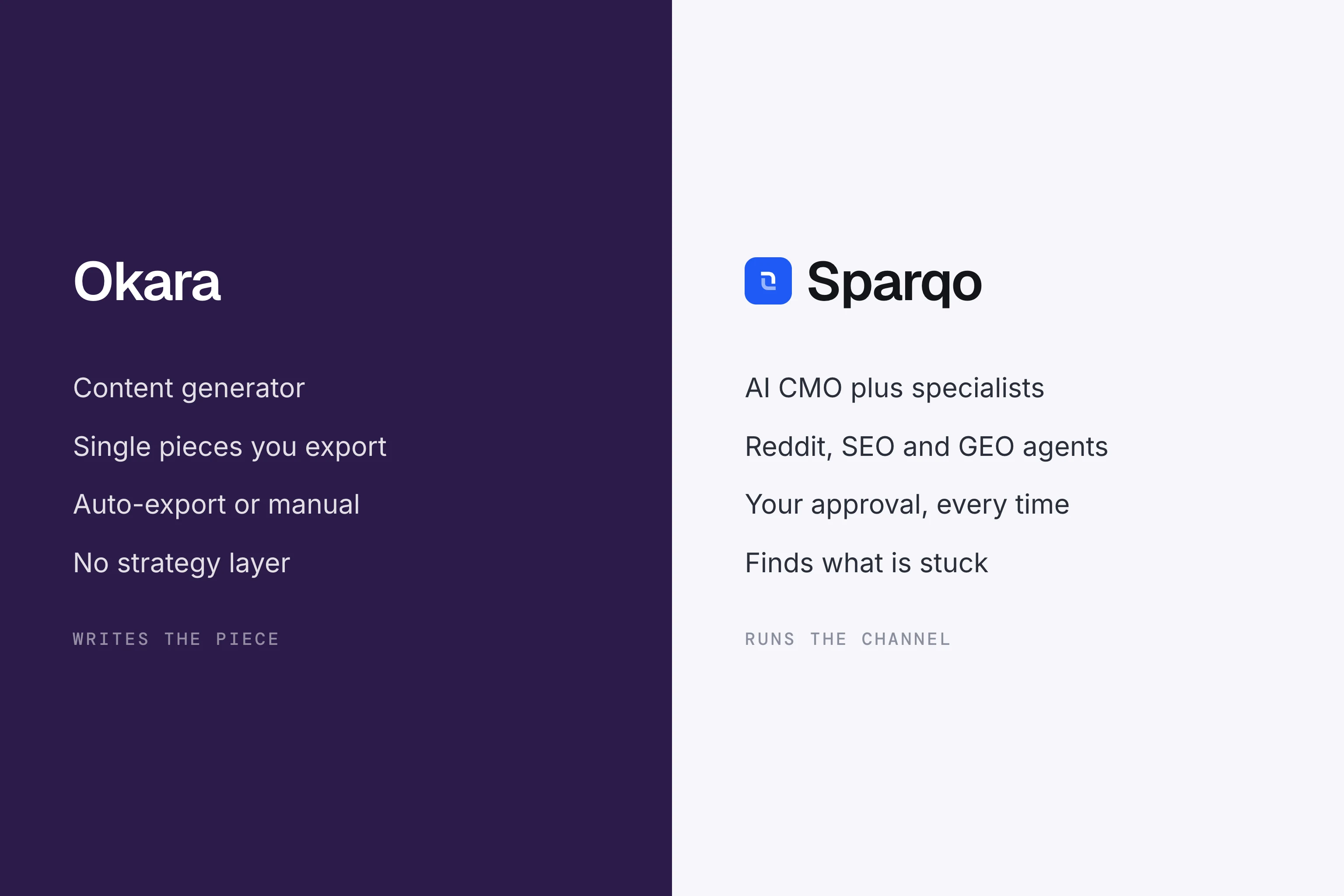
Sparqo is one example of an AI CMO platform built around this model. Its specialist agents work across SEO and Reddit, and drafts remain subject to review and approval before publication. That approach is relevant when a small team needs regular execution but cannot hand public communication to an unsupervised system.
Add paid ads after activation is understood
Paid traffic can test demand quickly, but it also exposes weak messaging quickly. Before spending, know:
- Which audience the campaign targets
- Which landing page matches the ad promise
- What event counts as activation
- How much a qualified activated user is worth
- How long you will run the test
- What result would make you stop or change it
A campaign that optimizes for cheap signups may produce people who never use the product. Optimize toward the deepest event you can measure reliably.
Add a second organic channel when the first creates insight
A second channel makes sense when it reuses learning from the first. Search insights can inform community answers. Questions from communities can become articles. Onboarding objections can become comparison pages and sales enablement content.
Do not add channels simply because competitors use them. Early stage SaaS marketing works best when every new activity has a job, an owner, and a measurable next action.
FAQ
How much should an early-stage SaaS company spend on marketing?
Spend according to the learning goal and the cost of a failed test, not a fixed percentage copied from another company. Founder-led conversations, useful content, and community participation can produce early evidence with limited cash. Paid spend deserves a larger budget only after the team knows which audience, message, and activation event it is testing.
Should an early-stage SaaS startup start with SEO?
Start with SEO when the target customer searches for the problem, workflow, or category your product addresses. Focus on specific high-intent pages and original examples rather than publishing broad articles for traffic. SEO is less suitable as the only first channel when the category is new and buyers do not yet know what to search for.
What is the most important SaaS marketing metric before scale?
The most useful early metric is usually the percentage of qualified signups that reach a meaningful activation event. Traffic and signup volume show interest, but activation indicates whether the right users understand the product and experience initial value.
How many marketing channels should an early-stage SaaS team use?
Use one primary channel and, at most, one supporting channel while the team is still learning. Add another only when the first channel produces repeatable insight or qualified activation and the team can maintain quality in both.
When should a SaaS startup hire a marketing agency or CMO?
Consider outside help after the company has a defined customer, a tested message, and a clear outcome for the engagement. An agency or fractional CMO can add planning and execution capacity, but neither can compensate for an unclear problem, weak activation, or an unproven audience.

Founder of Sparqo, building an AI CMO that runs SEO, AI visibility and Reddit for indie founders and small teams who do their own marketing.