AI for marketing means using language models and automation systems to handle research, drafting, scheduling, and analysis across channels, with a human reviewing before anything goes live. It is not auto-posting spam and hoping for engagement. The useful implementations treat AI as a first-draft engine that saves hours on repetitive work, not a replacement for human judgment in marketing strategies.
Most indie founders hit the same wall. You build something solid, then realize marketing requires skills you dont have and time you already spent. AI tools can bridge that gap, but only if you separate the workflows that actually work from the machine-driven ones that get your accounts banned.
Key takeaways
- AI for marketing uses language models and automation for research, drafting, scheduling, and analysis across channels, with a human reviewing before content goes live, rather than auto-posting spam.
- AI marketing covers three layers: research agents find audience discussions, drafting agents create channel-specific content variations, and orchestration systems coordinate timing across platforms.
- Real marketing AI use cases fall into audience intelligence (identifying pain points), content production (drafting first versions), distribution/scheduling (orchestrating cross-channel delivery), and performance feedback (improving output through tracking).
- The '30% rule' mandates that at least 30% of any AI-drafted marketing process piece must be materially changed by a human before publication to pass as human-generated and avoid platform flags.
- The 'best' AI marketing tools for indie founders in 2026 are those that solve coordination across multiple channels with machine learning optimization, not just content generation for a single one.
What Is AI for Marketing?
AI for marketing covers three layers: research agents that find what your audience discusses, drafting agents that turn that research into content, and orchestration systems that coordinate across channels without creating silos. The research layer scans Reddit threads, LinkedIn posts, and search results to surface pain points and phrasing your buyers actually use. The drafting layer generates variations for each channel, since a LinkedIn post and a Reddit comment should not read the same. The orchestration layer keeps schedules aligned so you are not accidentally posting the same angle three places at once.
This definition matters because the market is flooded with single-purpose tools that do one layer well and ignore the rest. A tool that only drafts blog posts leaves you doing keyword research in one tab, Reddit monitoring in another, and scheduling in a third. That fragmentation is why most AI marketing stacks fail. The best AI marketing tools for 2026 solve coordination using artificial intelligence, not just generation.
How Can AI Be Used in Marketing?
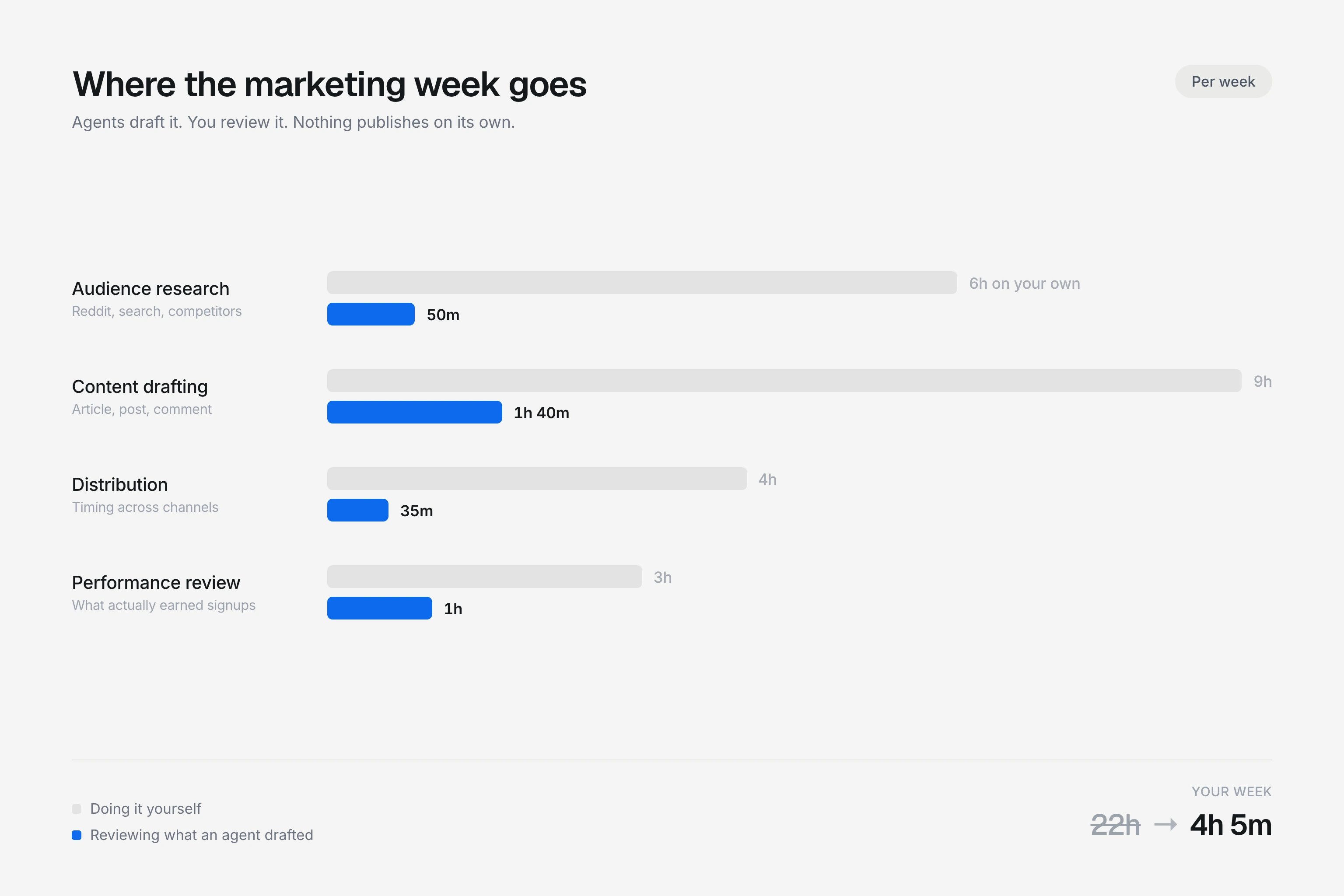
Real artificial intelligence marketing use cases fall into four buckets: audience intelligence, content production, distribution and scheduling, and performance feedback. Each has specific workflows that work, and specific ones that waste time.
Audience Intelligence
AI can scan thousands of Reddit comments, LinkedIn posts, and forum threads to identify recurring pain points and the exact language people use to describe them. This replaces manual lurking in your marketing process. A founder building a DevOps tool might discover that "deployment anxiety" gets mentioned 40 times more often than "CI/CD pipeline optimization," even though the latter is what they built. That insight from machine learning analysis reshapes messaging strategies.
Content Production
Drafting is where most founders start. AI writes first versions of blog posts, LinkedIn updates, X threads, and Reddit responses. The key constraint in this marketing process: you must edit before publishing. Auto-posting raw AI output gets accounts flagged on every platform. More on that in the 30% rule section.
Distribution and Scheduling
Orchestration agents handle the calendar math: this post goes to LinkedIn Tuesday, the related Reddit comment Wednesday, the SEO-optimized version Thursday. They also adapt formats using machine learning, turning a long post into a thread, then into a short-form script. Without this layer, founders default to batching everything manually, which means it does not happen.
Performance Feedback
Some systems track which drafts get approved, which get edited heavily, and which get rejected. That loop improves output over time through artificial intelligence learning. Most tools do not do this: they treat every prompt as independent.
Sparqo runs these as coordinated agents under a single CMO agent that routes work based on your current constraint. If your SEO is strong but Reddit presence is zero, the system shifts focus. You approve everything before it publishes, which keeps accounts alive.
The 30% Rule in AI
The 30% rule is a practical quality threshold for any marketing process using artificial intelligence: at least 30% of any AI-drafted piece must be materially changed by a human before publication. This includes rewriting hooks, adding specific examples from your experience, correcting tone mismatches, and removing generic transitions. It is not a precise word count. A 500-word post might need 150 words changed, or it might need the entire structure reordered with three sentences kept.
This rule exists because platforms have adapted. Reddit moderators can spot ChatGPT phrasing instantly. LinkedIn's algorithm deprioritizes posts with certain structural tells. X has started labeling automated content. The 30% edit is the minimum to pass as human.
Here is what counts toward the 30%:
| Edit Type | Example | Weight |
|---|---|---|
| Rewriting the hook | Changing "In today's fast-paced world" to a specific customer quote | High |
| Adding proprietary data | Inserting your actual churn rate or onboarding time | High |
| Removing AI filler | Cutting "it's important to note" and similar transitions | Medium |
| Swapping generic examples | Replacing "a SaaS company" with "a $2M ARR compliance tool" | High |
| Adjusting tone | Making dry technical content match your actual voice | Medium |
The 30% rule also protects you legally. Terms of service for most platforms prohibit fully automated posting without disclosure. Human review creates a defensible buffer.
Best AI Tools for Marketing
The "best" tool depends on your team size and whether you need orchestration or just generation. Here is how the categories break down for indie founders in 2026.
Single-Channel Drafting Tools
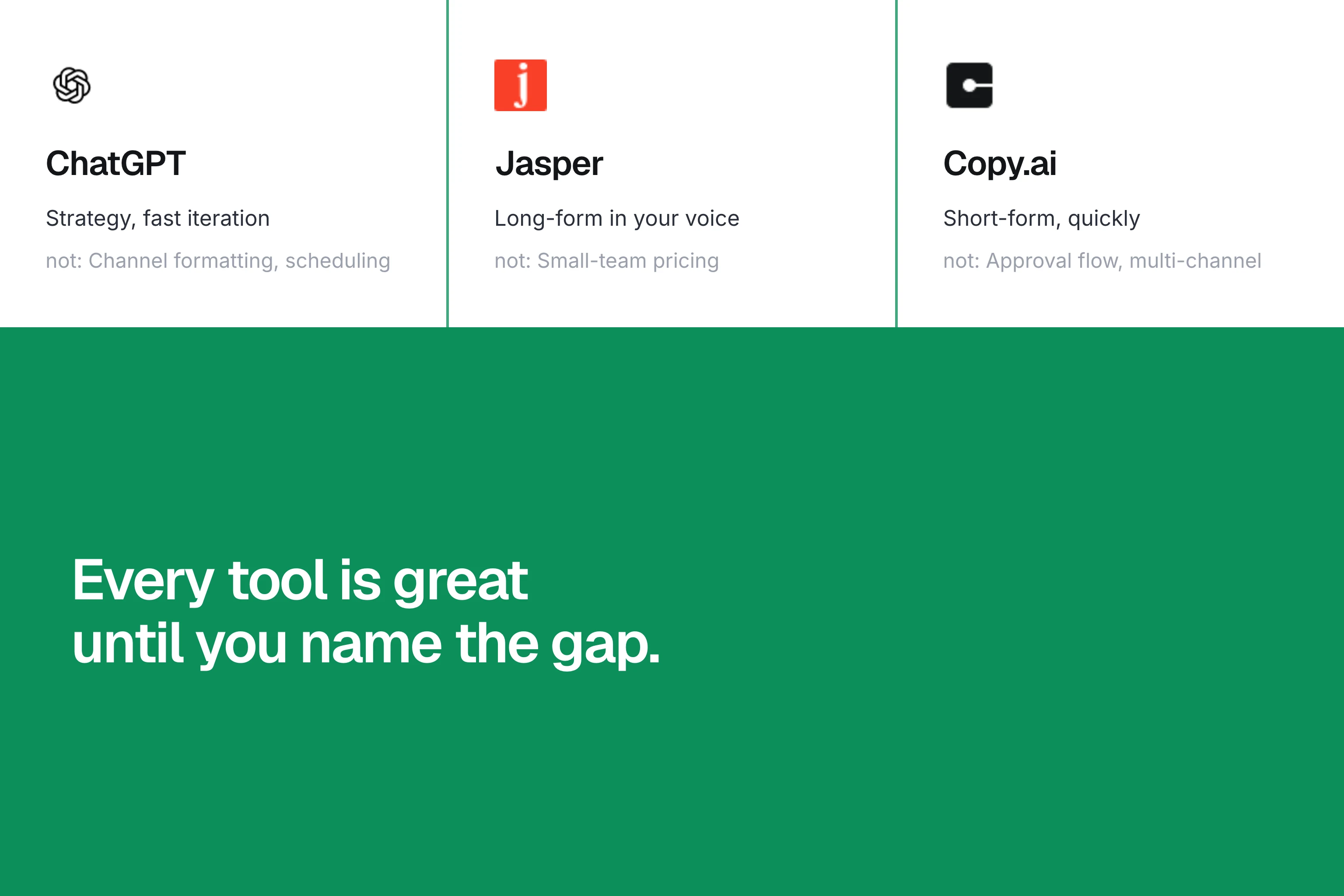
Jasper and Copy.ai dominate here. They generate blog posts, ad copy, and social content from templates. Strength: fast output for one channel. Weakness: no coordination across channels, no learning from your edits, and flat-fee pricing that scales poorly if you add seats.
SEO-Optimized Content Tools
SurferSEO combines drafting with real-time optimization against ranking pages. Useful if SEO is your only channel. The limitation: it treats content as isolated pages, not as part of a coordinated marketing process across Reddit, LinkedIn, and X.
Emerging Orchestration Tools
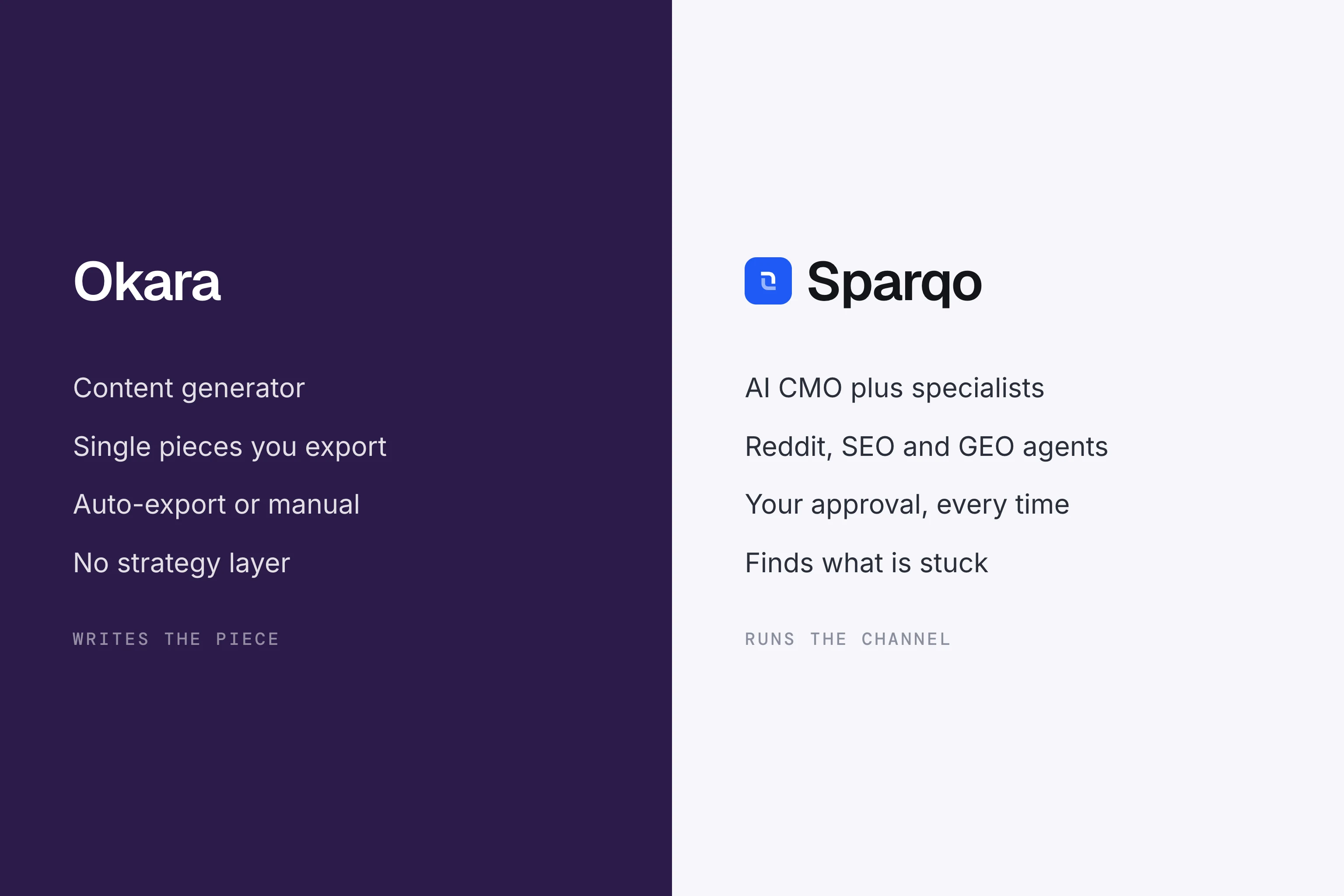
Okara and Noimosai attempt multi-channel coordination but still require manual handoffs between research and drafting phases. They are closer to the full stack than Jasper, but not fully integrated.
AI CMO Systems
Sparqo runs a CMO agent that coordinates specialist agents for each channel, requires approval before any publish, and learns from your edits. Flat pricing, no usage credits. This is the category we built for founders who tried point solutions and got buried in tabs.
| Factor |  Sparqo Sparqo | ||
|---|---|---|---|
| Channels supported | 1-2 | 1 (SEO) | 5+ |
| Human approval required | Optional | N/A | Mandatory |
| Learns from edits | No | No | Yes |
| Pricing model | Per-seat or usage | Flat + add-ons | Flat subscription |
| Best for | Content teams with editors | SEO-only focus | Indie founders, no marketing team |
See our deeper comparison of AI content marketing automation platforms for SaaS founders for workflow specifics.
Free AI Tools for Marketing: What They Can Do
Free tiers exist but come with hard limits. Understanding them prevents wasted setup time.
ChatGPT and Claude (Free Tiers)
OpenAI and Anthropic offer limited free access. Good for: occasional drafting, brainstorming hooks, rewriting single paragraphs. Bad for: scheduled output, multi-channel coordination, any workflow that needs consistency. The free tiers also lack memory across sessions, so you are re-explaining your product each time.
Perplexity and Research Agents
Perplexity's free tier handles source-backed research. Useful for finding Reddit threads and forum discussions to mine for language in your marketing strategies. Limit: no export or integration, so you are copying manually into your drafting tool.
Native Platform Tools
LinkedIn's AI suggestions, X's Grok integration, and Reddit's limited automation are all free. They optimize for platform engagement, not your business goals. LinkedIn will suggest posts that get likes from other marketers, not posts that reach your actual buyers.
Open-Source and Self-Hosted
Llama-based tools and local LLMs via Ollama cost nothing to run if you have hardware. The hidden cost: setup time, prompt engineering, and no commercial support when something breaks. Most founders underestimate this by 10-20 hours.
Free tools work for proving a single use case. They do not scale to a coordinated marketing operation using artificial intelligence. When you are ready to stop duct-taping workflows, see our guide to how to choose an AI marketing platform.
AI for Marketing vs Hiring Help
The tradeoff is not just cost. It is speed, consistency, and who owns the knowledge in your marketing process.
Hiring a Marketing Agency
A B2B marketing agency brings established playbooks and relationships. Cost: $5K-30K monthly for retainer work, often with 3-6 month minimums. Timeline: 4-8 weeks to first output. Risk: they learn your product, then the contract ends and that knowledge walks out.
Hiring a Fractional CMO
A fractional CMO provides strategic direction 1-2 days weekly. Cost: $3K-15K monthly. Better than an agency for alignment, but you still execute everything yourself or hire contractors. Most fractional CMOs do not write copy or manage Reddit accounts.
AI-First with Human Oversight
Systems like Sparqo draft daily across channels, require your approval, and learn from your edits. Cost: flat subscription under $500 monthly. Timeline: first drafts in 48 hours. The machine learning knowledge stays in your system, not a contractor's notes.
| Approach | Monthly Cost | Time to Output | Knowledge Retention | Best For |
|---|---|---|---|---|
| Full agency | $5K-30K | 4-8 weeks | Low | Series A+ with budget |
| Fractional CMO | $3K-15K | 2-4 weeks | Medium | Founders who need strategy, not execution |
| AI + human approval | Under $500 | 48 hours | High | Pre-revenue to $1M ARR, no marketing hire |
When AI Makes Money and When It Just Makes More Work
AI generates revenue when it removes a bottleneck in your actual funnel. It creates overhead when you use it for tasks that do not connect to revenue.
AI Makes Money When:
- Your constraint is content volume, not content quality. You have product-market fit and just need more surface area.
- You have a clear SEO playbook and AI accelerates execution of known keywords.
- You are present on multiple channels but inconsistent. AI enforces the schedule you cannot maintain manually.
- You need GEO optimization to appear in AI answer engines, which requires structured content at scale.
AI Makes More Work When:
- You have no positioning. AI will generate generic content that reinforces your lack of differentiation.
- You auto-post without review. Platform bans and reputation damage take months to undo.
- You chase every channel instead of nailing one. AI lets you be mediocre everywhere efficiently.
- You optimize for engagement metrics that do not correlate with revenue. AI will happily generate viral posts that convert zero.
The revenue test is simple: if you stopped using AI tools for marketing tomorrow, would your pipeline change in 30 days? If yes, AI is working. If no, you are optimizing metrics, not outcomes.
Related Searches and Specific Recommendations
AI for Marketing Reddit
Reddit is the highest-signal, highest-risk channel for AI-assisted marketing. The communities detect automation instantly and ban without appeal. The workflow that works: artificial intelligence researches threads to find relevant conversations, drafts responses that include specific technical detail from your product, and you rewrite every line in your actual voice before posting. See our full guide to Reddit marketing without getting banned.
AI for Marketing Course and AI for Marketing Course Free
Most courses in 2026 are outdated or generic. The useful ones teach prompt engineering for specific use cases, not "AI marketing strategy." Free options on YouTube and Coursera cover basics but lack implementation detail. The best training is building with the tools, starting with one channel and expanding.
Best AI for Marketing
There is no universal best. The right tool matches your constraint: Jasper if you need blog volume fast, Surfer if SEO is your only channel, Sparqo if you need coordination across channels with mandatory approval. Our best AI marketing agents for 2026 breaks down specific agent architectures.
Sparqo was built for founders who tried point solutions and got buried in the coordination work. One CMO agent routes tasks to specialist channel agents using machine learning strategies, nothing publishes without your approval, and the system learns from every edit. See pricing for flat subscription details.

Founder of Sparqo, building an AI CMO that runs SEO, AI visibility and Reddit for indie founders and small teams who do their own marketing.